Flies in the coop, and the number that stops them
A fly problem looks like an infestation and is actually a moisture reading. Penn State publishes the range manure has to be in for flies to breed in it, and the whole solution follows from getting underneath it.
We have not handled these coops, and we do not pretend to have. Here is what we did instead. Links to Amazon earn us a commission at no extra cost to you - disclosure.
| # | Coop | Best for | Honest count | Price |
|---|---|---|---|---|
| 1 | 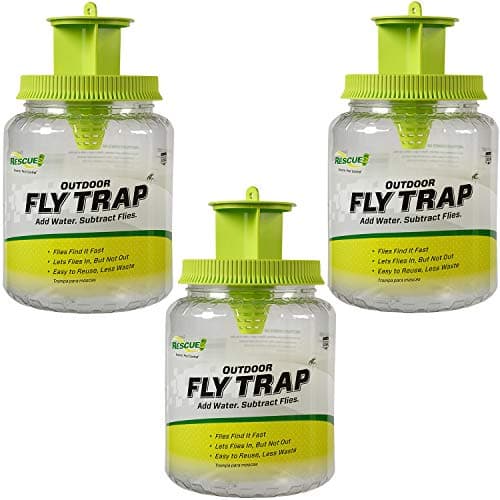 RESCUE! Outdoor Fly Trap, Reusable, 3 TrapsTop pickA reusable food-baited trap that drowns flies in water rather than poisoning them - and a listing honest enough to tell you it stinks. | Catching the adults, once the breeding is dealt with | not published | |
| 2 | 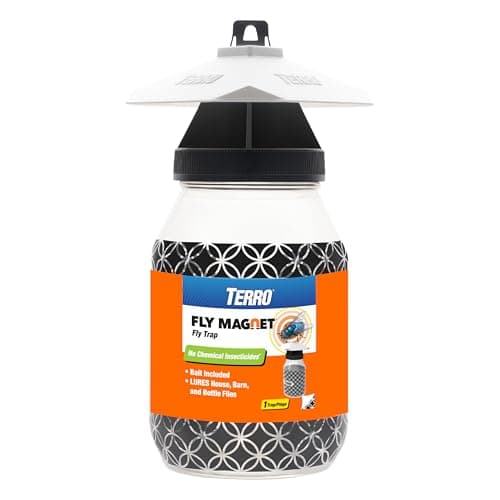 Terro Fly Magnet Trap, Reusable Poison-Free Outdoor Fly CatcherAdd bait, add water, hang it up. The long-standing default in this category and the lowest-cost way to start. | The cheapest poison-free trap that keeps working | not published | |
| 3 | 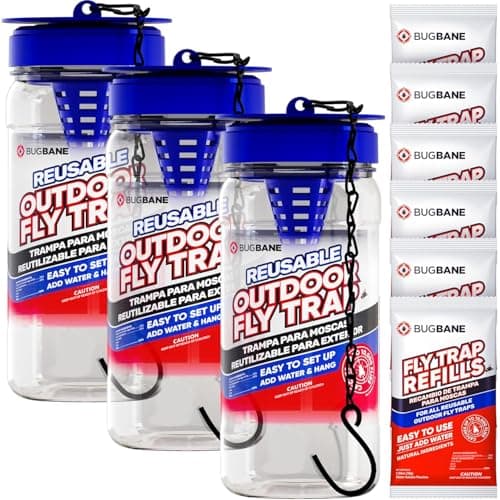 BugBane Outdoor Fly Traps, 3 Pack with 6 Dissolvable Bait RefillsThree traps and six refills, with a bait the listing states is only fish, egg and bran - and a visual lure that lets it be less pungent than most. | Ringing a run, with refills in the box | not published | |
| 4 | 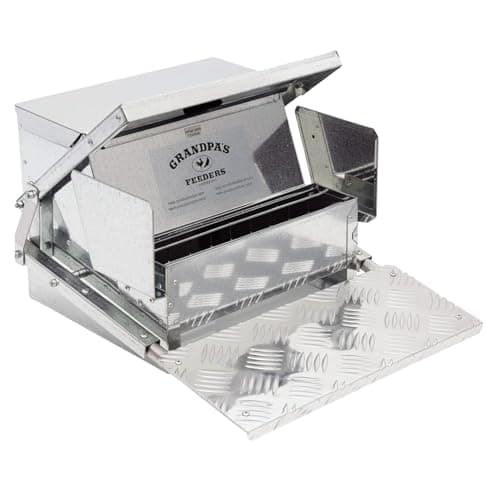 Grandpa's Feeders Automatic Chicken Feeder, 20 lbs TreadleThe benchmark treadle feeder, and the rare product on this site whose published bird-count claim is conservative rather than inflated. | Rodents, and a claim that survives checking | not published |
A coop that suddenly has flies feels like something that happened to you. It is closer to a reading on a gauge. Flies do not colonize a dry coop, and they explode in a wet one, and the difference between the two is a percentage that Penn State Extension actually publishes.
The number
This is why a fly problem so often follows rain, a leaking waterer or a winter of capped litter in one corner. Nothing about the flock changed. The moisture content of what is on the floor crossed a threshold.
Why it explodes rather than creeps
The other published figure explains the speed. Penn State gives the house fly life cycle as 10 days at 85F, 21 days at 70F and 45 days at 60F.
| Temperature | Life cycle | What that means in practice |
|---|---|---|
| 60F | 45 days | A spring problem builds slowly and is easy to miss |
| 70F | 21 days | Three weeks per generation - noticeable within a month |
| 85F | 10 days | Generations stack in a fortnight, which is why August feels sudden |
At ten days a generation, a small breeding site in July is a large one by the end of the month. That is the honest reason to act on damp litter immediately rather than when it becomes obvious.
What actually reduces them
- Dry the litter. Turn deep litter regularly, top it up rather than letting it cap, and strip any patch that has gone sour. Coop bedding compares materials on moisture rather than price.
- Fix the water before the litter. A dripping waterer or a leaking roof puts moisture in faster than turning removes it. A closed nipple system does not wet the bedding the way an open font does - see waterers.
- Clear spilled feed. Penn State states plainly that spilled feed and broken eggs left on the manure attract adult flies. This is the same habit that keeps rats away, and feeders covers what stops the spilling.
- Ventilate. Air moving through the coop takes moisture out with it, which is the whole argument of ventilation, not insulation.
- Mow the perimeter. Penn State notes that mowing grass and weeds next to the poultry house removes resting areas for adult flies - free, and usually overlooked.
- Scatter rather than pile. Manure removed and heaped next to the run is a breeding site with a roof on it.
Where traps fit
Traps catch adult flies. They do not touch eggs or larvae, and they do not change the moisture content of anything. Used on their own against an active breeding site they lose the arithmetic, because a site producing a generation every ten days outruns them.
Used alongside dry litter they are genuinely useful - they knock down the adults already flying, they give you a visible read on whether numbers are falling, and they pull flies away from where you stand. That is worth having. It is just not the mechanism.
How we judged the traps
- Poison-free. Nothing toxic belongs within reach of birds that investigate everything, so bait-and-drown beats insecticide in a coop run.
- Reusable, with refills available. Traps are cheap and attractant is the repeat cost, so the refill arrangement decides the running cost.
- Published bait contents where a maker gives them, because you are hanging this near food animals.
- Trap count against run size. One trap in a large run is decoration; a ring of them is a strategy.
- Honesty about the smell and the placement rule. A listing that tells you the 20-foot rule up front is a listing that respects your patio.
The picks
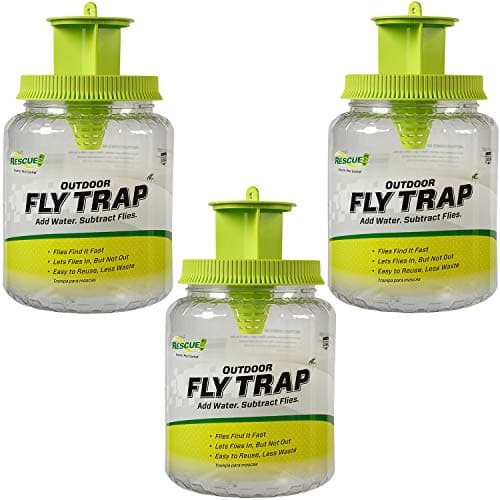
Top pick · Catching the adults, once the breeding is dealt with
RESCUE! Outdoor Fly Trap, Reusable, 3 Traps
A reusable food-baited trap that drowns flies in water rather than poisoning them - and a listing honest enough to tell you it stinks.
What the numbers say
The manufacturer does not publish the dimensions this calculation needs, so we do not print a number.
Figures from RESCUE! published specifications (Amazon listing) · 4.5"L x 4.5"W x 6.2"H, 3 traps · Reusable plastic trap with refill attractant
Read the placement instruction before you buy: the listing says to use it outdoors only and at least 20 feet away from living areas, because once activated the attractant genuinely smells. That is a siting constraint, not a detail.
Food-based attractant and drowning rather than insecticide means nothing toxic goes near the birds or the eggs, which is the right call in a coop run.
A trap catches adults. Penn State's pest guidance is that flies breed in manure at 50 to 85 percent moisture, and that is where a fly problem is actually solved - the trap is the visible half of the job, not the effective half.
Reusable with refill packets, so the running cost is attractant rather than traps. Three traps lets you ring a run rather than relying on one.
Good
- No insecticide - food attractant and water
- Reusable season after season with refill packets
- Three traps, enough to place around a run rather than in one spot
- Listing states the 20-foot placement rule plainly
Not so good
- Smells strongly once activated, by the maker's own admission
- Catches adults only and does nothing about breeding sites
- Needs emptying, which is exactly as unpleasant as it sounds
- Must be sited well away from the house and any seating
Skip this if: you have not yet dealt with wet litter and spilled feed. Hanging a trap next to a breeding site is treating the symptom while the cause keeps producing more.
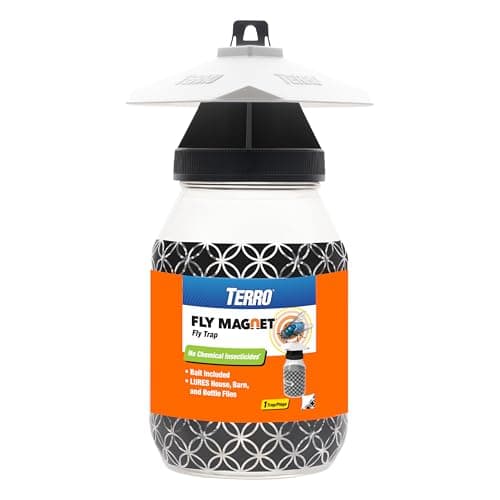
Pick 2 · The cheapest poison-free trap that keeps working
Terro Fly Magnet Trap, Reusable Poison-Free Outdoor Fly Catcher
Add bait, add water, hang it up. The long-standing default in this category and the lowest-cost way to start.
What the numbers say
The manufacturer does not publish the dimensions this calculation needs, so we do not print a number.
Figures from Terro published specifications (Amazon listing) · 4.3"L x 4.3"W x 9.1"H · Reusable plastic trap with bait
Poison-free matters more around poultry than around a patio. Nothing in the trap is something you want a curious hen investigating, and a bait-and-water trap keeps that risk at zero.
The listing's instruction to keep adding water so the bait stays moist and the flies stay submerged is the maintenance this actually needs. A dried-out trap stops working and starts smelling.
It is a single trap rather than a multipack, which suits a small run or a first try before committing.
As with every trap, this is adult control. The published fly figures - breeding in manure at 50 to 85 percent moisture, a life cycle as short as 10 days at 85F - mean a trap alone loses the arithmetic in summer.
Good
- Poison-free, which is the right call around birds and eggs
- Lowest price of the traps here
- Reusable - empty, re-bait and rehang
- Long-established product with a simple, published method
Not so good
- One trap, so a bigger run needs several
- Needs topping up with water or it stops working
- Smells, like every bait trap
- Does nothing about the breeding site
Skip this if: you want to place several traps around a large run at once. A multipack costs less per trap, and one trap in the middle of a big space is not enough.
#ad · how this is funded · price as of September 21, 2026
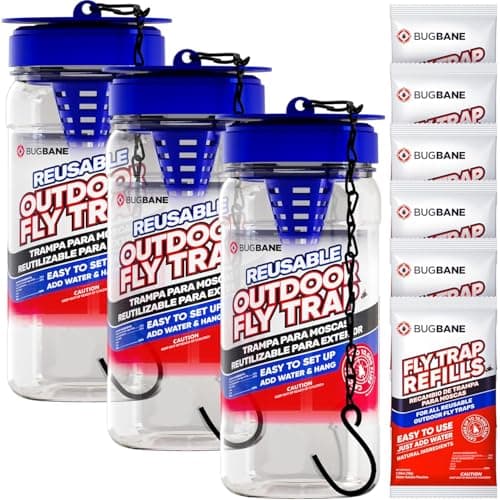
Pick 3 · Ringing a run, with refills in the box
BugBane Outdoor Fly Traps, 3 Pack with 6 Dissolvable Bait Refills
Three traps and six refills, with a bait the listing states is only fish, egg and bran - and a visual lure that lets it be less pungent than most.
What the numbers say
The manufacturer does not publish the dimensions this calculation needs, so we do not print a number.
Figures from BugBane published specifications (Amazon listing) · 3"L x 3"W x 9"H, 3 traps with hanging chains · Reusable hanging trap with dissolvable bait
The bait ingredients are published - fish, egg and bran - which is more than most traps disclose, and it means you know exactly what is hanging near the birds.
The listing claims a combined smell-and-visual lure lets the bait be less smelly than pure-scent traps. Treat that as the maker's claim; every bait trap smells, and the same 20-foot placement advice applies.
Six refills included changes the running cost. Traps are cheap and attractant is the repeat purchase, so a pack with refills is the better arithmetic if you are committing to a season.
Hanging chains included is a small thing that saves a trip to find wire. Three traps spread around a run beats one trap doing all the work.
Good
- Three traps plus six refills, so a season is covered in one purchase
- Bait ingredients published - fish, egg and bran
- Non-toxic, safe around birds and pets
- Hanging chains included
Not so good
- Still smells, whatever the lure design
- Must hang well away from the house, like every bait trap
- Generic brand with no long track record
- Adult control only, as with all traps
Skip this if: you only need one trap in a small run. A single-trap option costs a fraction of this, and unused bait refills go stale in a shed.
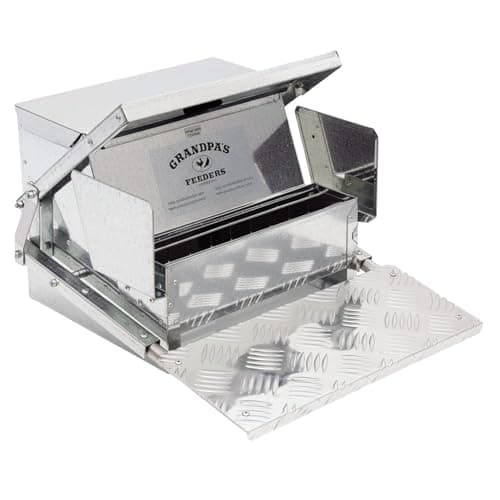
Pick 4 · Rodents, and a claim that survives checking
Grandpa's Feeders Automatic Chicken Feeder, 20 lbs Treadle
The benchmark treadle feeder, and the rare product on this site whose published bird-count claim is conservative rather than inflated.
What the numbers say
The manufacturer does not publish the dimensions this calculation needs, so we do not print a number.
Figures from Grandpa's Feeders published specifications (Amazon listing) · 17"L x 15"W x 12"H, 20 lb capacity · Galvanized steel
The listing claims it feeds 6 chickens for up to 10 days. Run that against the published feed figure - roughly 0.25 pounds per laying hen per day - and six birds for ten days is 15 pounds against a 20 pound capacity. The claim is not only plausible, it leaves headroom. We almost never get to write that sentence.
The lid only opens when a bird stands on the treadle, which is the entire rodent argument. Feed left in an open trough overnight is a standing invitation, and University of Minnesota Extension names house mice and Norway rats as the specific problem.
An anti-flick grill sits in the trough to stop birds raking feed onto the ground. Billing out is where most feed waste actually goes, and a grill addresses it directly rather than by exhortation.
Side guards stop birds feeding from the sides. That sounds like a detail and is not - side access is how birds get pecked at a feeder and how feed gets scattered.
Good
- Published claim of 6 chickens for 10 days checks out against the feed arithmetic
- Lid closes when no bird is standing on it - rodents and wild birds shut out
- Anti-flick grill addresses billing out, the main source of waste
- Galvanized steel, and a brand that has been doing this for decades
Not so good
- Comfortably the most expensive feeder here
- Birds must be trained to the treadle, which takes days and patience
- Light birds and bantams may not weigh enough to trigger it
- One trough means one feeding station, not the 3 inches per bird a trough figure assumes
Skip this if: your flock is mostly bantams or young pullets. A treadle needs a bird heavy enough to work it, and a feeder your smallest birds cannot open is a feeder that starves the bottom of the pecking order.
#ad · how this is funded · price as of September 21, 2026
The last pick is not a trap. A treadle feeder is on this page because spilled and exposed feed is named in the published guidance as something that attracts adult flies, and closing the feed off deals with that and with rats at the same time.
What we did not weigh
We have not measured the moisture content of any coop litter, and neither will you - this is a guide to staying well clear of a published range, not a laboratory method. Judge by feel and smell: litter that clumps, smells sour or sticks to a boot is in the range; litter that is loose and dry is not.
Where to go next
- Coop bedding - materials compared on moisture, which is the variable that matters here
- Ventilation, not insulation - how moisture leaves a coop
- A cleaning routine that gets done - the weekly habits that keep litter dry
- Rats in the chicken coop - the other problem spilled feed creates
Questions people actually ask
+How do I get rid of flies in my chicken coop?
+Why does my coop suddenly have so many flies?
+Do fly traps work for chicken coops?
+Where should I hang a fly trap near a coop?
+Does cleaning out the coop stop flies?
+Are flies in the coop dangerous to chickens?
Sources
- Penn State Extension - Pest management recommendations for poultry (flies breed in manure at 50-85% moisture; fresh manure is 75-80% moisture; house fly life cycle 10 days at 85F, 21 at 70F, 45 at 60F; spilled feed and broken eggs attract adult flies)
- University of Minnesota Extension - Common concerns with backyard or urban poultry keeping (remove wet feed and soiled bedding; cleanliness reduces house mice and Norway rats)
- Penn State Extension - Small-scale poultry housing
- Michigan State University Extension - Backyard poultry housing
Read next
Coop bedding, judged on moisture
Shavings, straw, sand and hemp compared on absorbency and running cost, plus how the deep litter method actually works.

Ventilation, not insulation
Why sealing a coop causes frostbite, where vents belong, and how to tell whether yours has enough.
A cleaning routine you will actually keep
Daily, weekly and seasonal jobs sized so they get done, plus the mite inspection nobody schedules until it is too late.

Rats in the chicken coop
Why rats colonize a coop, the half-inch figure that excludes them, and the three purchases that close off feed, entry and harborage.

Guides, and the arithmetic behind them
The reference library: sizing arithmetic, ventilation, predator-proofing, bedding, cost and the permits nobody checks first.
Chicken waterers, ranked on the published numbers
Heated, nipple and open waterers measured against the published 5 gallons per 100 birds daily, 1 inch of water space per bird, and the 12-hour rule.