Coop cleaners, and the two jobs they get confused for
Almost everything sold as a chicken coop cleaner is an enzyme deodorizer. Disinfectant is a different product for a different job, and the published guidance is clear that one has to follow the other in order.
We have not handled these coops, and we do not pretend to have. Here is what we did instead. Links to Amazon earn us a commission at no extra cost to you - disclosure.

| # | Coop | Best for | Honest count | Price |
|---|---|---|---|---|
| 1 | 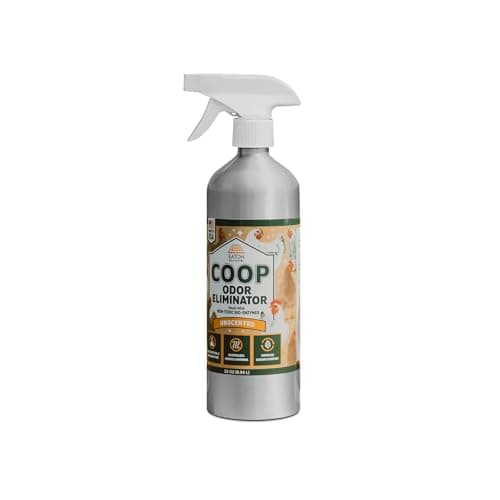 Eaton Pet and Pasture Coop Odor Eliminator Spray, Unscented Enzyme FormulaTop pickUnscented and enzyme-based, which is the right combination - a fragrance tells you a product has been applied, not that the ammonia has been dealt with. | Knowing whether the smell is actually gone | not published | |
| 2 | 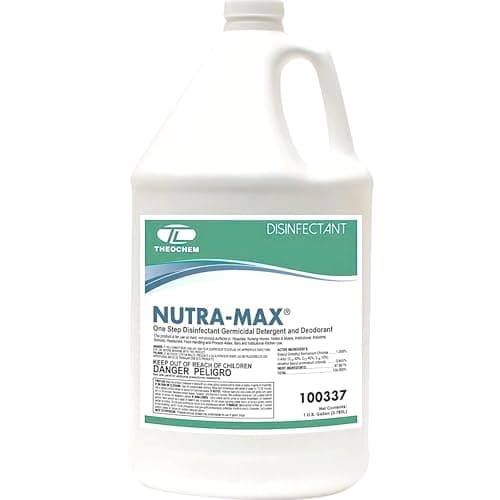 Theochem Nutra-Max Hospital Grade Disinfectant Cleaner ConcentrateA dual-quat concentrate that publishes the two numbers nothing else in this category does: a 1:32 dilution and a ten-minute wet contact time. | The only actual disinfectant here | not published | |
| 3 | 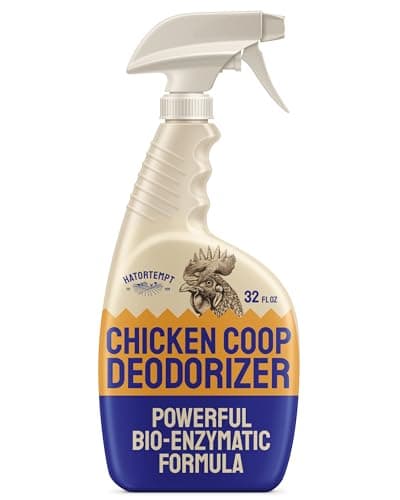 Hatortempt Chicken Coop Cleaner and Deodorizer Spray, 32 fl ozFragrance-free, no-rinse and ready to use, with a listing that argues its case against barn lime and zeolite rather than against dirt. | A fragrance-free bottle you can keep by the door | not published | |
| 4 | 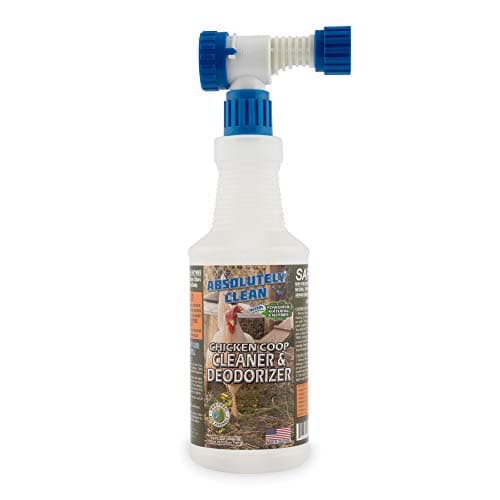 Absolutely Clean Chicken Coop Cleaner and Deodorizer, Enzyme FormulaShips with a hose-end sprayer and instructions that start by removing the birds and the bedding - which is the published sequence rather than a shortcut around it. | The twice-yearly strip-out | not published | |
| 5 | 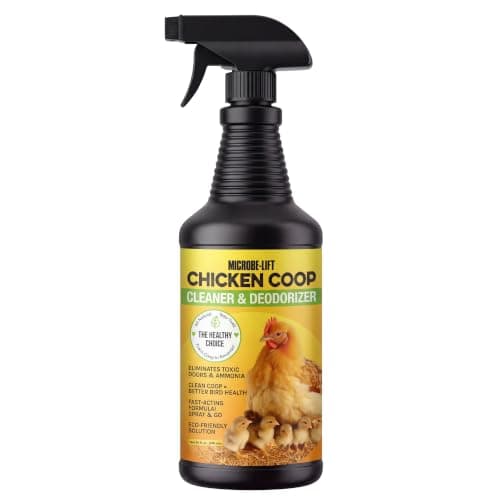 MICROBE-LIFT Chicken Coop Cleaner and Odor Eliminator, 32 OuncesThe one here the listing says can be applied with the birds present, and the one that frames the result as fertilizer rather than as clean. | Spraying without moving the flock out | not published | |
| 6 | 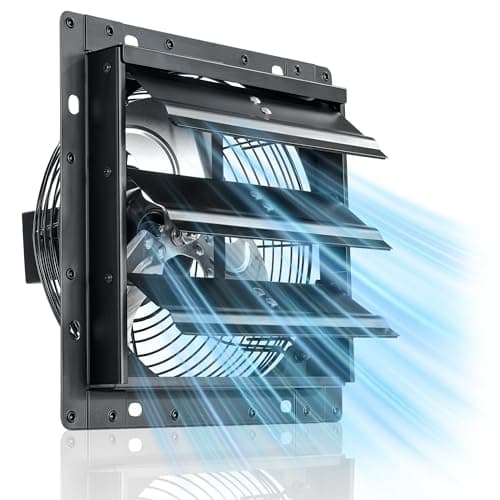 Generic 8in Shutter Exhaust Fan, 760 CFM760 CFM through an 8in shuttered opening. For hot climates this does more for the flock than any heater ever will. | Hot-climate summer ventilation | not published |
This is a category where the shelf label is doing a lot of work. Products sold as chicken coop cleaner fall into two groups that do genuinely different things, and the listings rarely say which one you are buying.
Two jobs, one shelf
| Enzyme deodorizer | Disinfectant | |
|---|---|---|
| Target | Ammonia and organic odor | Pathogens on surfaces |
| When | Weekly, with birds around | At a strip-out, coop empty |
| Surfaces | Litter, timber, anything | Hard, non-porous, cleaned first |
| Needs the flock out | Usually not | Yes |
| Published contact time | Almost never | Sometimes - and it matters |
| What it will not do | Kill pathogens | Fix a smell |
Five of the six picks below are the left-hand column. That is not an editorial preference, it is what the category consists of - and it is worth knowing before you buy something expecting the right-hand column.
The published sequence
eXtension's biosecurity guidance for small flocks states the order plainly, and the reason for it: it is important to remove the organic material before using disinfectants, because such material can make the disinfectants ineffective.
- Remove the birds and strip the litter. Nothing else on this list works around a full coop.
- Remove organic matter - sweep, scrape, scrub. eXtension notes that high-pressure sprayers effectively remove organic material.
- Clean. This is where an enzyme cleaner earns its place, breaking down what scraping left behind.
- Disinfect, on cleaned hard surfaces, for whatever contact time the product publishes.
- Dry and air it out before the birds and fresh litter go back.
For a full changeover between flocks, eXtension recommends a downtime of two weeks, which it describes as sufficient time for sweeping, cleaning, disinfection and drying of the entire coop. That is a different exercise from the weekly pass, and most of this category is aimed at the weekly pass.
Contact time is the spec nobody publishes
A disinfectant works by staying wet on a surface for a stated period. Below that period you have applied it rather than used it.
One product on this page publishes the figure - keep treated hard, non-porous surfaces wet for ten minutes before allowing them to air dry, at a 4 oz per gallon dilution. That is a manufacturer specification rather than an extension one, and eXtension's biosecurity page does not name disinfectants or publish contact times at all. But it is a number you can follow, and it is the only one in this roundup.
Everything else here publishes no dilution, no coverage figure and no contact time. That is normal for enzyme deodorizers, which are not making a pathogen claim - it just makes price comparison between a concentrate and a trigger bottle close to meaningless.
If it smells, the product is not the answer
Here is the uncomfortable part of the category. An ammonia smell in a coop is a moisture and airflow signal, and the site's position on that has not changed: an ammonia smell at bird height means the ventilation is insufficient.
Spraying a deodorizer onto that is treating the readout rather than the fault. It works, briefly, and the smell returns because the cause has not moved. The things that actually fix it are dry litter, high vents open all year and air genuinely crossing the space - ventilation, not insulation sets out why.
The same moisture drives the other problem in the coop. Penn State publishes that flies breed in manure at 50 to 85 percent moisture, which is why flies in the coop and a smell problem so often arrive in the same week.
How we judged
- Which job it actually does, stated plainly. A deodorizer that never claims to disinfect is honest; a listing that blurs the two is not.
- Published numbers - dilution, contact time, coverage. Almost nothing here has them, and the product that does is ranked accordingly.
- Whether the instructions match the published sequence. Listings that start by telling you to remove the birds and the bedding understand the job.
- Fragrance. Unscented ranks above scented, because the smell is information.
- Whether it can be used with the flock present, which decides if it is a weekly product or a strip-out product.
- What it adds to the coop. Everything sprayed is moisture going into a space where moisture is usually the underlying problem.
What we deliberately left out
Searching this category surfaces sprays that kill mites, lice, fleas and ticks. Those are parasite treatments rather than cleaning products, and this site does not carry flock health topics - we have no basis to advise on treating birds, and a page that sold you a pesticide alongside a deodorizer would be pretending otherwise.
We have also left out barn lime and zeolite, which are the traditional answers to coop ammonia. Both are real, both are cheap, and both put dust into an enclosed space birds breathe in - one listing here makes exactly that argument against them, and we think it is a fair one.
The picks
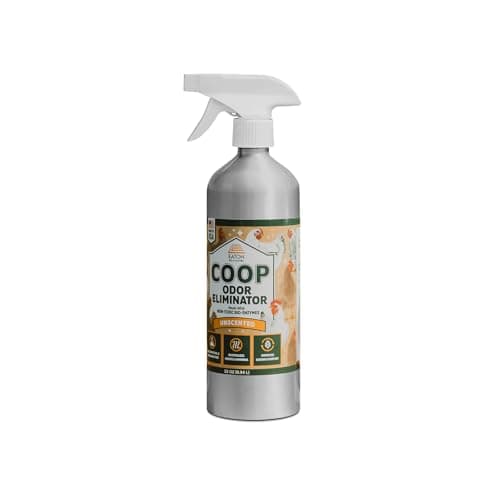
Top pick · Knowing whether the smell is actually gone
Eaton Pet and Pasture Coop Odor Eliminator Spray, Unscented Enzyme Formula
Unscented and enzyme-based, which is the right combination - a fragrance tells you a product has been applied, not that the ammonia has been dealt with.
What the numbers say
The manufacturer does not publish the dimensions this calculation needs, so we do not print a number.
Figures from Eaton Pet and Pasture published specifications (Amazon listing) · Enzyme formula in aluminum packaging
Unscented is the feature worth choosing deliberately. A pine or citrus fragrance masks ammonia, and masking is precisely what you do not want when the smell is the diagnostic that tells you the litter is too wet.
The listing targets ammonia specifically rather than odor in general, and says the enzyme formula supports composting. Both are the right claims for a coop rather than a living room.
Aluminum bottles rather than plastic is unusual in this category. It is a packaging decision rather than a performance one, but it is a real difference if that matters to you.
No dilution ratio, coverage figure or contact time is published anywhere in the listing - which is normal for this category and worth knowing before you compare it on price against a concentrate.
Good
- Unscented, so it does not mask the smell you are using as a signal
- Targets ammonia by name rather than odor in general
- Compost-friendly enzyme formula, stated on the listing
- Aluminum packaging rather than single-use plastic
Not so good
- No published dilution, coverage or contact time
- Most expensive ready-to-use bottle on this page
- An enzyme deodorizer is not a disinfectant and the listing does not claim to be
- Does nothing about the moisture causing the ammonia in the first place
Skip this if: your coop smells because the litter is soaking. A deodorizer applied to genuinely wet bedding is a temporary result at a recurring price - strip it, dry it, and fix the airflow first.
#ad · how this is funded · price as of September 26, 2026
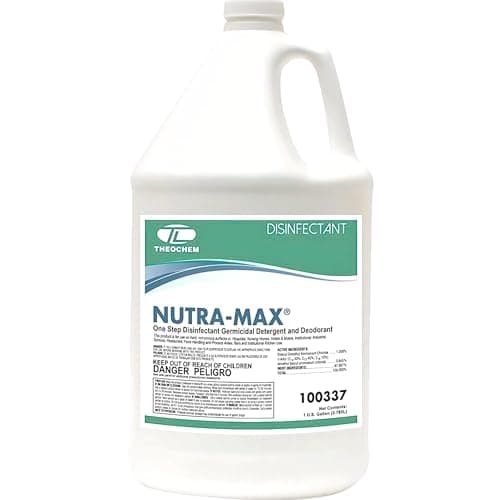
Pick 2 · The only actual disinfectant here
Theochem Nutra-Max Hospital Grade Disinfectant Cleaner Concentrate
A dual-quat concentrate that publishes the two numbers nothing else in this category does: a 1:32 dilution and a ten-minute wet contact time.
What the numbers say
The manufacturer does not publish the dimensions this calculation needs, so we do not print a number.
Figures from Theochem published specifications (Amazon listing) · 1 gallon concentrate; listing states it makes 32 gallons at 4 oz per gallon · Dual quaternary ammonium concentrate
Everything else sold as chicken coop cleaner is an enzyme deodorizer. This is a disinfectant, and the difference is the whole point of the page it appears on - deodorizers address smell, disinfectants address pathogens, and the two are not substitutes.
The listing publishes an actual method rather than a promise: pre-clean heavy soil, mix 4 oz per gallon, then keep treated hard non-porous surfaces wet for ten minutes before allowing them to air dry. Contact time is the specification almost every disinfectant listing omits.
Pre-clean heavy soil is not a throwaway line. eXtension states that organic material can make disinfectants ineffective and must be removed first - so a disinfectant sprayed onto droppings is money poured onto manure.
Read hard, non-porous carefully. That is the surface class this is rated for. A bare wooden coop wall is porous and deep litter is organic matter, so the honest use here is plastic, metal and sealed surfaces after a strip-out.
Good
- Publishes a real contact time - ten minutes wet - which most disinfectants do not
- 1:32 concentrate, so the cost per gallon of working solution is very low
- Neutral pH and non-corrosive, per the listing
- States the pre-clean step rather than implying the product does everything
Not so good
- Rated for hard, non-porous surfaces - not bare timber or litter
- Requires stripping the coop and removing the birds first
- Quaternary ammonium is a real chemical, not a natural enzyme formula
- You have to mix it, which is one more step than a trigger bottle
Skip this if: what you actually have is a smell. Disinfectant does nothing about ammonia coming off damp litter, and an enzyme deodorizer or better ventilation is the honest answer to that problem.
#ad · how this is funded · price as of September 26, 2026
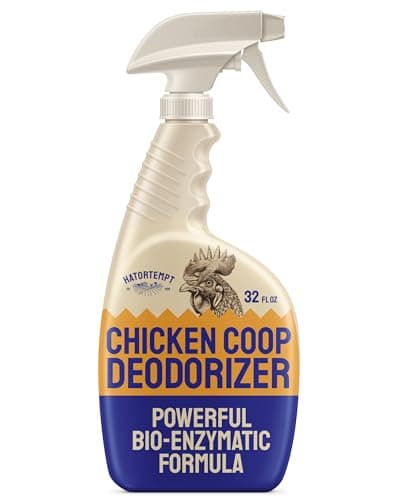
Pick 3 · A fragrance-free bottle you can keep by the door
Hatortempt Chicken Coop Cleaner and Deodorizer Spray, 32 fl oz
Fragrance-free, no-rinse and ready to use, with a listing that argues its case against barn lime and zeolite rather than against dirt.
What the numbers say
The manufacturer does not publish the dimensions this calculation needs, so we do not print a number.
Figures from Hatortempt published specifications (Amazon listing) · 32 fl oz ready-to-use spray · Enzymatic solution, ready to use
The comparison the listing draws is the useful part: unlike barn lime it needs no preparation, and unlike zeolite minerals it creates no dust. Both of those are the traditional answers to coop ammonia and both have real drawbacks in an enclosed space birds breathe in.
Fragrance-free and no-rinse means it is the bottle that actually gets used on a Tuesday. The strip-out products on this page are for the twice-yearly clean; this is the one for the weekly pass.
The listing claims it neutralizes in minutes and dries fast even in winter. Drying matters more than it sounds - anything you spray adds moisture, and moisture is what produced the ammonia.
Thirty-two ounces is a small bottle for a large coop. The listing claims a little goes a long way, which is the least checkable claim in this category.
Good
- Fragrance-free, so it does not mask the ammonia signal
- No-rinse and ready to use - no mixing, no second pass
- Creates no dust, unlike lime or zeolite
- The cheapest ready-to-use bottle here
Not so good
- Thirty-two ounces does not go far in a walk-in coop
- No published dilution, coverage or contact figures
- A deodorizer, not a disinfectant
- Every spray adds moisture to a coop where moisture is usually the problem
Skip this if: you are cleaning between flocks rather than maintaining week to week. That job needs a strip-out and a disinfectant with a published contact time, not a trigger bottle.
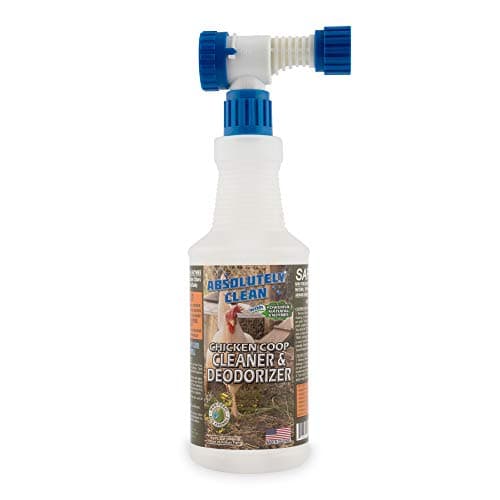
Pick 4 · The twice-yearly strip-out
Absolutely Clean Chicken Coop Cleaner and Deodorizer, Enzyme Formula
Ships with a hose-end sprayer and instructions that start by removing the birds and the bedding - which is the published sequence rather than a shortcut around it.
What the numbers say
The manufacturer does not publish the dimensions this calculation needs, so we do not print a number.
Figures from Absolutely Clean published specifications (Amazon listing) · Natural enzyme formula with garden sprayer attachment
The instruction sequence in the listing is the reason this is here: remove the chickens and the bedding, connect the sprayer to a hose, then clean. eXtension's guidance is to remove organic material first, and this is one of the few listings that leads with that rather than implying you can spray over the top.
A hose-end sprayer is the right tool for an emptied coop and the wrong one for a weekly pass. Treat this as the seasonal-clean product and keep a trigger bottle for the rest of the year.
The listing describes the formula as veterinarian approved. That is the maker's claim, we have no way to verify what it means, and we are not going to repeat it as a finding.
Enzyme cleaners break down organic residue, which is the cleaning half of the published clean-then-disinfect sequence. If you are cleaning between flocks, a disinfectant still follows.
Good
- Instructions lead with removing birds and bedding - the published sequence
- Hose-end sprayer included, which suits an emptied coop
- Enzyme formula without harsh fumes in an enclosed space
- Covers barns, hutches and runs as well as the coop
Not so good
- Hose-end application is impractical for a quick weekly pass
- The veterinarian approved claim is the maker's and unverifiable
- Cleans and deodorizes - it does not disinfect
- Needs a hose within reach of the coop
Skip this if: you have no hose at the coop. The sprayer is most of what you are paying for, and without water pressure it is an expensive bottle of enzyme cleaner.
#ad · how this is funded · price as of September 26, 2026
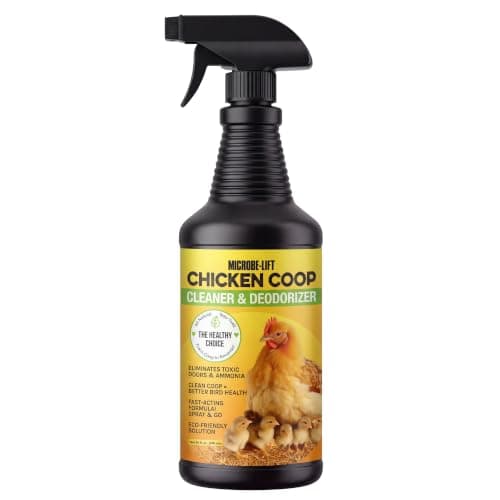
Pick 5 · Spraying without moving the flock out
MICROBE-LIFT Chicken Coop Cleaner and Odor Eliminator, 32 Ounces
The one here the listing says can be applied with the birds present, and the one that frames the result as fertilizer rather than as clean.
What the numbers say
The manufacturer does not publish the dimensions this calculation needs, so we do not print a number.
Figures from MICROBE-LIFT published specifications (Amazon listing) · 32 oz, no additional water required per the listing · Concentrated natural formula
The practical difference is stated plainly: it can be applied in the pen while the birds are present and will not affect feed or water. Most products here want the flock out first, and for a mid-week ammonia problem that is a real distinction.
It is aimed at the litter as much as the surfaces - spray the shavings, let it air dry, no rinsing. That is a different model from wiping down a wall, and it is the one that matches how deep litter actually works.
The fertilizer claim is the interesting one. The listing says it adds nitrogen and turns manure into usable fertilizer, which is a composting argument rather than a hygiene argument - and our deep litter position is that litter composting in place is a feature.
Claiming you will not have to change bedding as often is the claim to be most careful with. Bedding gets changed because it is wet and fouled, and a spray does not remove either.
Good
- Can be applied with the flock present, per the listing
- Works on litter rather than only on hard surfaces
- Concentrated, with no additional water needed
- Frames the output as compost, which fits how deep litter is meant to work
Not so good
- The claim that you change bedding less often is the weakest in the category
- Thirty-two ounces, like the other trigger bottles
- No disinfection - this is ammonia and odor only
- No published coverage figure to compare on price
Skip this if: you are dealing with a disease scare or cleaning between flocks. Those need the coop stripped and a disinfectant with a published contact time, and nothing applied around live birds does that job.
#ad · how this is funded · price as of September 26, 2026
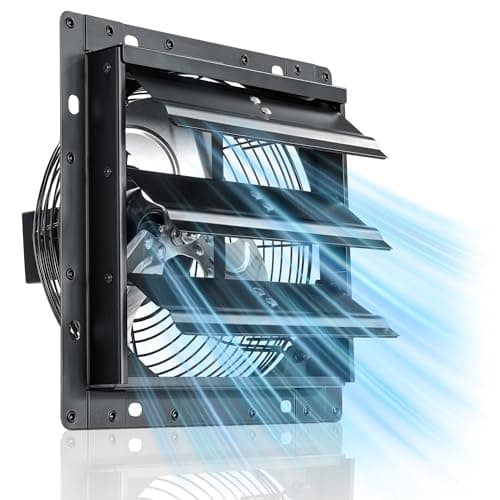
Pick 6 · Hot-climate summer ventilation
Generic 8in Shutter Exhaust Fan, 760 CFM
760 CFM through an 8in shuttered opening. For hot climates this does more for the flock than any heater ever will.
What the numbers say
The manufacturer does not publish the dimensions this calculation needs, so we do not print a number.
Figures from Generic published specifications (Amazon listing)
Heat kills far more backyard birds than cold does. A fan is the hot-climate equivalent of a coop heater, and it is more often the right purchase.
The shutter matters: it closes when the fan is off, so the same opening is not a winter draft.
760 CFM is generous for a backyard coop, which means it can run at lower speed and quieter for the same effect.
Good
- Shutter closes off the opening when not running
- Generous airflow for a backyard-sized coop
- Plug-and-play rather than hard-wired
Not so good
- Needs mains power at the coop
- Cutting an 8in opening is irreversible
- Dust needs clearing off the blades periodically
Skip this if: your summers are mild or your coop is well shaded and cross-ventilated. Passive ventilation solves most cases without a fan.
The last pick is not a cleaner. It is a shutter fan, and it is here for the same reason a treadle feeder closes the flies page: if the coop smells, moving air does more than anything you can spray, and coop fans and vents is the page for that half of the problem.
What we did not weigh
We have not tested any of these products and we have not measured ammonia in any coop. What is above is the published biosecurity sequence, the manufacturer specifications where they exist, and an honest account of which claims are the maker's rather than anyone else's.
One listing describes itself as veterinarian approved. We have no way to verify what that means or who approved it, so it appears on the pick as the maker's claim and nowhere else.
Where to go next
- A cleaning routine that gets done - daily, weekly and seasonal, which is when these products get used
- Ventilation, not insulation - the actual fix for an ammonia smell
- Coop bedding - materials judged on moisture, which is what drives the smell
- Flies in the coop - the other problem wet litter produces
Questions people actually ask
+What is the best chicken coop cleaner?
+Do I need to disinfect my chicken coop?
+Can you spray disinfectant on chicken coop bedding?
+Why does my chicken coop still smell after cleaning it?
+Are enzyme coop cleaners safe to use around chickens?
+Is scented or unscented coop cleaner better?
+How long should disinfectant stay wet on a surface?
Sources
- eXtension Small and Backyard Poultry - Biosecurity for small poultry flocks (remove organic material before disinfecting, because it makes disinfectants ineffective; two weeks downtime between flocks for sweeping, cleaning, disinfection and drying; clean boots or disposable booties for visitors)
- Penn State Extension - Pest management recommendations for poultry (flies breed in manure at 50-85% moisture; fresh manure is 75-80% moisture; house fly life cycle 10 days at 85F, 21 at 70F, 45 at 60F; spilled feed and broken eggs attract adult flies)
- University of Minnesota Extension - Common concerns with backyard or urban poultry keeping (remove wet feed and soiled bedding; cleanliness reduces house mice and Norway rats)
- Penn State Extension - Small-scale poultry housing
Read next
A cleaning routine you will actually keep
Daily, weekly and seasonal jobs sized so they get done, plus the mite inspection nobody schedules until it is too late.
Ventilation, not insulation
Why sealing a coop causes frostbite, where vents belong, and how to tell whether yours has enough.
Coop bedding, judged on moisture
Shavings, straw, sand and hemp compared on absorbency and running cost, plus how the deep litter method actually works.
Flies in the coop, and the number that stops them
The published moisture range flies breed in, the life-cycle figures that explain a summer explosion, and where traps genuinely help.
Coop gear, ranked by the problem it solves
The gear that fixes what coops arrive without - doors, mesh, roosts, boxes, heat and airflow - in buying order.
Coop fans and ventilation hardware
Vent placement, how much opening a coop needs, and when a powered shutter fan earns its wiring.