Chicken waterers, ranked on the published numbers
Water is the one thing a flock cannot go a day without, and the coop never comes with a way to supply it. Three published figures decide which waterer you need.
We have not handled these coops, and we do not pretend to have. Here is what we did instead. Links to Amazon earn us a commission at no extra cost to you - disclosure.
| # | Coop | Best for | Honest count | Price |
|---|---|---|---|---|
| 1 | 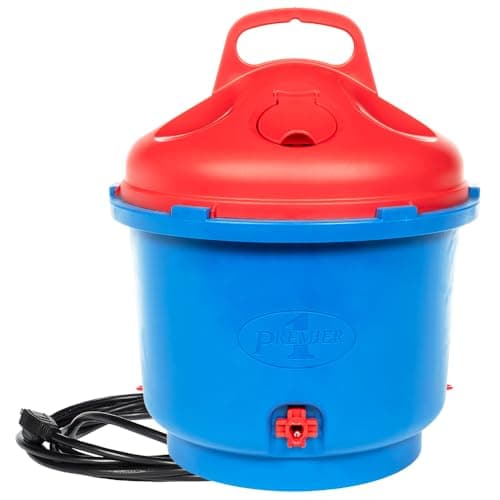 Premier 1 Supplies All-Season Heated Poultry Waterer for Chickens & Ducks, 3 GallonTop pickThe only heated unit here that solves both winter and fouling at once - a real thermostat plus three recessed nipple drinkers, so nothing gets kicked into it. | Unfrozen water that also stays clean | not published | |
| 2 | 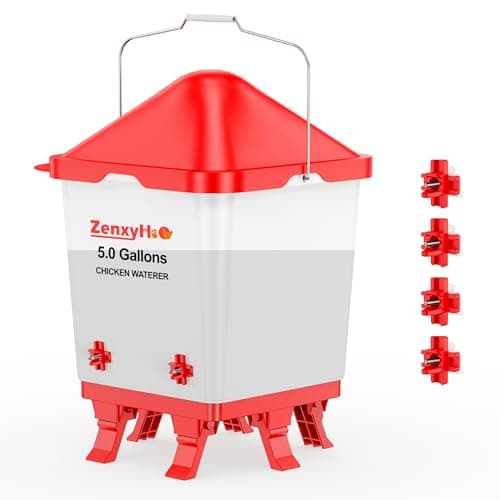 ZenxyHoC 5.0 Gal Chicken Waterer Bucket with 4 Horizontal Water NipplesFive gallons, four nipples, an anti-roost cone and legs that extend as the birds grow. The default answer if your water does not freeze. | Most flocks, most of the year | not published | |
| 3 | 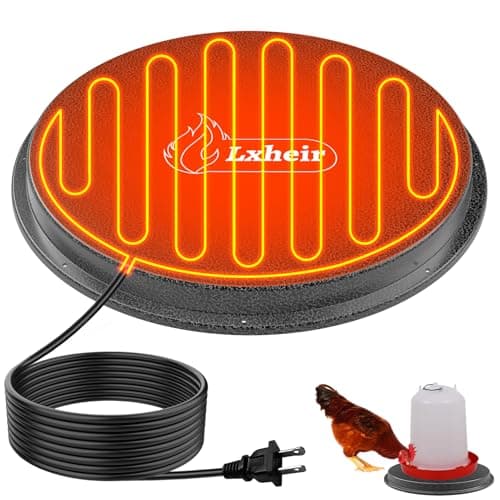 Myodal 62W Metal Chicken Water Heater Base, 13in ThermostatA thermostatic heated base that sits under a waterer you already have. Much the cheapest route to unfrozen water, and it replaces nothing. | Winterizing the waterer you already own | not published | |
| 4 | 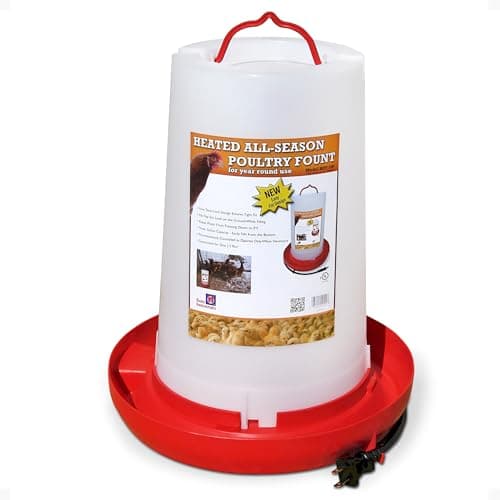 Farm Innovators Thermostatically Controlled Heated 3 Gallon Hanging Water FountainThe category's long-standing default. Thermostatically controlled, published as preventing freezing down to 0F, and it hangs - which is the only way an open font stays usable. | The traditional heated font, done properly | not published | |
| 5 | 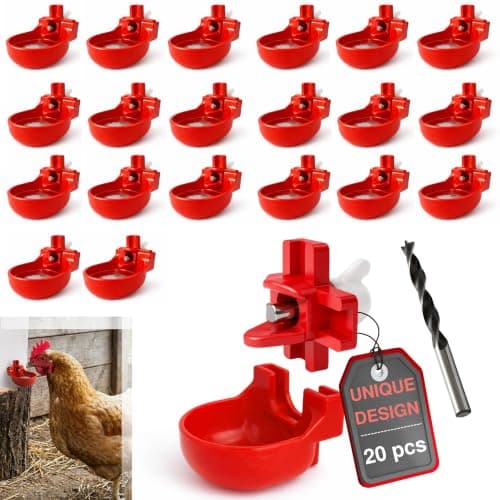 VARYOK Chicken Water Nipples with Cups, 20-Pack HorizontalTwenty horizontal nipples with catch cups, side-mounted into any bucket or PVC run. The cheapest clean water per bird by a wide margin. | Converting a bucket you already have | not published | |
| 6 | 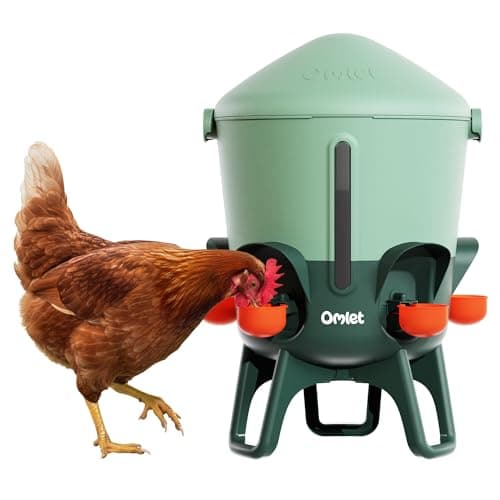 Omlet Insulated Chicken Waterer, 3 GallonInsulated and opaque - the listing claims it blocks 99% of light, which is the actual fix for algae. Ships with both cups and nipples so you can change your mind. | Water that does not go green | not published | |
| 7 | 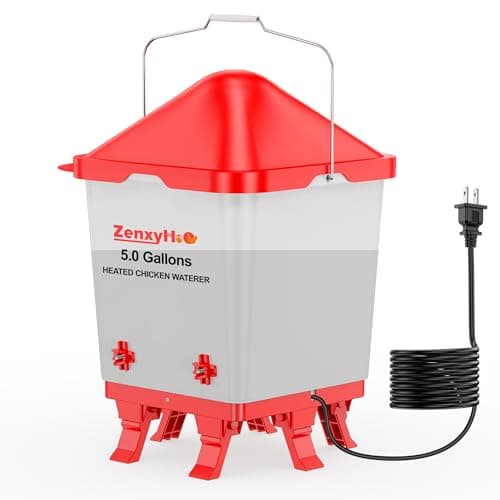 ZenxyHoC 5.0 Gal Heated Chicken Waterer Bucket with 4 Horizontal Water NipplesThe unheated bucket with an element added - five gallons, four nipples, published to switch on below 35F. The most water and the most drinking points of anything heated here. | Winter without giving up the nipples | not published |
Every coop on this site arrives without a waterer. That is not a criticism of any particular maker - it is simply not part of what a coop is - but it does mean the decision lands on you at the worst possible moment, in the same week as the birds.
It is also a decision people redo. The usual sequence is an open font because it is cheap, then a nipple system because the font was filthy, then something heated because the nipples froze. This page exists to let you skip to the end of that.
The three published figures
This site runs on arithmetic from published guidance rather than on opinion, and waterers happen to be unusually well served by it. Penn State Extension's laying-flock guide gives all three numbers that matter.
Read the capacity figure carefully, because it is a floor and not a refill schedule. Nothing about it says the water will still be fit to drink on day ten - it says the container has to be able to supply at least that much. In an open font the water is filthy long before it is empty.
Summer moves the number, and it moves it a lot
The 0.05 gallons a bird figure is not a constant. University of Georgia Extension's drinking water primer puts the relationship at roughly 7 percent more water consumed for each degree Fahrenheit of temperature rise, and birds drinking something like 1.6 to 2.0 times their feed weight in water.
Those particular figures are published for broilers, and we are not going to quietly pass them off as layer numbers. What they establish is the shape of the problem rather than a precise multiplier: a reservoir that is comfortable in April is not necessarily comfortable in a July heat wave, and a hot-weather flock can empty a waterer at several times its cool-weather rate.
The practical consequence is that capacity is worth over-buying. Heat is the more dangerous half of the year for a chicken - they cannot sweat - and running out of water on a 95 degree afternoon is a different kind of problem from running out on a mild one. Coops for hot climates covers the rest of that.
How we judged
- Reservoir against the published figure. Every waterer here is quoted at its maker's stated capacity, and we do the per-bird arithmetic in the open rather than repeating a bird count off the box.
- Drinking points. Penn State's 1 inch of water space per bird is a figure for open troughs and fonts. For nipples and cups the honest answer is that no extension service publishes a birds-per-nipple number we could find, so where a maker states one we attribute it to the maker.
- Whether the water stays clean. An open dish at scratching height fills with bedding and droppings within a day. This is the single largest practical difference between formats and it barely shows up in listings.
- Freeze behavior, stated rather than implied. We rank a published switch-on temperature above the word winterproof.
- Light. Algae needs light, so an opaque body is a functional specification in a sunny run, not a color choice.
- Whether it needs mains power, and whether you have any at the coop.
The three formats
| Format | Stays clean | Below freezing | Best when |
|---|---|---|---|
| Open font or fountain | No - fouls within a day at ground level | Freezes solid unless heated | Hung at back height, and refilled daily anyway |
| Nipple or cup system | Yes - water is enclosed until pecked | Nipples are the first thing to freeze | Any climate, once the birds have learned it |
| Heated base under an existing waterer | Unchanged - it does not touch cleanliness | Warms from below, surface ice still possible | You already own a waterer worth keeping |
Notice that no single row wins outright. That is why several picks below are heated nipple systems, which is the combination that solves both halves, and why the cheapest sensible answer for a lot of keepers is an unheated nipple bucket plus a heated base underneath it in December.
Nipples: the part people get wrong
Nipple waterers are the single biggest upgrade in coop hygiene and they are also the one people abandon most often, almost always for the same two reasons.
- Height. The nipple should sit at roughly eye level for the bird, so she reaches slightly up rather than stoops. Set for chicks and left there, it is unusable for adults; set for adults on day one, the chicks never find it.
- Training. Birds do not arrive knowing what a nipple is. Tap it in front of them so it drips and catches the light, and expect a few days of watching before you remove the old waterer. Cups shorten this considerably because there is visible water to aim at.
Do not remove the previous waterer on day one. Run both for a week, then take the old one away once you have actually seen every bird drink from the new one. A flock that quietly stops drinking is a flock that quietly stops laying, and the 12-hour figure above is why that matters.
Winter, honestly
There is no unheated waterer that stays liquid through a hard freeze, and nothing sold as insulated changes that - insulation buys hours, not nights. If your winter goes below freezing and stays there, you have three options and they are all fine.
- Carry warm water out twice a day. Free, reliable, and genuinely what a lot of keepers do. It is also a commitment every single morning including the ones you are ill.
- A heated base under the waterer you already own. Cheapest hardware route, and it replaces nothing.
- A purpose-built heated waterer. Most expensive up front, least to think about afterwards, and the only option that also solves cleanliness if it uses nipples.
The ranked picks
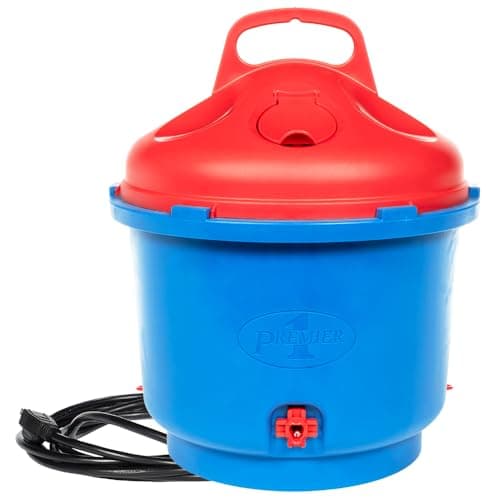
Top pick · Unfrozen water that also stays clean
Premier 1 Supplies All-Season Heated Poultry Waterer for Chickens & Ducks, 3 Gallon
The only heated unit here that solves both winter and fouling at once - a real thermostat plus three recessed nipple drinkers, so nothing gets kicked into it.
What the numbers say
The manufacturer does not publish the dimensions this calculation needs, so we do not print a number.
Figures from Premier 1 Supplies published specifications (Amazon listing) · 13"L x 13"W x 14"H, 3 gallon · Insulated plastic with a heavy-duty handle
Premier 1 publishes the thermostat behavior rather than implying it: a 100 watt element that switches on below 40F and off at 60F. That is a specification you can check against your own winter, which is more than most heated waterers offer.
Three recessed nipple drinkers mean the water is not an open dish sitting at scratching height. This is the single biggest difference between a waterer you refill and a waterer you scrub.
The listing claims 3 gallons is suitable for up to 35 adult chickens. That is the manufacturer's number, not a published extension figure - Penn State Extension's guidance is at least 5 gallons per 100 birds daily, which works out far more conservatively.
Premier 1 says outright that in extreme cold the insulated lid may freeze to the basin, which is why they added a hinged quick-fill cap. A maker documenting its own failure mode is worth more than one that does not.
Good
- Published thermostat range - on below 40F, off at 60F
- Nipple drinkers keep the water clean, not just liquid
- Hinged quick-fill cap for when the lid ices to the basin
- Heavy-duty handle for carrying or hanging
Not so good
- The most expensive waterer here by a clear margin
- The maker itself warns the lid can freeze to the basin in extreme cold
- Only three nipples, so a large flock queues at dusk
- Needs mains power run safely to the coop
Skip this if: your winter never reaches freezing - you are paying for a heating element you will never switch on, and an unheated nipple bucket does the clean-water half for a fraction of it.
#ad · how this is funded · price as of September 14, 2026
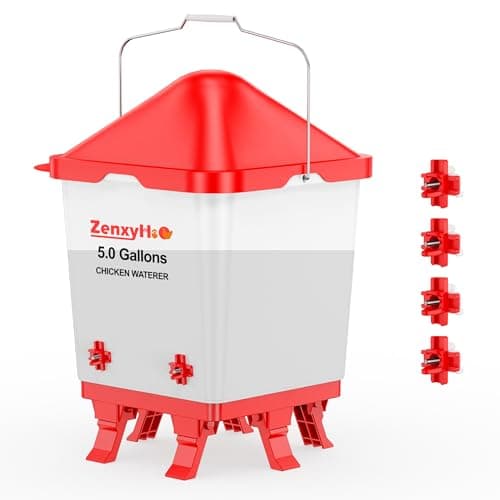
Pick 2 · Most flocks, most of the year
ZenxyHoC 5.0 Gal Chicken Waterer Bucket with 4 Horizontal Water Nipples
Five gallons, four nipples, an anti-roost cone and legs that extend as the birds grow. The default answer if your water does not freeze.
What the numbers say
The manufacturer does not publish the dimensions this calculation needs, so we do not print a number.
Figures from ZenxyHoC published specifications (Amazon listing) · 12.4"L x 12.4"W x 19.6"H, 5 gallon · Plastic
Five gallons against Penn State Extension's at-least-5-gallons-per-100-birds-daily means a small backyard flock is not refilling this every morning - which is the point of a closed system over an open font.
The anti-roost cone is not a gimmick. A flat lid at bird height becomes a perch, and a perch above the water supply becomes the reason you are scrubbing it.
Four nipples is more drinking points than the premium heated unit here offers, which matters at dusk when a flock drinks heavily before roosting.
Adjustable legs let the nipple height rise with the birds. Nipples set too high for chicks or too low for adults are the usual reason a nipple waterer gets abandoned.
Good
- Five gallons, so refills are weekly rather than daily for a small flock
- Four nipples - more drinking points than most units at any price
- Anti-roost cone and a removable lid for top filling
- Adjustable, foldable legs that grow with the flock
Not so good
- Not heated - nipples freeze solid and are the first thing to do so
- Birds have to learn nipples, which takes a few days of watching
- Generic brand with no published thermostat or material grade
- A full 5 gallon bucket is heavy to move once sited
Skip this if: you get hard winters and have no power at the coop. An unheated nipple waterer in a freeze is a solid block with four blocked outlets, and you will be carrying warm water out twice a day regardless.
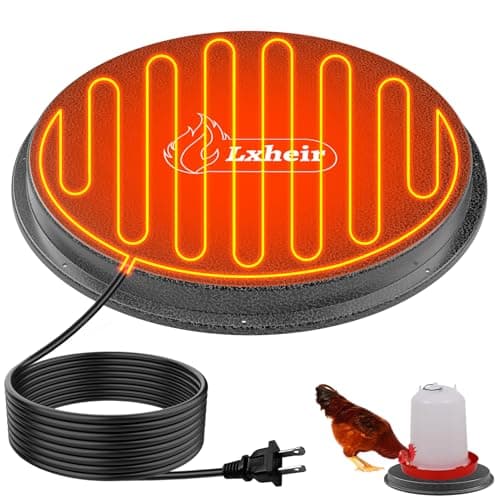
Pick 3 · Winterizing the waterer you already own
Myodal 62W Metal Chicken Water Heater Base, 13in Thermostat
A thermostatic heated base that sits under a waterer you already have. Much the cheapest route to unfrozen water, and it replaces nothing.
What the numbers say
The manufacturer does not publish the dimensions this calculation needs, so we do not print a number.
Figures from Myodal published specifications (Amazon listing) · 13"L x 13"W x 1.1"H, 62W · Stainless steel
This is the pick that saves the most money, because it does not ask you to throw away a working waterer to solve a three-month problem.
The listing states compatibility with plastic, metal, glass or ceramic waterers from 1 to 5 gallons, and a 13 inch platform. Measure the base of your waterer against that before ordering - a font wider than the plate overhangs and heats unevenly.
62 watts is a modest draw, and the published 6.56 foot cold-resistant cord is the number that decides where this can physically go relative to your outlet.
A base warms from below, so it fights freezing at the water surface last. In a hard, still freeze expect a skin of ice on top of liquid water underneath.
Good
- By far the cheapest route to unfrozen water
- Works with a waterer you already own, metal or plastic
- Thermostatically controlled rather than always-on
- Stainless steel platform, rated for outdoor weather
Not so good
- It is a base - there is no waterer in the box
- Needs safe, outdoor-rated mains power at the coop
- Heats from below, so surface ice can still form in a hard freeze
- A waterer wider than the 13in plate will overhang it
Skip this if: you do not already own a waterer worth keeping. Buying a base plus a font separately costs more than a purpose-built heated unit and gives you two things to store instead of one.
#ad · how this is funded · price as of September 14, 2026
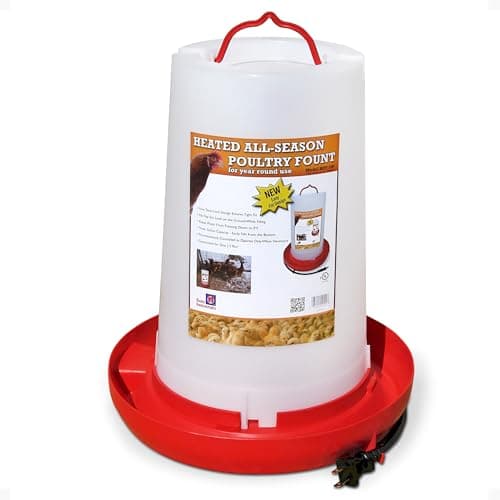
Pick 4 · The traditional heated font, done properly
Farm Innovators Thermostatically Controlled Heated 3 Gallon Hanging Water Fountain
The category's long-standing default. Thermostatically controlled, published as preventing freezing down to 0F, and it hangs - which is the only way an open font stays usable.
What the numbers say
The manufacturer does not publish the dimensions this calculation needs, so we do not print a number.
Figures from Farm Innovators published specifications (Amazon listing) · 3 gallon reservoir; listing states 20"L x 13.5"W x 13.5"H · Plastic
The published claim is specific and therefore checkable: thermostatically controlled, operating only when needed, and capable of preventing water from freezing down to 0F. If your winter goes below zero, the maker has told you where its limit is.
It is an open fountain, and that is the trade. Open water at floor level collects bedding, droppings and everything a scratching hen kicks sideways, which is why hanging it is not optional.
Hang it so the water lip sits at roughly the height of the birds' backs. Too low and it fouls in a day; too high and the smaller birds stop drinking.
Note a discrepancy worth knowing about: the listing's own dimension fields and its feature bullets do not agree with each other. The 3 gallon capacity is consistent across both, so that is the figure to plan around.
Good
- Thermostatic control, so it runs only when it needs to
- Published freeze protection down to 0F
- Designed to hang, which is what keeps an open font clean
- The most widely used heated waterer in the category
Not so good
- Open fountain - it fouls far faster than any nipple system
- 0F is a stated limit, not a guarantee below it
- Plastic, and plastic gets brittle after several hard winters
- The listing's own dimension fields contradict its feature bullets
Skip this if: your birds have a habit of kicking bedding everywhere or your run floods. An open font in a wet, scratched-up run is a daily scrub, and a nipple bucket removes the job entirely.
#ad · how this is funded · price as of September 14, 2026
Pick 5 · Converting a bucket you already have
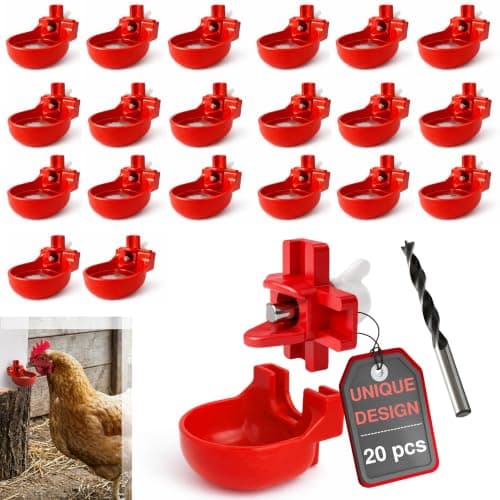
VARYOK Chicken Water Nipples with Cups, 20-Pack Horizontal
Twenty horizontal nipples with catch cups, side-mounted into any bucket or PVC run. The cheapest clean water per bird by a wide margin.
What the numbers say
The manufacturer does not publish the dimensions this calculation needs, so we do not print a number.
Figures from VARYOK published specifications (Amazon listing) · Plastic with stainless components
A food-grade bucket, a drill and four of these is a five gallon closed waterer for a fraction of what a finished one costs. That is the entire argument, and it is a good one.
The cups matter more than the count. A bare nipple drips onto the ground and a bird has to work the valve precisely; a cup catches the drip and gives a hesitant bird something visible to drink from, which shortens the training period.
Horizontal side-mount is the right format for a bucket. Vertical nipples point down through the base and are far more prone to dripping into the bedding directly below.
Twenty is far more than one coop needs. Treat the surplus as spares - nipples do eventually stick open or clog, and having a replacement in the drawer beats a dry flock.
Good
- Cheapest route to clean, closed water by a wide margin
- Cups shorten the training period compared to bare nipples
- Horizontal side mount, which drips less than vertical
- Twenty in a pack means spares for when one sticks
Not so good
- You supply the bucket, the drill and the afternoon
- Twenty is far more than any single coop needs
- Cups still need occasional cleaning - they are not zero-maintenance
- A DIY bucket has no heating option without adding one
Skip this if: you do not want a project. It is genuinely simple, but it is still drilling, sealing and testing for leaks before any bird drinks from it - and a finished waterer arrives working.
#ad · how this is funded · price as of September 14, 2026
Pick 6 · Water that does not go green
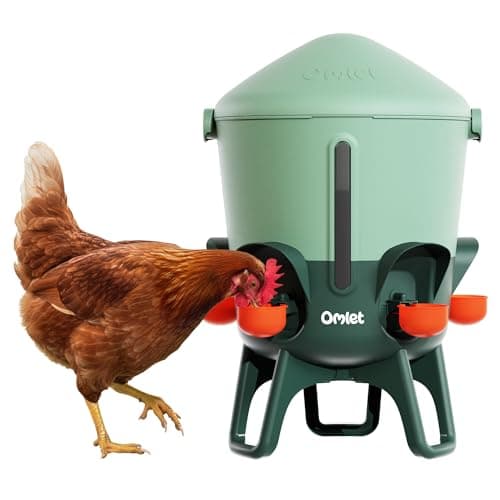
Omlet Insulated Chicken Waterer, 3 Gallon
Insulated and opaque - the listing claims it blocks 99% of light, which is the actual fix for algae. Ships with both cups and nipples so you can change your mind.
What the numbers say
The manufacturer does not publish the dimensions this calculation needs, so we do not print a number.
Figures from Omlet published specifications (Amazon listing) · 3 gallon · BPA-free, UV-stable plastic
Blocking light is the one thing that genuinely stops the green slime in a summer waterer. Algae needs light, and a translucent container in a sunny run is a greenhouse - so an opaque body is a functional specification rather than a styling one.
Insulated is not the same word as heated, and Omlet does not claim otherwise: the listing says it helps prevent freezing. In a hard, sustained freeze it will still freeze, just later.
Shipping both cups and nipples is unusually sensible. Cups are easier for birds to learn and nipples stay cleaner, and you find out which your flock prefers by trying rather than by buying twice.
Omlet sells its coops direct rather than through Amazon, but this waterer is carried there - so unlike the Eglu, it is something we can actually link.
Good
- Opaque body - listing claims it blocks 99% of light, which is the real algae fix
- Insulated, so it keeps water cooler in summer as well
- Ships with both cups and nipples, plus a spare set of each
- Anti-roost lid, BPA-free and UV stable
Not so good
- The highest price here, and it has no heating element at all
- Insulated only helps in a freeze - it does not prevent one
- 3 gallons, so less reserve than the 5 gallon buckets
- Omlet's published dimensions are weight only, with no size given
Skip this if: your problem is winter rather than summer. Insulation buys you time in a freeze and nothing more, and a heated base under a cheaper font will outperform it every cold night.
#ad · how this is funded · price as of September 14, 2026
Pick 7 · Winter without giving up the nipples
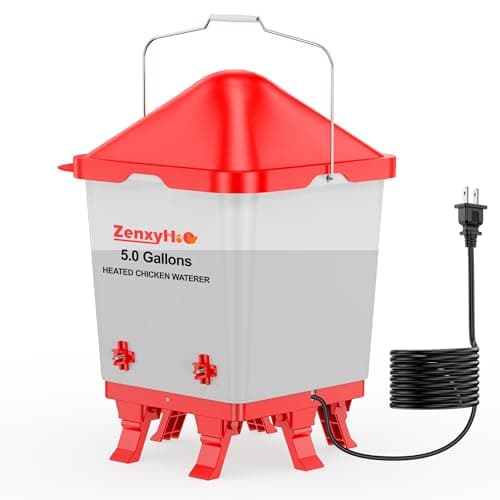
ZenxyHoC 5.0 Gal Heated Chicken Waterer Bucket with 4 Horizontal Water Nipples
The unheated bucket with an element added - five gallons, four nipples, published to switch on below 35F. The most water and the most drinking points of anything heated here.
What the numbers say
The manufacturer does not publish the dimensions this calculation needs, so we do not print a number.
Figures from ZenxyHoC published specifications (Amazon listing) · 12.4"L x 12.4"W x 19.6"H, 5 gallon · Plastic
Five gallons is the largest reservoir on this page, and against Penn State Extension's at-least-5-gallons-per-100-birds-daily that is a serious amount of reserve for a backyard flock.
The published switch-on point is 35F, which is a stated number rather than 'senses cold'. Four nipples heated is more drinking points than the premium unit offers at three.
A 10 foot cord is published, and that is the specification that decides whether this can reach your outlet. Measure before ordering - extension cords across a run are how coop fires start.
The visible water level is a small feature that saves a real annoyance: you can see it needs filling without lifting a lid in the rain.
Good
- Five gallons heated - the largest reserve on this page
- Four nipples, so no queue at dusk
- Published switch-on temperature of 35F
- 10 foot cord and a visible water level
Not so good
- Generic brand with no safety certification stated in the listing
- Nipples are the first part to freeze if the element fails
- Needs mains power at the coop, run safely
- Heavy to move once filled
Skip this if: you want a documented safety certification. Premier 1 publishes its thermostat behavior and its failure mode in detail; this listing publishes a switch-on temperature and little else.
#ad · how this is funded · price as of September 14, 2026
What we did not weigh
We have not handled any of these waterers, and the methodology page says so on every page that recommends something. What is above is the published specification, the published extension guidance, and the arithmetic between them - which is checkable, unlike a testing claim.
Where a maker states a bird count - and one here claims 3 gallons suits up to 35 adult chickens - we attribute it to the maker rather than adopting it. That is the same treatment coop capacity claims get on this site, and for the same reason.
Where to go next
- Chicken feeders - the other thing no coop includes, and the rodent problem that comes with it
- Coop heaters - the other thing that needs power at the coop, and why most flocks do not need it
- Coops for hot climates - where the summer water figure comes from
- A cleaning routine that gets done - the waterer scrub, and how often it is really needed
- Coop gear in buying order - where a waterer sits against mesh, latches and roost bar
Questions people actually ask
+What is the best chicken waterer?
+How much water do chickens drink per day?
+How long can chickens go without water?
+Are nipple waterers better than open waterers?
+Do I need a heated chicken waterer?
+How do I stop algae in a chicken waterer?
+How many nipples do chickens need?
Sources
- Penn State Extension - Management requirements for laying flocks (3 inches of feeder space per bird; feeder lip level with the birds' back height; trough filled only one-third to one-half full to prevent wastage; at least 5 gallons of water per 100 birds daily; 1 inch of water space per bird; never more than 12 hours without water)
- University of Georgia Extension B1301 - Poultry drinking water primer (broiler water consumption rises ~7% per degree F; broilers drink ~1.6-2.0x their feed weight in water)
- Penn State Extension - Small-scale poultry housing
- University of Minnesota Extension - Raising chickens for eggs (3-5 sq ft indoor space per bird; one nest box per 4-5 birds)
Read next
Coop gear, ranked by the problem it solves
The gear that fixes what coops arrive without - doors, mesh, roosts, boxes, heat and airflow - in buying order.
Coop heaters, and whether you need one
Flat radiant panels compared, with an honest answer first on whether heat is the right intervention at all.
Chicken coops for hot climates
Coops and gear for genuine heat, ranked on airflow and shade rather than on how well they seal.
A cleaning routine you will actually keep
Daily, weekly and seasonal jobs sized so they get done, plus the mite inspection nobody schedules until it is too late.
Chicken coops for cold climates
Cold-climate coops ranked on the things that matter below freezing - dryness, roof geometry, ventilation and floor area per bird.
What a coop listing means by holds 6 chickens
How listing bird counts are constructed, the four ways they drift, and a thirty-second check that works on any product page.