Wooden chicken coops, measured and weathered
Fir is warm, cheap and workable, and it is also the material that decides when you buy your next coop. Here is what each wooden coop measures and what keeping it alive involves.
We have not handled these coops, and we do not pretend to have. Here is what we did instead. Links to Amazon earn us a commission at no extra cost to you - disclosure.
| # | Coop | Best for | Honest count | Price |
|---|---|---|---|---|
| 1 | 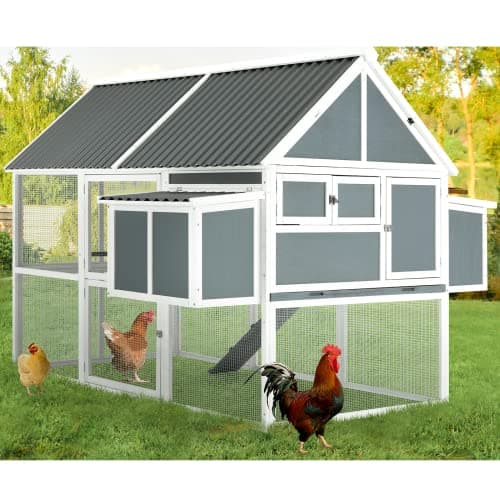 AECOJOY 84" Large Chicken CoopTop pick40.3 sq ft against a claim of ten. The numbers land exactly where the box says they do, which is rarer here than it should be. | Ten hens, claim and arithmetic agreeing | 10box says 10 | |
| 2 | 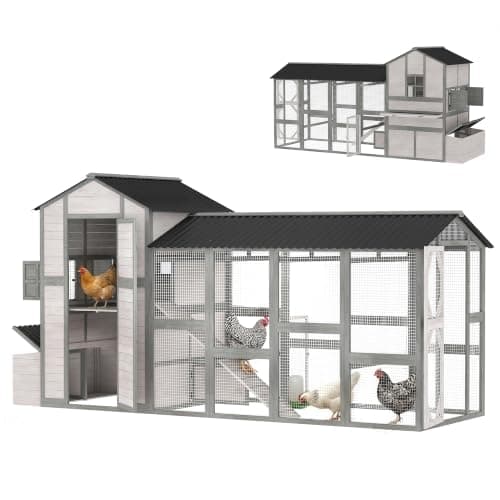 PawHut 147" Extra Large Wooden Hen House51.6 sq ft against a claim of eight to ten hens. It is the only coop on this site with real headroom over its own marketing. | The rare coop that beats its own claim | 12box says 10 | |
| 3 | 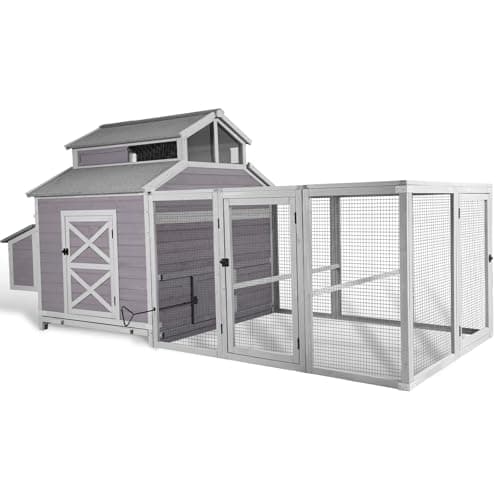 GUTINNEEN 115" Large Hen House with Run43.1 sq ft against a claim of eight to ten - it clears its own number with a small amount to spare. | Ten hens with a little margin | 10box says 10 | |
| 4 | 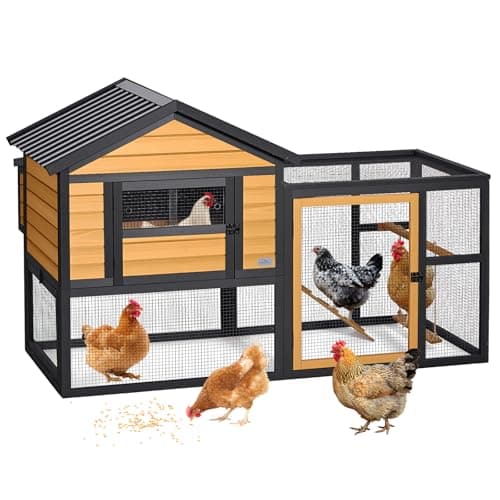 Petsfit Outdoor Coop with Run20.7 sq ft against a claim of six - one bird out, which makes it one of the more honest small coops here. | Five hens, honestly | 5box says 6 | Check price#ad |
| 5 | 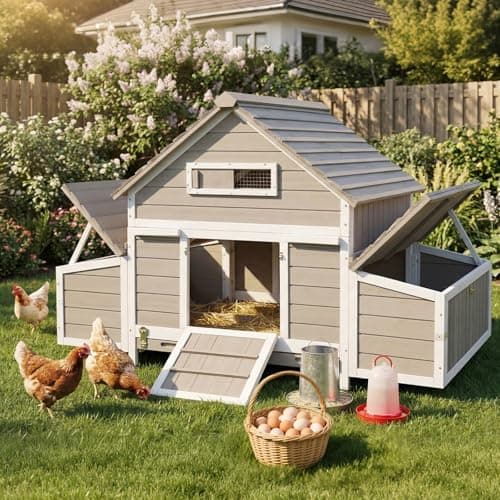 Magazoopet Wooden Hen House with 6 Nesting Boxes14.2 sq ft against a claim of six. Same pattern as the AECOJOY: real floor for three, nest boxes for a flock twice the size. | Three hens in a compact footprint | 3box says 6 | |
| 6 | 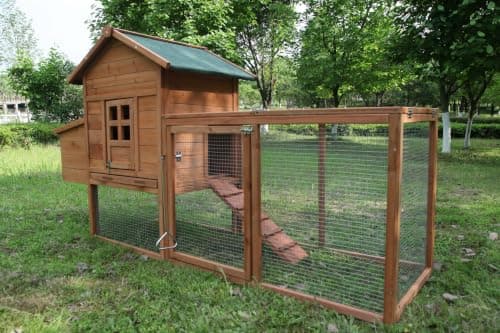 GOJOOASIS 80" Wooden Hen House14.4 sq ft against a claim of four, so three hens - a small, honest-ish coop for a first flock. | A first coop for three hens | 3box says 4 |
Wood is the default material in this category for good reasons. It holds warmth better than steel, it takes screws and modifications without special tools, it arrives as a complete coop with nest boxes and roosts already fitted, and it is cheap. The catch is that almost all of it is untreated fir, and untreated fir in contact with wet litter and wet ground has a limited life.
How long a fir coop actually lasts
Three to six seasons is the honest range for an untreated flat-pack coop, and the base rail fails first. It is the part sitting in wet ground and the part absorbing droppings and rain. Almost nothing else on the coop is close to failure when the base goes, which is why raising it matters so much for so little money.
- Raise the coop off soil. Bricks, paving slabs or a gravel pad under the frame keep the base out of standing water and add years for a few dollars.
- Treat annually with a poultry-safe exterior wood preservative, paying most attention to end grain and to cut edges left by assembly - is pressure-treated wood safe for a chicken coop? covers what EPA records about preservatives, and why no coop in this category is treated to begin with.
- Keep litter dry. Wet litter rots a floor from the inside, and it is also the ammonia source behind most respiratory trouble.
- Replace the supplied mesh with half-inch hardware cloth at build time, while the panels are still apart and the job is easy.
- Check the roof felt each spring. Cheap asphalt felt lifts at the edges, water gets underneath, and the roof sheet delaminates.
Red mite lives in wood, not in plastic
Red mite colonizes cracks, joints and end grain, comes out at night to feed, and is genuinely hard to clear once established. It is the strongest practical argument for plastic or steel over timber and the reason experienced keepers reach for smooth surfaces. If you buy wood, design for inspection: anything you cannot see into, you cannot treat.
The depth trap
Wooden coops are sold on length, because length is cheap to add and looks generous in a listing photograph. Depth is what decides capacity. A coop published at 76 inches long is a two-hen coop if it is 22.5 inches deep, and no amount of length changes that - the arithmetic is on the sizing hub.
The ranked picks
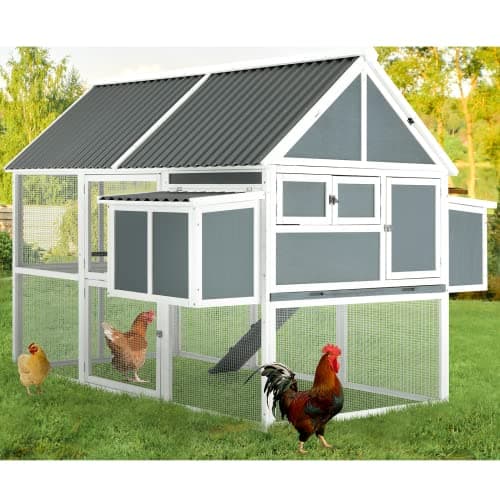
Top pick · Ten hens, claim and arithmetic agreeing
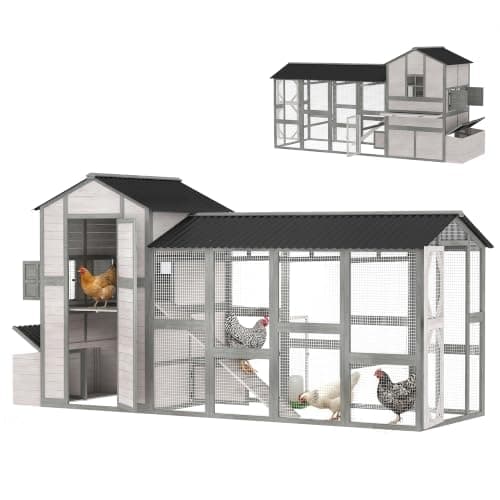
AECOJOY 84" Large Chicken Coop
40.3 sq ft against a claim of ten. The numbers land exactly where the box says they do, which is rarer here than it should be.
What the numbers say
84in x 69in = 40.3 sq ft of whole-unit footprint, which includes the attached run and is therefore generous. At 4 sq ft per standard hen that is 10 birds, against a claim of 10.
Figures from AECOJOY published specifications (Amazon listing) · 84"L x 69"W x 60"H · Wood
84 x 69 inches is 40.3 sq ft, which is exactly ten standard hens at the published 4 sq ft figure. AECOJOY claims eight to ten.
The 69in depth is what makes it work. Most coops in this class buy their length cheaply and stay narrow, which produces a corridor rather than a floor.
It is a square-ish footprint rather than a long thin one, so the usable area is genuinely usable - birds distribute across it instead of queueing down it.
Good
- Claim and arithmetic agree at ten hens
- 69in depth gives a floor rather than a corridor
- Two nesting boxes, which is the right count for ten hens on the published ratio
Not so good
- No margin - ten is the ceiling, not a comfortable number
- Wood construction needs annual attention
- Heavy once assembled and awkward to reposition
Skip this if: you plan to grow past ten birds. It meets its claim exactly, which means it has no room for the two extra chicks you will inevitably bring home.
#ad · how this is funded · price as of October 17, 2026
Pick 2 · The rare coop that beats its own claim
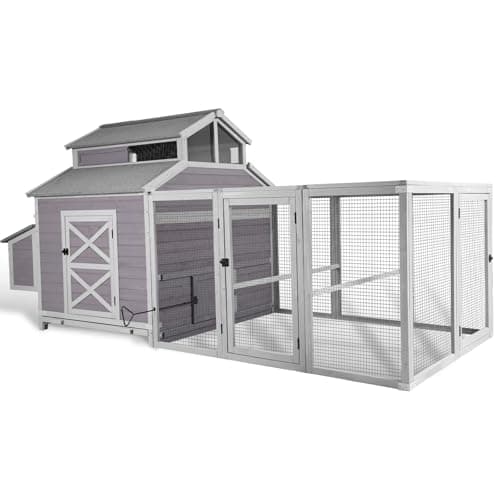
PawHut 147" Extra Large Wooden Hen House
51.6 sq ft against a claim of eight to ten hens. It is the only coop on this site with real headroom over its own marketing.
What the numbers say
146.9in x 50.6in = 51.6 sq ft of whole-unit footprint, which includes the attached run and is therefore generous. At 4 sq ft per standard hen that is 12 birds, against a claim of 10.
Figures from PawHut published specifications (Amazon listing) · 146.9"L x 50.6"W x 73.6"H · Fir and plastic
51.6 sq ft of whole-unit footprint supports twelve standard hens at 4 sq ft each. PawHut claims eight to ten. It is the only coop in this research pass that under-claims.
That matters more than it sounds. Every other maker here is asking you to trust a number that its own dimensions contradict; this one leaves you room.
At 73.6in tall it is genuinely walk-in at the run end, which changes daily keeping more than any feature on the spec sheet.
Good
- Beats its own claim - 12 hens of floor against a claim of 10
- Walk-in height at the run end makes cleaning tolerable
- Large enough to be the last coop you buy for a while
Not so good
- 12ft of yard is a real commitment
- Fir and plastic, so expect maintenance
- Assembly is a long afternoon with two people
Skip this if: your yard cannot give up a 12ft run of ground, or if you are keeping three or four hens - you would be heating and cleaning space nobody uses.
#ad · how this is funded · price as of October 17, 2026
Pick 3 · Ten hens with a little margin
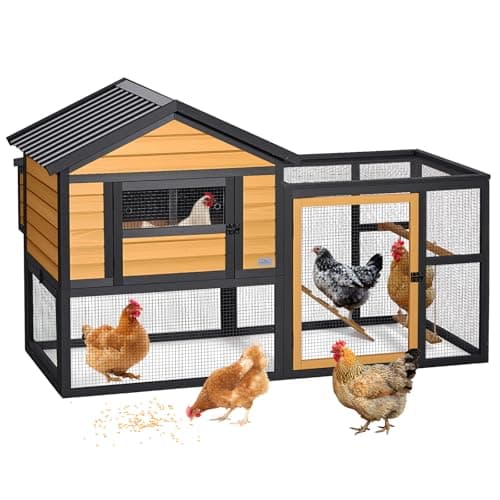
GUTINNEEN 115" Large Hen House with Run
43.1 sq ft against a claim of eight to ten - it clears its own number with a small amount to spare.
What the numbers say
115in x 54in = 43.1 sq ft of whole-unit footprint, which includes the attached run and is therefore generous. At 4 sq ft per standard hen that is 10 birds, against a claim of 10.
Figures from GUTINNEEN published specifications (Amazon listing) · 115"L x 54"W x 56"H · Fir
43.1 sq ft is ten standard hens with roughly three square feet left over. The claim is eight to ten, so the arithmetic supports the top of the range.
The 54in depth is the reason. It is not as generous as the AECOJOY's 69in, but it is well clear of the 22-26in corridors that dominate the cheaper end.
Six nesting boxes for ten hens is more than the one-per-four guidance needs. Extra boxes do not reduce squabbling; they add cleaning.
Good
- Clears its claim rather than exactly meeting it
- 54in depth produces a genuinely usable floor
- Run and house in a single purchase
Not so good
- Six nest boxes is more than ten hens need
- Fir at this size is a lot of surface to re-treat
- Nearly 10ft long - measure the yard first
Skip this if: you want walk-in access. At 56in tall you are still stooping, and for a coop this long that gets old fast.
#ad · how this is funded · price as of October 17, 2026
Pick 4 · Five hens, honestly
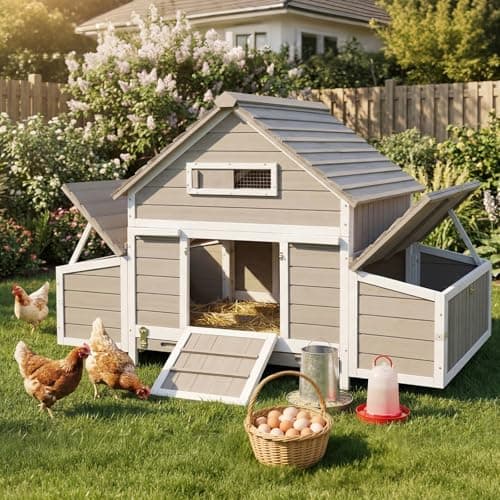
Petsfit Outdoor Coop with Run
20.7 sq ft against a claim of six - one bird out, which makes it one of the more honest small coops here.
What the numbers say
71in x 42in = 20.7 sq ft of whole-unit footprint, which includes the attached run and is therefore generous. At 4 sq ft per standard hen that is 5 birds, against a claim of 6.
Figures from Petsfit published specifications (Amazon listing) · 71"L x 42"W x 45"H · Fir
20.7 sq ft supports five standard hens. Petsfit claims four to six, so the arithmetic sits inside its stated range rather than outside it.
The 42in depth is why. Among the small coops on this site, depth is almost perfectly predictive of whether the claim survives contact with a tape measure.
Three nesting boxes for five hens is more than the one-per-four guidance requires, but not wastefully so.
Good
- Arithmetic lands inside the claimed range
- 42in depth is generous for this size class
- Predator-resistant hardware noted in the listing specification
Not so good
- Six is one bird past the floor
- Fir needs seasonal re-treating
- 45in height means stooping to clean
Skip this if: you are set on six birds. Five is what it holds, and the sixth is the one that gets pecked.
Pick 5 · Three hens in a compact footprint
Magazoopet Wooden Hen House with 6 Nesting Boxes
14.2 sq ft against a claim of six. Same pattern as the AECOJOY: real floor for three, nest boxes for a flock twice the size.
What the numbers say
61in x 33.5in = 14.2 sq ft of whole-unit footprint, which includes the attached run and is therefore generous. At 4 sq ft per standard hen that is 3 birds, against a claim of 6.
Figures from Magazoopet published specifications (Amazon listing) · 61"L x 33.5"W x 40.2"H · Fir
14.2 sq ft supports three standard hens. The claim is four to six.
33.5in of depth is respectable; 61in of length is simply not much coop. The two together produce a footprint that is honest for three birds and marketed for six.
The pull-out tray is the practical high point and the reason to prefer it over similarly sized coops without one.
Good
- Pull-out tray makes cleaning genuinely quick
- Sensible depth for the footprint
- Compact enough for a small yard
Not so good
- Six is double the honest count
- Six nest boxes for three hens of floor
- Fir at this price point will need re-treating
Skip this if: you keep more than three standard hens, or step up to something with a 50in-plus depth.
#ad · how this is funded · price as of October 17, 2026
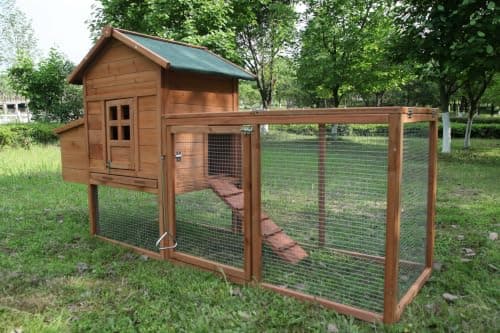
Pick 6 · A first coop for three hens
GOJOOASIS 80" Wooden Hen House
14.4 sq ft against a claim of four, so three hens - a small, honest-ish coop for a first flock.
What the numbers say
80in x 26in = 14.4 sq ft of whole-unit footprint, which includes the attached run and is therefore generous. At 4 sq ft per standard hen that is 3 birds, against a claim of 4.
Figures from GOJOOASIS published specifications (Amazon listing) · 80"L x 26"W x 44"H · Wood
14.4 sq ft supports three standard hens. The claim is two to four, so the arithmetic sits inside the range.
Makers that claim a range starting at two are generally more trustworthy than ones that print a single confident number, and this listing is an example.
The 26in depth is the constraint, as it is on every narrow coop here. Length past about 70in stops adding useful floor once the depth is this tight.
Good
- Claimed range brackets the honest number
- Small enough for a suburban yard
- Simple build with few failure points
Not so good
- 26in depth limits roost arrangement
- Four is one bird past the floor
- No wheels, so the ground beneath will bare off
Skip this if: you are already thinking about a fourth or fifth hen. Flocks grow, and this one has no margin at all.
The measured figures
| Coop | Published size | Floor area | Maker says | Arithmetic says |
|---|---|---|---|---|
| AECOJOY 84" Large Chicken Coop | 84"L x 69"W x 60"H | 40.3 sq ft | 10 hens | 10 hens |
| PawHut 147" Extra Large Wooden Hen House | 146.9"L x 50.6"W x 73.6"H | 51.6 sq ft | 10 hens | 12 hens |
| GUTINNEEN 115" Large Hen House with Run | 115"L x 54"W x 56"H | 43.1 sq ft | 10 hens | 10 hens |
| Petsfit Outdoor Coop with Run | 71"L x 42"W x 45"H | 20.7 sq ft | 6 hens | 5 hens |
| Magazoopet Wooden Hen House with 6 Nesting Boxes | 61"L x 33.5"W x 40.2"H | 14.2 sq ft | 6 hens | 3 hens |
| GOJOOASIS 80" Wooden Hen House | 80"L x 26"W x 44"H | 14.4 sq ft | 4 hens | 3 hens |
Floor area is the maker’s published footprint. Where a unit includes an attached run that figure spans the run too, which makes it a generous reading - the enclosed roosting floor is smaller still. How we work these out.
Questions people actually ask
+What wood are cheap chicken coops made from?
+Should I paint or treat a wooden chicken coop?
+How do I stop a wooden coop from rotting?
+Is a wooden coop warmer than a metal one in winter?
Sources
Read next
Metal against wooden chicken coops
Metal wins for runs, wood for henhouses - and most metal 'coops' are really runs with no house.
Metal chicken coops and runs
Steel runs and enclosures ranked on measured area, with the henhouse gap and the base-security fix stated up front.
The best chicken coops, ranked by what they actually hold
The flagship roundup. Twelve coops ranked on measured floor area against the maker's own bird-count claim.
Ventilation, not insulation
Why sealing a coop causes frostbite, where vents belong, and how to tell whether yours has enough.
Coop types, and what each format actually gives you
Five formats compared on measured floor area, security ceiling and lifespan, with the picks that survive their own spec sheet.
A cleaning routine you will actually keep
Daily, weekly and seasonal jobs sized so they get done, plus the mite inspection nobody schedules until it is too late.