Chicken coops, sized by the tape measure
Pick your flock size. We take each maker's published dimensions, work out the floor area, and print the bird count the arithmetic actually supports next to the one on the box.
We have not handled these coops, and we do not pretend to have. Here is what we did instead. Links to Amazon earn us a commission at no extra cost to you - disclosure.
| # | Coop | Best for | Honest count | Price |
|---|---|---|---|---|
| 1 | 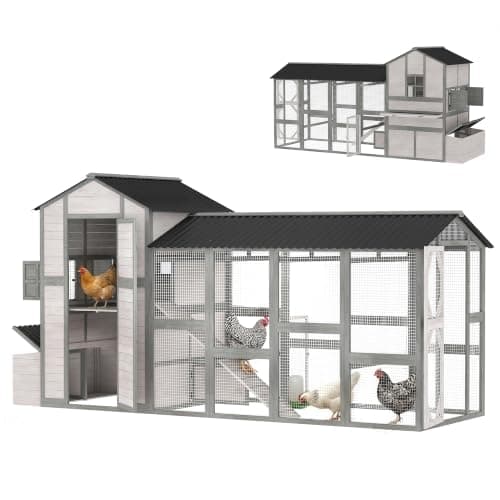 PawHut 147" Extra Large Wooden Hen HouseTop pick51.6 sq ft against a claim of eight to ten hens. It is the only coop on this site with real headroom over its own marketing. | The rare coop that beats its own claim | 12box says 10 | |
| 2 | 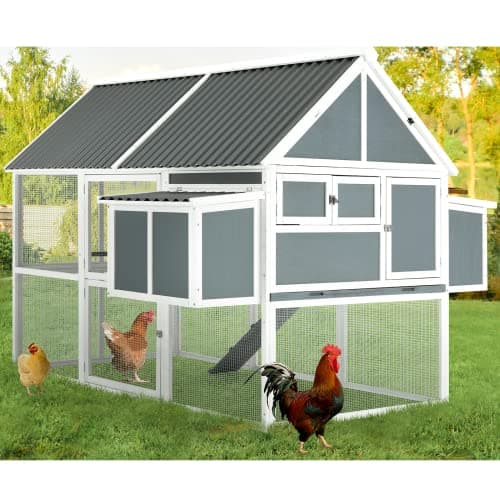 AECOJOY 84" Large Chicken Coop40.3 sq ft against a claim of ten. The numbers land exactly where the box says they do, which is rarer here than it should be. | Ten hens, claim and arithmetic agreeing | 10box says 10 | |
| 3 | 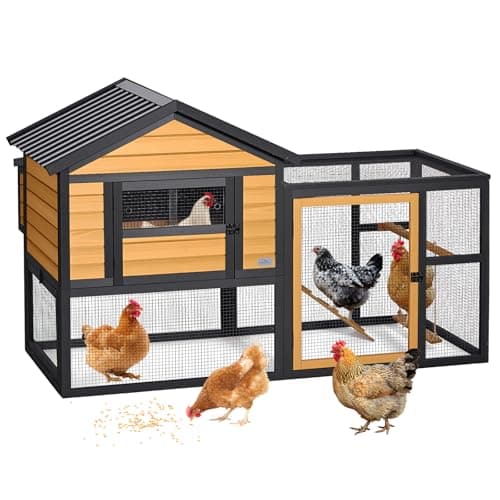 Petsfit Outdoor Coop with Run20.7 sq ft against a claim of six - one bird out, which makes it one of the more honest small coops here. | Five hens, honestly | 5box says 6 | Check price#ad |
Buying a chicken coop is a sizing problem disguised as a shopping problem. You know how many hens you want. The listings are titled with bird counts. It looks like the two should match up, and almost every time they do not.
We checked. Across the coops on this site, read from each maker's own published dimensions on its own listing, the typical coop sold for six hens has floor area for three. One is sold for ten and has room for three. A small number are honest, and one is actually better than its own marketing claims.
The arithmetic, once
There is only one calculation on this site, and it is deliberately simple enough that you can check it with a tape measure and a phone calculator.
Two details matter. First, depth is what decides capacity, not length - a coop can be six feet long and hold two birds because it is only 22 inches deep. Second, where a unit includes an attached run, the published footprint spans the run too, so our figure is generous. The enclosed roosting floor is smaller than the number we print.
Start with your bird count
These are the flock-size roundups. Each one lists the coops whose published dimensions genuinely support that number of birds, ranked, with the working shown for every pick.
| Hens | Coop floor needed | Run floor needed | Roost bar | Nest boxes |
|---|---|---|---|---|
| 4 hens | 16 sq ft | 32 sq ft | 32 in | 1 |
| 6 hens | 24 sq ft | 48 sq ft | 48 in | 2 |
| 10 hens | 40 sq ft | 80 sq ft | 80 in | 3 |
| 12 hens | 48 sq ft | 96 sq ft | 96 in | 3 |
| 20 hens | 80 sq ft | 160 sq ft | 160 in | 5 |
- Coops for 2 chickens - a pair, and the size class where claims are inflated widest
- Coops for 3 chickens - the number most first flocks settle on
- Coops for 4 chickens - the smallest flock worth housing properly
- Coops for 5 chickens - where the small-coop shelf runs out
- Coops for 6 chickens - the most common backyard number, and the most overstated size class
- Coops for 8 chickens - the last flock a single wooden kit houses honestly
- Coops for 10 chickens - where honest coops start to appear
- Coops for 12 chickens - walk-in territory
- Coops for 15 chickens - where single kits stop working entirely
- Coops for 20 chickens - and why almost nothing sold as a coop reaches it
- Best chicken coops overall - the full ranked list across every size
- Best coops for beginners - first flock, no prior kit
- Budget chicken coops - ranked on measured floor per dollar, not sticker price
- Chicken coop brands - what a year of measuring says about who publishes honest numbers
- Omlet Eglu and Nestera alternatives - the premium direct-sale coops, measured
- Coops that take an automatic door - no coop ships with one fitted
- Coops for silkies and bantams - half the floor area, and a roost a bird that cannot fly can reach
The three picks worth knowing about
If you read nothing else here, these are the coops whose numbers survive their own spec sheet. Full write-ups and the arithmetic for each are below.
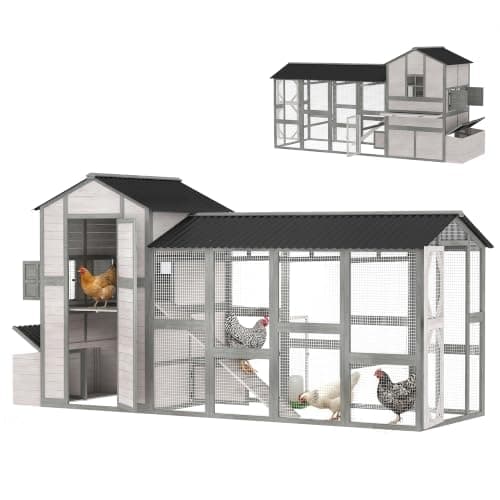
Top pick · The rare coop that beats its own claim
PawHut 147" Extra Large Wooden Hen House
51.6 sq ft against a claim of eight to ten hens. It is the only coop on this site with real headroom over its own marketing.
What the numbers say
146.9in x 50.6in = 51.6 sq ft of whole-unit footprint, which includes the attached run and is therefore generous. At 4 sq ft per standard hen that is 12 birds, against a claim of 10.
Figures from PawHut published specifications (Amazon listing) · 146.9"L x 50.6"W x 73.6"H · Fir and plastic
51.6 sq ft of whole-unit footprint supports twelve standard hens at 4 sq ft each. PawHut claims eight to ten. It is the only coop in this research pass that under-claims.
That matters more than it sounds. Every other maker here is asking you to trust a number that its own dimensions contradict; this one leaves you room.
At 73.6in tall it is genuinely walk-in at the run end, which changes daily keeping more than any feature on the spec sheet.
Good
- Beats its own claim - 12 hens of floor against a claim of 10
- Walk-in height at the run end makes cleaning tolerable
- Large enough to be the last coop you buy for a while
Not so good
- 12ft of yard is a real commitment
- Fir and plastic, so expect maintenance
- Assembly is a long afternoon with two people
Skip this if: your yard cannot give up a 12ft run of ground, or if you are keeping three or four hens - you would be heating and cleaning space nobody uses.
#ad · how this is funded · price as of October 17, 2026
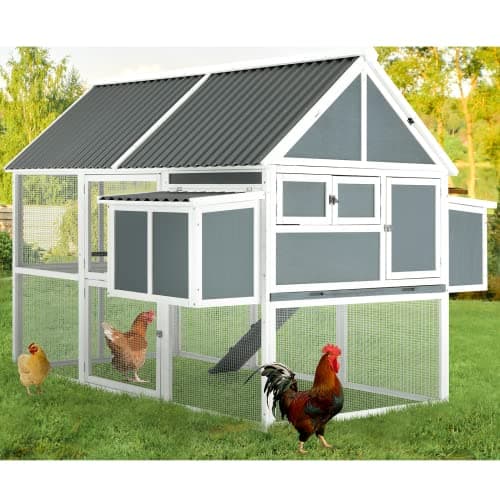
Pick 2 · Ten hens, claim and arithmetic agreeing
AECOJOY 84" Large Chicken Coop
40.3 sq ft against a claim of ten. The numbers land exactly where the box says they do, which is rarer here than it should be.
What the numbers say
84in x 69in = 40.3 sq ft of whole-unit footprint, which includes the attached run and is therefore generous. At 4 sq ft per standard hen that is 10 birds, against a claim of 10.
Figures from AECOJOY published specifications (Amazon listing) · 84"L x 69"W x 60"H · Wood
84 x 69 inches is 40.3 sq ft, which is exactly ten standard hens at the published 4 sq ft figure. AECOJOY claims eight to ten.
The 69in depth is what makes it work. Most coops in this class buy their length cheaply and stay narrow, which produces a corridor rather than a floor.
It is a square-ish footprint rather than a long thin one, so the usable area is genuinely usable - birds distribute across it instead of queueing down it.
Good
- Claim and arithmetic agree at ten hens
- 69in depth gives a floor rather than a corridor
- Two nesting boxes, which is the right count for ten hens on the published ratio
Not so good
- No margin - ten is the ceiling, not a comfortable number
- Wood construction needs annual attention
- Heavy once assembled and awkward to reposition
Skip this if: you plan to grow past ten birds. It meets its claim exactly, which means it has no room for the two extra chicks you will inevitably bring home.
#ad · how this is funded · price as of October 17, 2026
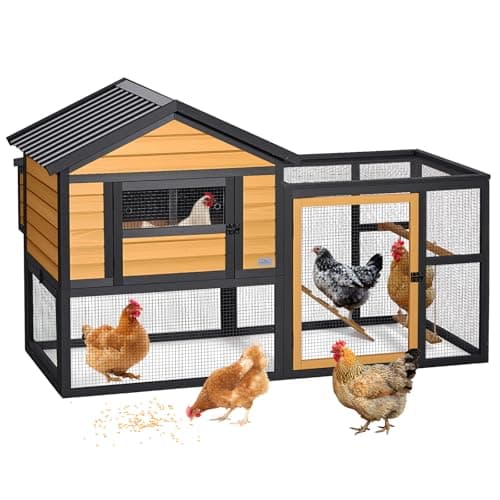
Pick 3 · Five hens, honestly
Petsfit Outdoor Coop with Run
20.7 sq ft against a claim of six - one bird out, which makes it one of the more honest small coops here.
What the numbers say
71in x 42in = 20.7 sq ft of whole-unit footprint, which includes the attached run and is therefore generous. At 4 sq ft per standard hen that is 5 birds, against a claim of 6.
Figures from Petsfit published specifications (Amazon listing) · 71"L x 42"W x 45"H · Fir
20.7 sq ft supports five standard hens. Petsfit claims four to six, so the arithmetic sits inside its stated range rather than outside it.
The 42in depth is why. Among the small coops on this site, depth is almost perfectly predictive of whether the claim survives contact with a tape measure.
Three nesting boxes for five hens is more than the one-per-four guidance requires, but not wastefully so.
Good
- Arithmetic lands inside the claimed range
- 42in depth is generous for this size class
- Predator-resistant hardware noted in the listing specification
Not so good
- Six is one bird past the floor
- Fir needs seasonal re-treating
- 45in height means stooping to clean
Skip this if: you are set on six birds. Five is what it holds, and the sixth is the one that gets pecked.
What we could not work out
Almost no manufacturer in this category publishes the interior henhouse dimension separately from the whole-unit footprint. That is the single figure that would settle every argument on this site, and it is the one nobody prints. Where a maker publishes nothing usable at all, our tables say "not published" rather than carrying an estimate.
A small number of makers publish no bird count either. We treat that as a point in their favor, not against them - see the Aivituvin AIR31 and the metal runs in coop types, none of which claim a number they cannot support.
Before you buy anything
Sizing is one of three decisions and it is only the first. The other two cost more to get wrong: whether the coop can be made secure, and whether it can be ventilated without being drafty.
- Work out your exact numbers - floor, run, roost and nest boxes for your flock
- What manufacturers mean by "holds 6 chickens" - the full method and why the claims drift
- Predator-proofing - the mesh gauge and latch specifics that decide whether a coop holds
- Ventilation, not insulation - the mistake that causes frostbite in a warm coop
Questions people actually ask
+How much space does one chicken need in a coop?
+Why does your bird count differ from the number on the coop listing?
+Is a bigger coop always better?
+Does the run count toward the coop space requirement?
+What happens if a coop is too small?
+How many nesting boxes do I need?
Sources
Read next
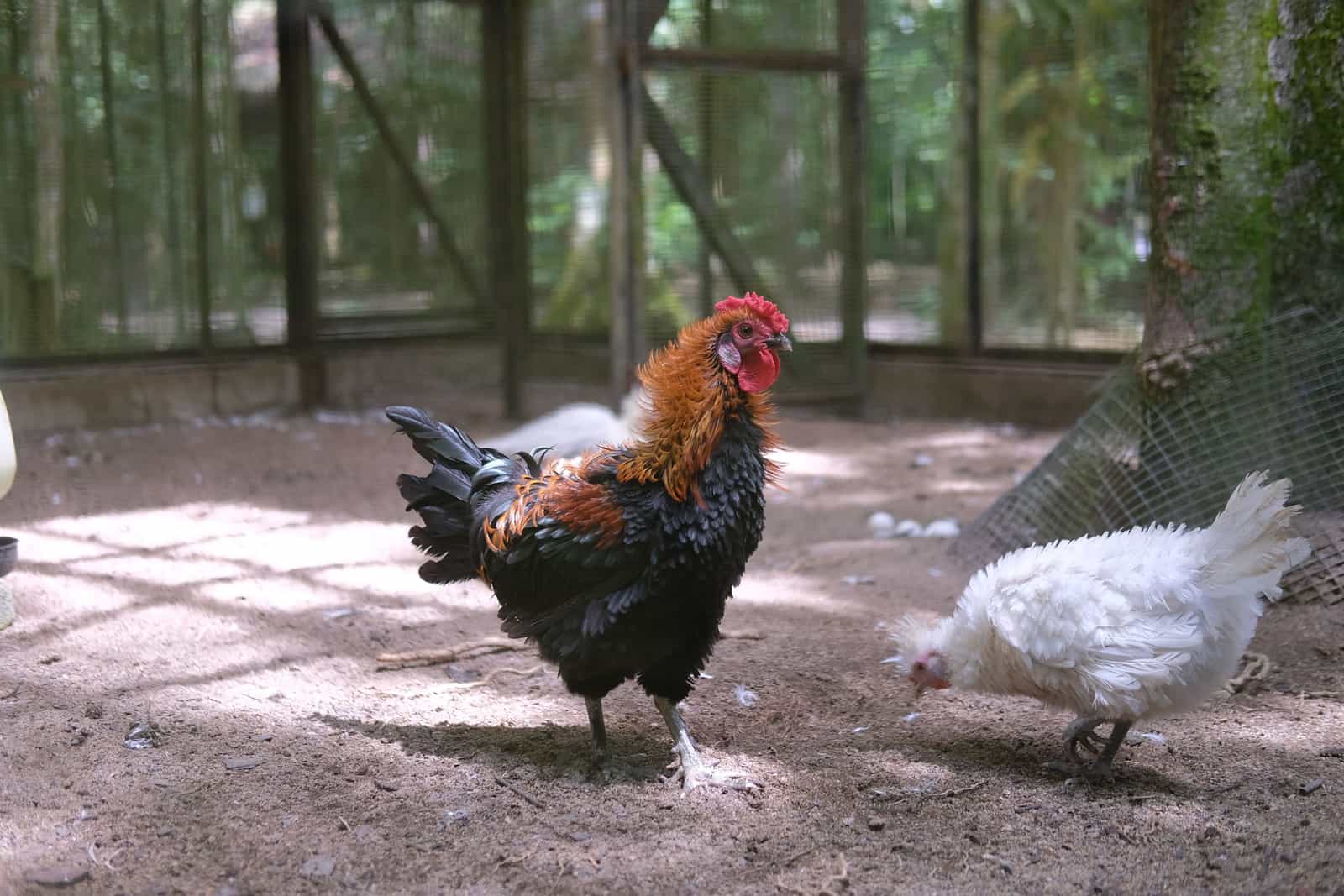
The best chicken coops, ranked by what they actually hold
The flagship roundup. Twelve coops ranked on measured floor area against the maker's own bird-count claim.
Chicken coops for 6 chickens
Six hens need 24 sq ft. Coops sold for six average 13. The ones that genuinely fit, ranked.
What a coop listing means by holds 6 chickens
How listing bird counts are constructed, the four ways they drift, and a thirty-second check that works on any product page.
Predator-proofing, as numbers rather than adjectives
The three specifics that decide whether a coop holds - aperture, gauge and latch - with the products that fix what every kit gets wrong.
Climate, ventilation and the season problem
Why moisture rather than cold decides winter outcomes, what changes in heat, and the coops and gear that suit each climate.