Build or buy a chicken coop
This site spends most of its time showing that coop kits hold fewer birds than they claim. The obvious next question is whether you should just build one, and the honest answer is that it depends on which of three things you are short of.
We have not handled these coops, and we do not pretend to have. Here is what we did instead. Links to Amazon earn us a commission at no extra cost to you - disclosure.
| # | Coop | Best for | Honest count | Price |
|---|---|---|---|---|
| 1 | 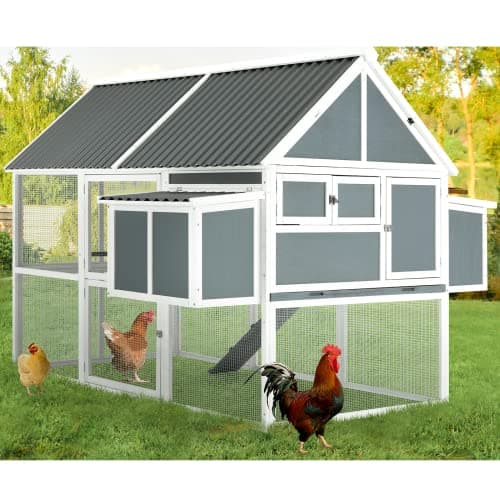 AECOJOY 84" Large Chicken CoopTop pick40.3 sq ft against a claim of ten. The numbers land exactly where the box says they do, which is rarer here than it should be. | Ten hens, claim and arithmetic agreeing | 10box says 10 | |
| 2 | 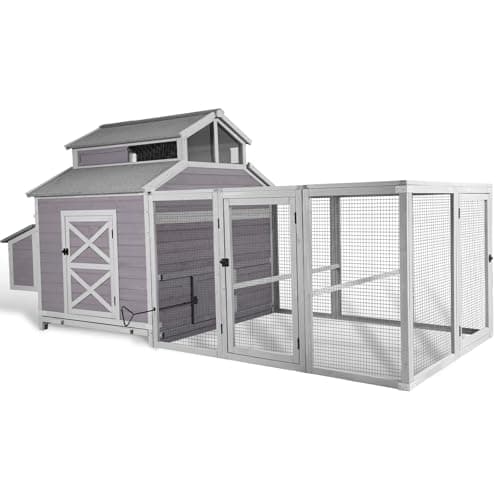 GUTINNEEN 115" Large Hen House with Run43.1 sq ft against a claim of eight to ten - it clears its own number with a small amount to spare. | Ten hens with a little margin | 10box says 10 | |
| 3 | 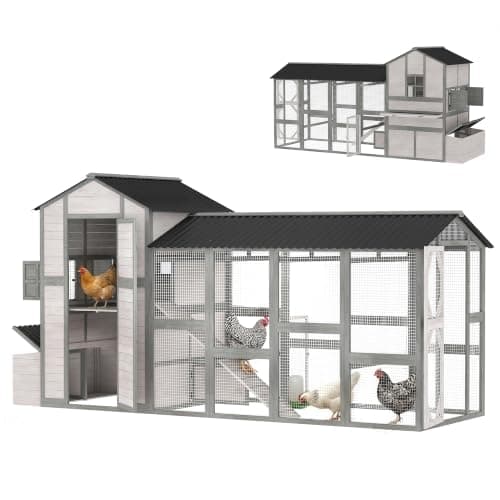 PawHut 147" Extra Large Wooden Hen House51.6 sq ft against a claim of eight to ten hens. It is the only coop on this site with real headroom over its own marketing. | The rare coop that beats its own claim | 12box says 10 | |
| 4 | 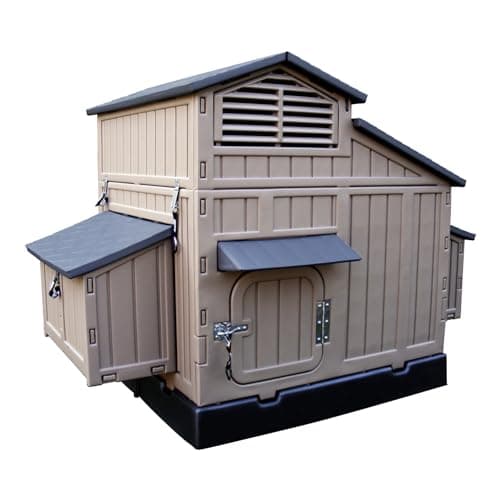 Hatching Time Formex Snap Lock Large Chicken CoopThe one coop here whose material genuinely earns its price, sized for four hens rather than the six on the box. | Cleaning, and cold that stays out | 4box says 6 | |
| 5 | 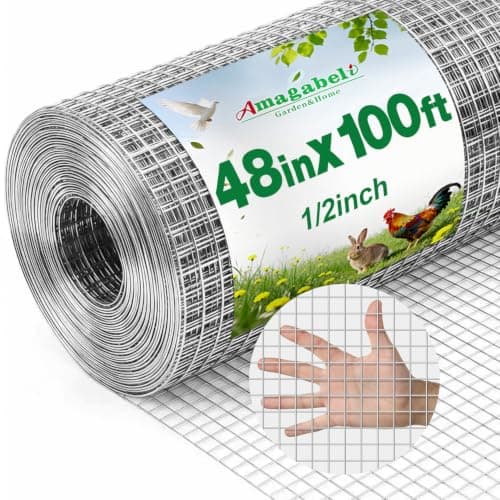 Amagabeli 1/2" Hardware Cloth, 48in x 100ftHalf-inch aperture, 19 gauge, hot-dipped galvanized after welding. This is the specification that actually keeps raccoons out. | The single most important predator purchase | not published |
Almost everything on this site is a version of the same finding: coop listings claim more birds than their own published dimensions support, and they do it consistently rather than occasionally. Read enough of those pages and a reasonable person asks the obvious question. If the kits are all undersized, why buy one at all? There is a third answer besides building and buying, and it is the cheapest of the three if you already have the structure: turning a shed into a chicken coop.
It is a fair question and the answer is not the one the internet usually gives. Most build-or-buy advice frames it as a money question, and money is the least interesting variable here.
The size argument, which is the strong one
This is the reason to build, and it is worth putting the numbers side by side because the gap is larger than people expect.
| Structure | Floor area | Standard hens at 4 sq ft | Source of the figure |
|---|---|---|---|
| Largest wooden kit on this site | 59.5 sq ft whole-unit | 14 | Maker's published dimensions |
| Second largest wooden kit | 51.6 sq ft whole-unit | 12 | Maker's published dimensions |
| LSU AgCenter family-size laying house | 8ft x 12ft = 96 sq ft | 24 | Free published plan |
| LSU AgCenter poultry house | 10ft x 12ft = 120 sq ft | 30 | Free published plan |
And the kit figures are the generous reading. Both are whole-unit footprints that count the open run beneath a raised house as though it were enclosed roosting floor, so the real henhouse is smaller than the number shown. The plan figures are enclosed floor throughout.
So if your flock is heading past about a dozen birds, building stops being a hobby preference and becomes the practical route. Coops for 20 chickens makes the same point from the other direction - almost nothing sold as a coop reaches that flock size, and the answer there is a steel enclosure with a henhouse you provide.
What a kit actually buys you
It is easy to be dismissive about flat-pack coops on a site that spends its time correcting their claims. That would be unfair. A kit buys three things that are genuinely worth money.
- Completeness. A henhouse, a run, nest boxes, a roost, a ramp and a pull-out tray, all designed to fit each other, in one delivery. Sourcing that list yourself is most of the work of a build.
- Speed. An afternoon with a screwdriver against a project measured in weekends.
- A known outcome. It will look like the photograph. A first build frequently does not look like the drawing, and the parts that go wrong are usually the joints that keep weather out.
| Buying a kit | Building | |
|---|---|---|
| Floor area available | Capped - largest here is 59.5 sq ft whole-unit | Whatever you draw |
| Sized to your flock | Rarely - you pick the nearest listing | Exactly, which is the whole point |
| Time to usable coop | An afternoon | Weekends, plural |
| Tools needed | A screwdriver | Saw, drill, square, and somewhere to work |
| Material quality | Untreated fir, mostly | Your choice, including treated lumber |
| Cost of materials | Included | Usually less than a kit of the same size |
| Cost of your time | Almost none | Substantial, and easy to ignore in the sums |
| Repairability | Proprietary panels | You know how it goes together |
| Mesh and latches | Inadequate as supplied on every kit here | Inadequate unless you buy the right ones |
What building actually costs
We do not print prices anywhere on this site, and lumber is exactly the sort of thing that makes that policy look sensible - it moves too much for a typed figure to survive a season. What we can describe is the shape of the cost, which is stable.
- Materials for a build usually come in under a kit of comparable floor area, and the advantage widens as the structure gets bigger. That is the honest headline.
- It narrows sharply if you buy treated lumber, exterior ply and decent hardware rather than the cheapest of each - and those are precisely the choices that make a build outlast a kit.
- Tools are a real cost if you do not own them. A circular saw, a drill and a square are the minimum, and hiring or borrowing changes the arithmetic completely.
- Waste is a cost nobody budgets for. A first build produces offcuts and at least one part you cut twice.
- Your weekends are the largest line item and the one that never appears in a comparison. Price them at anything above zero and the gap closes.
The full picture of what a coop costs beyond its sticker price - security hardware, bedding, and either annual treatment or replacement - is on what a coop really costs. Those costs apply to both routes equally.
Buy if any of these is true
- Your flock is six birds or fewer and you have found a kit whose measured floor area genuinely supports it. Several exist - they are just not the ones with the biggest numbers in the title.
- You do not own the tools, and buying them for one project costs more than the saving.
- You want chickens this month rather than next season.
- You are not certain you will still be keeping chickens in three years. A kit is easier to resell and easier to walk away from.
- You rent, or the coop may need to move. Flat-pack comes apart the way it went together.
Build if any of these is true
- Your flock is heading past about a dozen birds. The format simply runs out, and every workaround is a compromise.
- You have an awkward site - a narrow side return, a slope, an existing wall to build against. A kit is a fixed rectangle and your yard is not.
- You want the coop to outlast a few seasons. Treated lumber and exterior ply are choices a kit does not offer you.
- You care about cleaning access. Building lets you put a full-height door and a droppings board exactly where they save you time every week.
- You already own the tools and enjoy the work, in which case the time cost is not really a cost.
The third option nobody mentions
Buy the henhouse and build the run. It is the best value route in the category and it almost never comes up, because it does not fit either side of the argument.
A henhouse is the fiddly part - weatherproof joints, nest boxes, a pop door, a roof that sheds. A run is a rectangle of framing and mesh, which is the easiest carpentry there is. Buying a well-made small coop and framing a generous run around it gets you the enclosed quality of a kit and the area of a build, and it is why modular steel run panels bolt onto existing kits so readily.
The same logic runs the other way for large flocks: a steel walk-in enclosure with a simple henhouse built inside it is far less work than building the whole thing, and the enclosure will outlast anything you make from fir.
What is identical either way
Building does not exempt you from the three upgrades every coop on this site needs, and it is worth saying plainly because a self-built coop feels more secure than it is.
- Half-inch welded hardware cloth on every opening. Chicken wire is a containment product whichever route built the frame it is stapled to. Hardware cloth against chicken wire.
- A latch needing two distinct motions on every opening, including the nest-box lid. Latches a raccoon cannot open.
- A wire apron at the ground line, 12 inches out and pinned flat. Stopping predators that dig.
- Ventilation high on the walls, above roost height. A home-built coop is if anything easier to get wrong here, because it is tempting to seal a structure you made. Ventilation, not insulation.
- The published per-bird figures. A coop you built to the wrong size is exactly as overcrowded as one you bought to the wrong size - work the numbers out first.
If you buy: the kits whose numbers hold
These are the coops on this site where the maker's own claim survives its own published dimensions, plus the mesh you will need whichever route you take. Full arithmetic on each below.
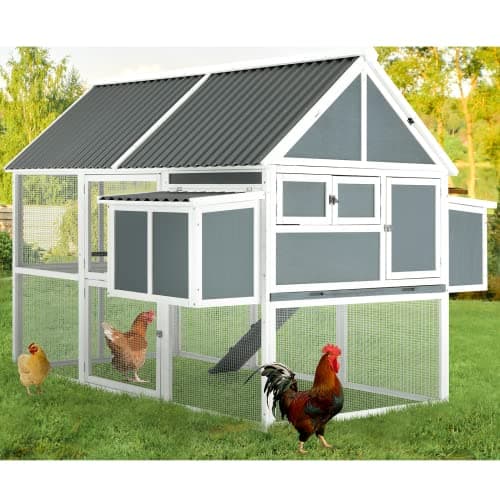
Top pick · Ten hens, claim and arithmetic agreeing
AECOJOY 84" Large Chicken Coop
40.3 sq ft against a claim of ten. The numbers land exactly where the box says they do, which is rarer here than it should be.
What the numbers say
84in x 69in = 40.3 sq ft of whole-unit footprint, which includes the attached run and is therefore generous. At 4 sq ft per standard hen that is 10 birds, against a claim of 10.
Figures from AECOJOY published specifications (Amazon listing) · 84"L x 69"W x 60"H · Wood
84 x 69 inches is 40.3 sq ft, which is exactly ten standard hens at the published 4 sq ft figure. AECOJOY claims eight to ten.
The 69in depth is what makes it work. Most coops in this class buy their length cheaply and stay narrow, which produces a corridor rather than a floor.
It is a square-ish footprint rather than a long thin one, so the usable area is genuinely usable - birds distribute across it instead of queueing down it.
Good
- Claim and arithmetic agree at ten hens
- 69in depth gives a floor rather than a corridor
- Two nesting boxes, which is the right count for ten hens on the published ratio
Not so good
- No margin - ten is the ceiling, not a comfortable number
- Wood construction needs annual attention
- Heavy once assembled and awkward to reposition
Skip this if: you plan to grow past ten birds. It meets its claim exactly, which means it has no room for the two extra chicks you will inevitably bring home.
#ad · how this is funded · price as of October 21, 2026
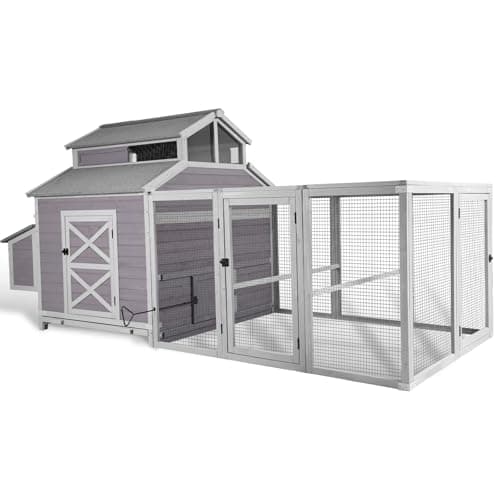
Pick 2 · Ten hens with a little margin
GUTINNEEN 115" Large Hen House with Run
43.1 sq ft against a claim of eight to ten - it clears its own number with a small amount to spare.
What the numbers say
115in x 54in = 43.1 sq ft of whole-unit footprint, which includes the attached run and is therefore generous. At 4 sq ft per standard hen that is 10 birds, against a claim of 10.
Figures from GUTINNEEN published specifications (Amazon listing) · 115"L x 54"W x 56"H · Fir
43.1 sq ft is ten standard hens with roughly three square feet left over. The claim is eight to ten, so the arithmetic supports the top of the range.
The 54in depth is the reason. It is not as generous as the AECOJOY's 69in, but it is well clear of the 22-26in corridors that dominate the cheaper end.
Six nesting boxes for ten hens is more than the one-per-four guidance needs. Extra boxes do not reduce squabbling; they add cleaning.
Good
- Clears its claim rather than exactly meeting it
- 54in depth produces a genuinely usable floor
- Run and house in a single purchase
Not so good
- Six nest boxes is more than ten hens need
- Fir at this size is a lot of surface to re-treat
- Nearly 10ft long - measure the yard first
Skip this if: you want walk-in access. At 56in tall you are still stooping, and for a coop this long that gets old fast.
#ad · how this is funded · price as of October 21, 2026
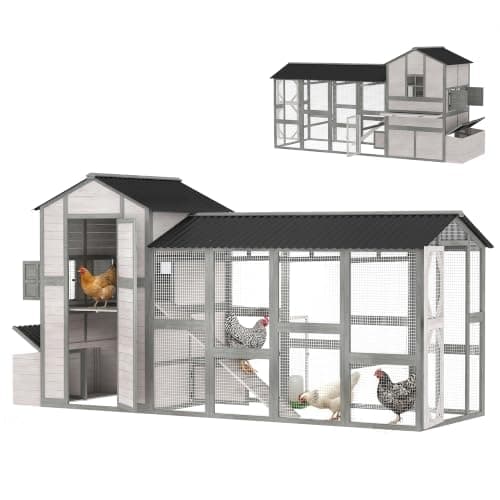
Pick 3 · The rare coop that beats its own claim
PawHut 147" Extra Large Wooden Hen House
51.6 sq ft against a claim of eight to ten hens. It is the only coop on this site with real headroom over its own marketing.
What the numbers say
146.9in x 50.6in = 51.6 sq ft of whole-unit footprint, which includes the attached run and is therefore generous. At 4 sq ft per standard hen that is 12 birds, against a claim of 10.
Figures from PawHut published specifications (Amazon listing) · 146.9"L x 50.6"W x 73.6"H · Fir and plastic
51.6 sq ft of whole-unit footprint supports twelve standard hens at 4 sq ft each. PawHut claims eight to ten. It is the only coop in this research pass that under-claims.
That matters more than it sounds. Every other maker here is asking you to trust a number that its own dimensions contradict; this one leaves you room.
At 73.6in tall it is genuinely walk-in at the run end, which changes daily keeping more than any feature on the spec sheet.
Good
- Beats its own claim - 12 hens of floor against a claim of 10
- Walk-in height at the run end makes cleaning tolerable
- Large enough to be the last coop you buy for a while
Not so good
- 12ft of yard is a real commitment
- Fir and plastic, so expect maintenance
- Assembly is a long afternoon with two people
Skip this if: your yard cannot give up a 12ft run of ground, or if you are keeping three or four hens - you would be heating and cleaning space nobody uses.
#ad · how this is funded · price as of October 21, 2026
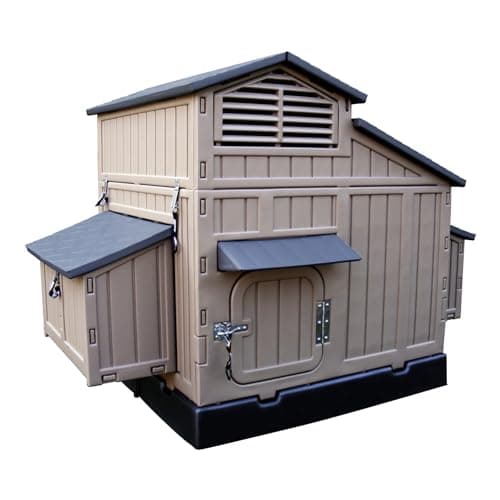
Pick 4 · Cleaning, and cold that stays out
Hatching Time Formex Snap Lock Large Chicken Coop
The one coop here whose material genuinely earns its price, sized for four hens rather than the six on the box.
What the numbers say
64in x 39in = 17.3 sq ft of enclosed henhouse floor. At 4 sq ft per standard hen that is 4 birds, against a claim of 6.
Figures from Hatching Time published specifications (Amazon listing) · 64"L x 39"W x 42"H · Double-walled polyethylene
This is a standalone henhouse with no attached run, so the published footprint is all enclosed floor. That makes it one of the few coops on this site where the generous reading and the honest reading are the same number.
17.3 sq ft supports four standard hens at the 4 sq ft figure. The listing says four to six. Four is right; six is a winter of pecked backs.
Double-walled polyethylene is the reason to buy it. There is no end grain to rot, no seam for mites to colonize, and it hoses out in minutes - the single biggest practical difference between a coop you keep clean and one you avoid.
Good
- Whole footprint is enclosed floor, not run
- Double-walled plastic will not rot, absorb, or harbor mites the way fir does
- Panels unclip for cleaning without tools
Not so good
- Costs more than the wooden coops it outlasts
- No run included, so budget for one
- Plastic walls hold no insulation value on their own
Skip this if: you want a coop and run in one purchase. This is a henhouse only, and pairing it with a run pushes the total past most wooden coop-plus-run kits.
#ad · how this is funded · price as of October 21, 2026
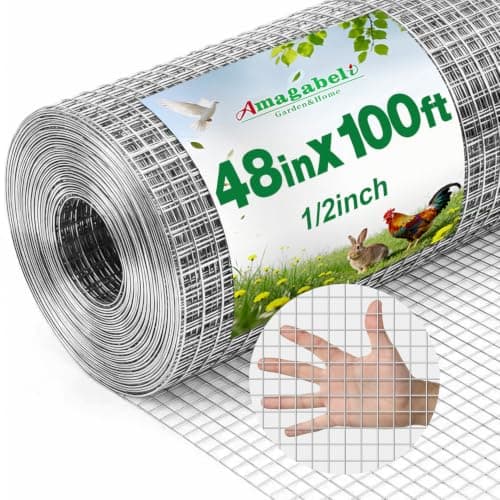
Pick 5 · The single most important predator purchase
Amagabeli 1/2" Hardware Cloth, 48in x 100ft
Half-inch aperture, 19 gauge, hot-dipped galvanized after welding. This is the specification that actually keeps raccoons out.
What the numbers say
The manufacturer does not publish the dimensions this calculation needs, so we do not print a number.
Figures from Amagabeli published specifications (Amazon listing)
Half-inch aperture is the number that matters. A raccoon can reach through 1in mesh and a weasel walks through 1in chicken wire; half-inch stops both.
Galvanized AFTER welding, not before, is the second specification to check. Welding burns the coating off, so mesh galvanized beforehand rusts at every joint - which is exactly where it needs to hold.
19 gauge is the practical minimum for a coop perimeter. Thinner mesh sold as hardware cloth exists and bends open by hand.
Good
- Half-inch aperture excludes raccoons and weasels
- Hot-dipped galvanized after welding, so joints do not rust first
- 48in width covers most run walls in a single run
Not so good
- Cutting it is hard on the hands and on your snips
- 100ft is more than a small coop needs
- Edges are sharp and need capping or folding
Skip this if: only if you already have half-inch hardware cloth. Do not substitute chicken wire - it is a containment material, not a security one.
#ad · how this is funded · price as of October 21, 2026
Measured against the claims
| Coop | Published size | Floor area | Maker says | Arithmetic says |
|---|---|---|---|---|
| AECOJOY 84" Large Chicken Coop | 84"L x 69"W x 60"H | 40.3 sq ft | 10 hens | 10 hens |
| GUTINNEEN 115" Large Hen House with Run | 115"L x 54"W x 56"H | 43.1 sq ft | 10 hens | 10 hens |
| PawHut 147" Extra Large Wooden Hen House | 146.9"L x 50.6"W x 73.6"H | 51.6 sq ft | 10 hens | 12 hens |
| Hatching Time Formex Snap Lock Large Chicken Coop | 64"L x 39"W x 42"H | 17.3 sq ft | 6 hens | 4 hens |
Floor area is the maker’s published footprint. Where a unit includes an attached run that figure spans the run too, which makes it a generous reading - the enclosed roosting floor is smaller still. How we work these out.
Compare the best of those against the 96 square feet of a free published plan and the trade is clear. Buying gets you a finished coop quickly at a fixed ceiling on space. Building removes the ceiling and charges you weekends for it.
Questions people actually ask
+Is it cheaper to build a chicken coop than to buy one?
+Where can I get free chicken coop plans?
+How big can a store-bought chicken coop get?
+Should a beginner build or buy a chicken coop?
+Can I buy a coop and extend it?
+Does a home-built coop still need hardware cloth?
Sources
- eXtension Small and Backyard Poultry - Housing design for small and backyard poultry flocks (links free published plans from LSU AgCenter, University of Wisconsin and University of Kentucky)
- Penn State Extension - Small-scale poultry housing
- University of Minnesota Extension - Raising chickens for eggs (3-5 sq ft indoor space per bird; one nest box per 4-5 birds)
- eXtension Small and Backyard Poultry - Space allowances in housing (3-4 sq ft indoor / 10 sq ft outdoor per laying hen; 5 sq ft indoor per duck; 6 sq ft indoor and 20 sq ft outdoor per turkey; states there is very little peer-reviewed research on backyard space allowances)
Read next
What a coop costs, beyond the listing price
The four costs that follow a coop purchase, and why the cheapest coop is usually the expensive one over a decade.
Chicken coops for 20 chickens
Twenty hens need 80 sq ft. No off-the-shelf coop we measured gets there - here is the honest route.
Metal chicken coops and runs
Steel runs and enclosures ranked on measured area, with the henhouse gap and the base-security fix stated up front.
How much space one chicken needs
The per-bird floor figure by breed class and run access, with worked examples and the coops that actually meet it.
Guides, and the arithmetic behind them
The reference library: sizing arithmetic, ventilation, predator-proofing, bedding, cost and the permits nobody checks first.