How much space one chicken needs
One published figure decides almost everything else about a coop purchase, and almost no listing applies it.
We have not handled these coops, and we do not pretend to have. Here is what we did instead. Links to Amazon earn us a commission at no extra cost to you - disclosure.
| # | Coop | Best for | Honest count | Price |
|---|---|---|---|---|
| 1 | 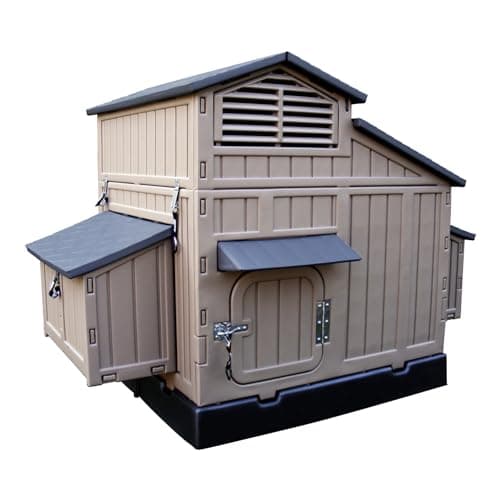 Hatching Time Formex Snap Lock Large Chicken CoopTop pickThe one coop here whose material genuinely earns its price, sized for four hens rather than the six on the box. | Cleaning, and cold that stays out | 4box says 6 | |
| 2 | 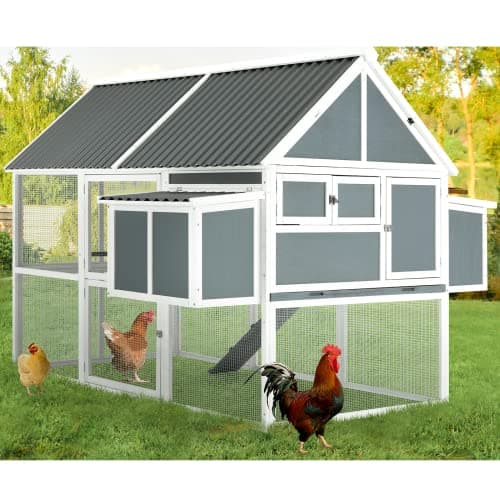 AECOJOY 84" Large Chicken Coop40.3 sq ft against a claim of ten. The numbers land exactly where the box says they do, which is rarer here than it should be. | Ten hens, claim and arithmetic agreeing | 10box says 10 | |
| 3 | 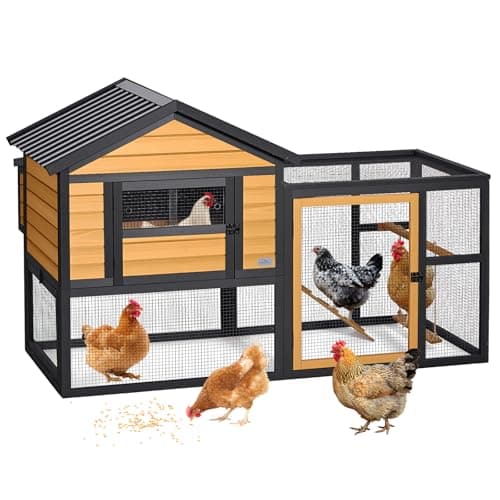 Petsfit Outdoor Coop with Run20.7 sq ft against a claim of six - one bird out, which makes it one of the more honest small coops here. | Five hens, honestly | 5box says 6 | Check price#ad |
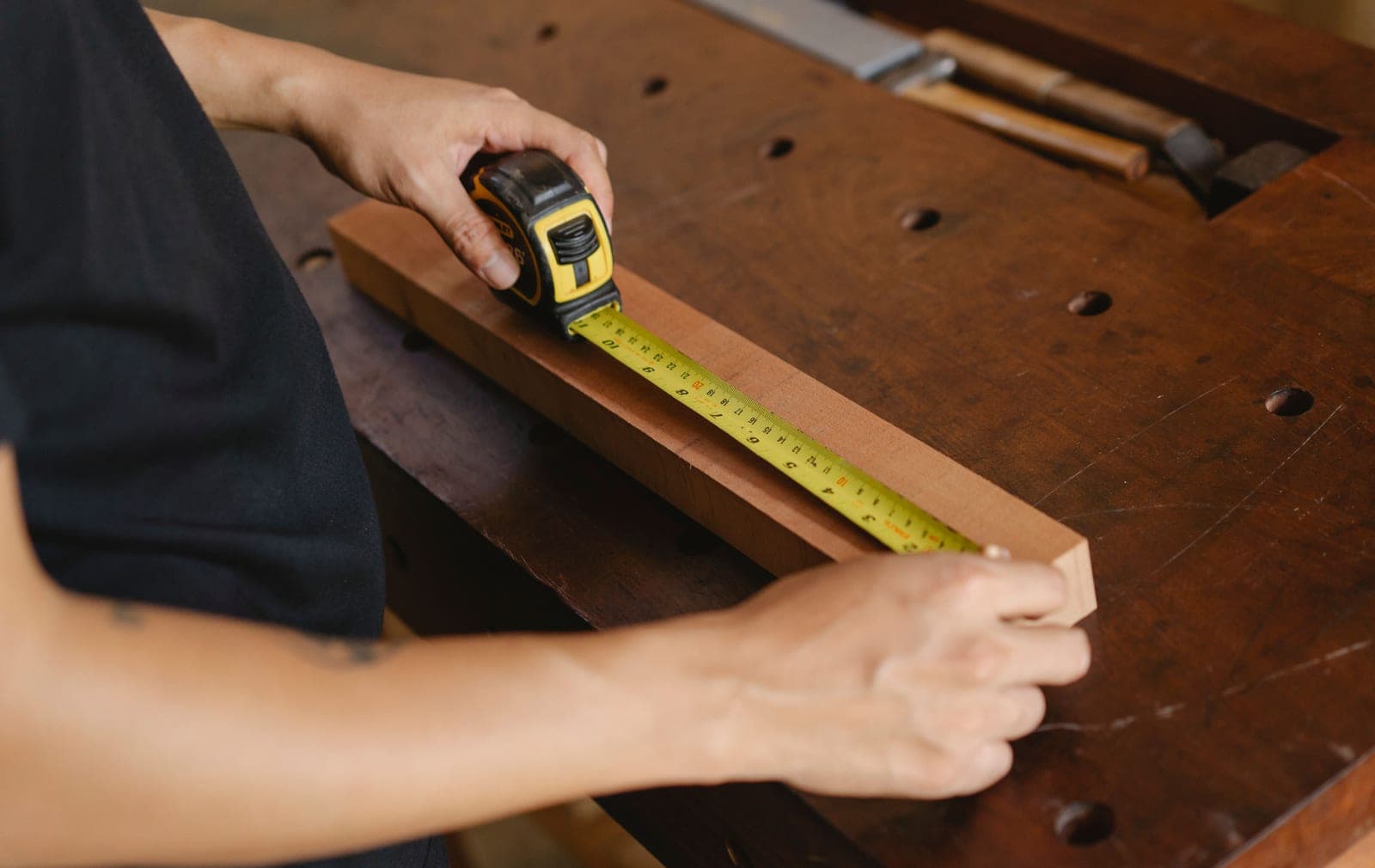
University of Minnesota Extension publishes 3 to 5 square feet of indoor space per bird for backyard flocks. We use 4 - the midpoint - for standard-size hens throughout this site, and it is the number every capacity figure here divides by.
It sounds like a small amount of space until you multiply it. Six hens is 24 square feet of enclosed floor, which is a coop roughly 4 feet by 6. Almost nothing sold online as a six-bird coop is anywhere near that, and that gap is the reason this site exists.
The figure by breed class
| Bird type | Coop floor with run access | Coop floor, no run | Run area | Roost bar |
|---|---|---|---|---|
| Bantam | 2 sq ft | 4 sq ft | 5 sq ft | 6 in |
| Standard laying hen | 4 sq ft | 8 sq ft | 8 sq ft | 8 in |
| Large fowl | 5 sq ft | 10 sq ft | 10 sq ft | 10 in |
Why no-run birds need double
The per-bird indoor figure assumes birds spend daylight hours somewhere else - a run, a fenced yard, open range. Take that away and the coop becomes the entire environment: where they eat, dust bathe, escape each other, and pass twelve hours of daylight. The published guidance moves up accordingly, and in practice the difference between a permanently housed flock at 4 square feet and one at 8 is visible in feather condition within weeks.
What too little space looks like
- Feather-pecking, most often around the vent and the back of the neck. It escalates once blood is drawn.
- Bullying at the feeder, and one or two birds consistently kept away from it.
- Birds sleeping in nest boxes because there is nowhere else, which produces dirty eggs.
- Damp, capped litter that needs changing far more often, and the ammonia that comes with it.
- A drop in laying that is easy to blame on the season, the feed or the birds.
Working out your own numbers
Allow for the birds you will acquire
Most people add birds in the first year. Two or three more is the common pattern - a neighbor rehoming, a straight-run chick that turns out fine, a friend's flock breaking up. Sizing exactly to today's flock is how a coop that fitted in March is crowded by September. Buying one size class up costs less than buying twice - and past about a dozen birds the kits run out entirely, which is where building rather than buying starts to make sense.
Coops whose measurements meet the standard
These three are the coops on this site where the published dimensions and the maker's own bird count are closest to agreeing. Full arithmetic on each below.
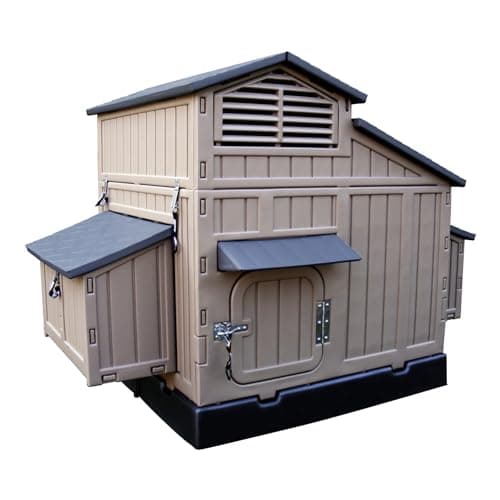
Top pick · Cleaning, and cold that stays out
Hatching Time Formex Snap Lock Large Chicken Coop
The one coop here whose material genuinely earns its price, sized for four hens rather than the six on the box.
What the numbers say
64in x 39in = 17.3 sq ft of enclosed henhouse floor. At 4 sq ft per standard hen that is 4 birds, against a claim of 6.
Figures from Hatching Time published specifications (Amazon listing) · 64"L x 39"W x 42"H · Double-walled polyethylene
This is a standalone henhouse with no attached run, so the published footprint is all enclosed floor. That makes it one of the few coops on this site where the generous reading and the honest reading are the same number.
17.3 sq ft supports four standard hens at the 4 sq ft figure. The listing says four to six. Four is right; six is a winter of pecked backs.
Double-walled polyethylene is the reason to buy it. There is no end grain to rot, no seam for mites to colonize, and it hoses out in minutes - the single biggest practical difference between a coop you keep clean and one you avoid.
Good
- Whole footprint is enclosed floor, not run
- Double-walled plastic will not rot, absorb, or harbor mites the way fir does
- Panels unclip for cleaning without tools
Not so good
- Costs more than the wooden coops it outlasts
- No run included, so budget for one
- Plastic walls hold no insulation value on their own
Skip this if: you want a coop and run in one purchase. This is a henhouse only, and pairing it with a run pushes the total past most wooden coop-plus-run kits.
#ad · how this is funded · price as of October 17, 2026
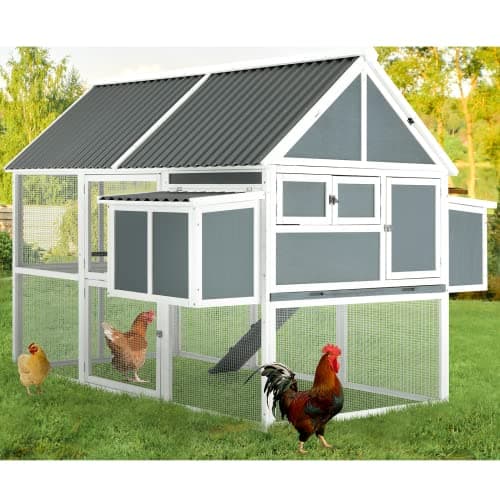
Pick 2 · Ten hens, claim and arithmetic agreeing
AECOJOY 84" Large Chicken Coop
40.3 sq ft against a claim of ten. The numbers land exactly where the box says they do, which is rarer here than it should be.
What the numbers say
84in x 69in = 40.3 sq ft of whole-unit footprint, which includes the attached run and is therefore generous. At 4 sq ft per standard hen that is 10 birds, against a claim of 10.
Figures from AECOJOY published specifications (Amazon listing) · 84"L x 69"W x 60"H · Wood
84 x 69 inches is 40.3 sq ft, which is exactly ten standard hens at the published 4 sq ft figure. AECOJOY claims eight to ten.
The 69in depth is what makes it work. Most coops in this class buy their length cheaply and stay narrow, which produces a corridor rather than a floor.
It is a square-ish footprint rather than a long thin one, so the usable area is genuinely usable - birds distribute across it instead of queueing down it.
Good
- Claim and arithmetic agree at ten hens
- 69in depth gives a floor rather than a corridor
- Two nesting boxes, which is the right count for ten hens on the published ratio
Not so good
- No margin - ten is the ceiling, not a comfortable number
- Wood construction needs annual attention
- Heavy once assembled and awkward to reposition
Skip this if: you plan to grow past ten birds. It meets its claim exactly, which means it has no room for the two extra chicks you will inevitably bring home.
#ad · how this is funded · price as of October 17, 2026
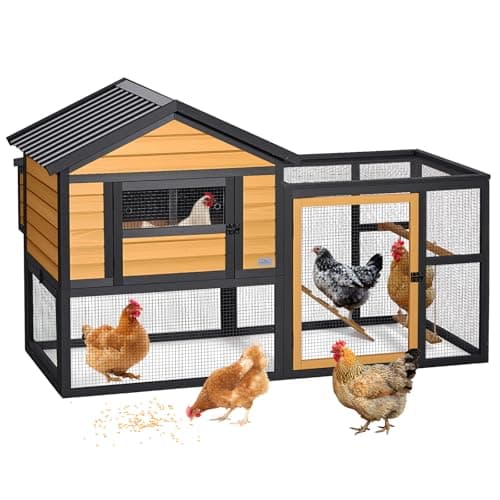
Pick 3 · Five hens, honestly
Petsfit Outdoor Coop with Run
20.7 sq ft against a claim of six - one bird out, which makes it one of the more honest small coops here.
What the numbers say
71in x 42in = 20.7 sq ft of whole-unit footprint, which includes the attached run and is therefore generous. At 4 sq ft per standard hen that is 5 birds, against a claim of 6.
Figures from Petsfit published specifications (Amazon listing) · 71"L x 42"W x 45"H · Fir
20.7 sq ft supports five standard hens. Petsfit claims four to six, so the arithmetic sits inside its stated range rather than outside it.
The 42in depth is why. Among the small coops on this site, depth is almost perfectly predictive of whether the claim survives contact with a tape measure.
Three nesting boxes for five hens is more than the one-per-four guidance requires, but not wastefully so.
Good
- Arithmetic lands inside the claimed range
- 42in depth is generous for this size class
- Predator-resistant hardware noted in the listing specification
Not so good
- Six is one bird past the floor
- Fir needs seasonal re-treating
- 45in height means stooping to clean
Skip this if: you are set on six birds. Five is what it holds, and the sixth is the one that gets pecked.
| Coop | Published size | Floor area | Maker says | Arithmetic says |
|---|---|---|---|---|
| Hatching Time Formex Snap Lock Large Chicken Coop | 64"L x 39"W x 42"H | 17.3 sq ft | 6 hens | 4 hens |
| AECOJOY 84" Large Chicken Coop | 84"L x 69"W x 60"H | 40.3 sq ft | 10 hens | 10 hens |
| Petsfit Outdoor Coop with Run | 71"L x 42"W x 45"H | 20.7 sq ft | 6 hens | 5 hens |
Floor area is the maker’s published footprint. Where a unit includes an attached run that figure spans the run too, which makes it a generous reading - the enclosed roosting floor is smaller still. How we work these out.
Questions people actually ask
+How much space do 6 chickens need in a coop?
+How much space do chickens need if they free-range?
+Is 2 square feet per chicken enough?
+Does coop height matter for chickens?
+How much run space does a chicken need?
Sources
Read next
What a coop listing means by holds 6 chickens
How listing bird counts are constructed, the four ways they drift, and a thirty-second check that works on any product page.
Chicken coops, sized by the tape measure
The main hub: flock-size roundups from four hens to twenty, each with the capacity arithmetic shown.
Chicken coops for 6 chickens
Six hens need 24 sq ft. Coops sold for six average 13. The ones that genuinely fit, ranked.
Guides, and the arithmetic behind them
The reference library: sizing arithmetic, ventilation, predator-proofing, bedding, cost and the permits nobody checks first.
Roost bar length, height and shape
Per-bird bar length by breed, the flat-versus-round question, mounting height, and how to add bar without carpentry.
Coop vs run
What a coop does, what a run does, why the space requirements add rather than overlap, and what to buy when you already have one of the two.