Chicken coops for silkies and bantams
A silkie is not a small chicken with the same needs. It cannot fly, its feathers are not waterproof, and the roost height that suits a Rhode Island Red puts a silkie on the floor.
We have not handled these coops, and we do not pretend to have. Here is what we did instead. Links to Amazon earn us a commission at no extra cost to you - disclosure.
| # | Coop | Best for | Honest count | Price |
|---|---|---|---|---|
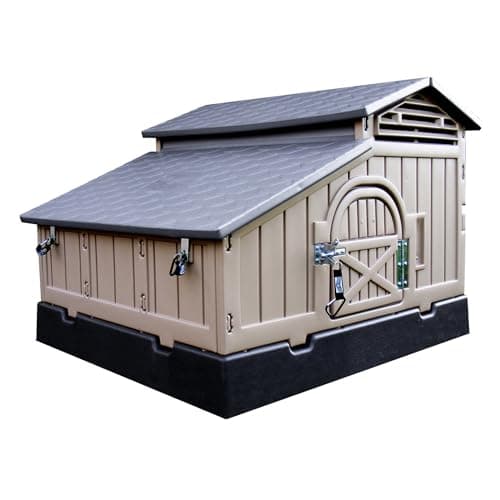
| 1 | 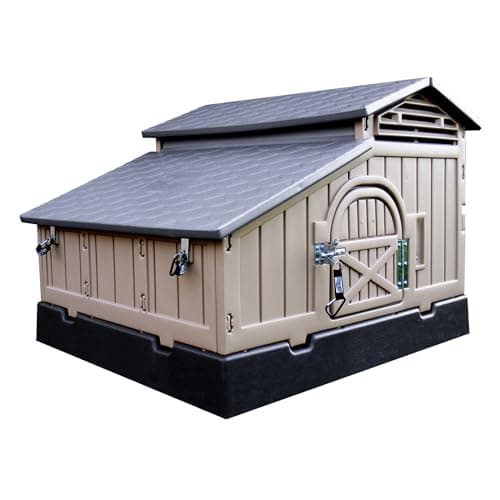 Hatching Time SnapLock Formex Standard CoopTop pickSame material logic as its bigger sibling, but the claim of four hens is the most overstated on this page relative to its size. | Two hens, or a bantam trio | 2box says 4 | |
| 2 | 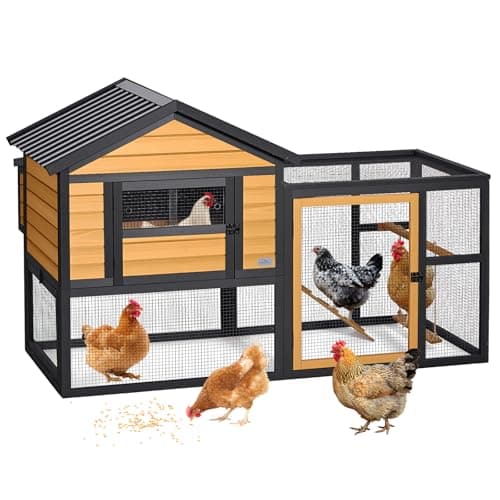 Petsfit Outdoor Coop with Run20.7 sq ft against a claim of six - one bird out, which makes it one of the more honest small coops here. | Five hens, honestly | 5box says 6 | Check price#ad |
| 3 | 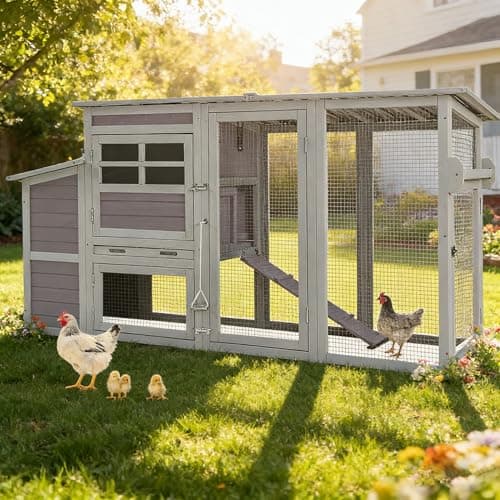 Aivituvin AIR31 Wooden Hen HouseWell made for the money and unusually honest by omission - Aivituvin publishes no bird count here at all. | A tidy two-hen setup in a small yard | 3no claim made | |
| 4 | 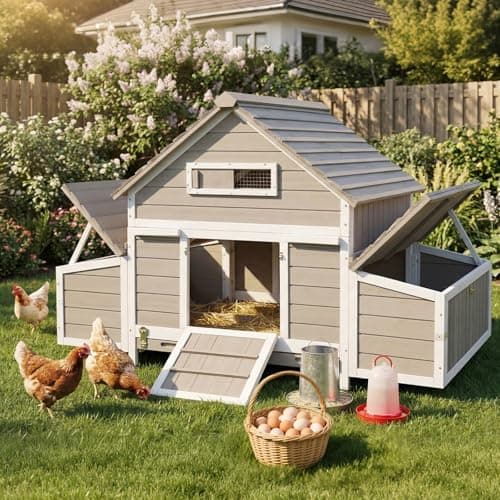 Magazoopet Wooden Hen House with 6 Nesting Boxes14.2 sq ft against a claim of six. Same pattern as the AECOJOY: real floor for three, nest boxes for a flock twice the size. | Three hens in a compact footprint | 3box says 6 | |
| 5 | 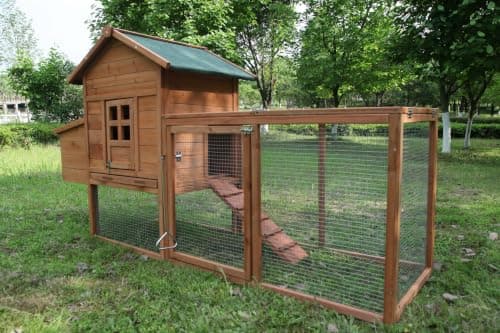 GOJOOASIS 80" Wooden Hen House14.4 sq ft against a claim of four, so three hens - a small, honest-ish coop for a first flock. | A first coop for three hens | 3box says 4 | |
| 6 | 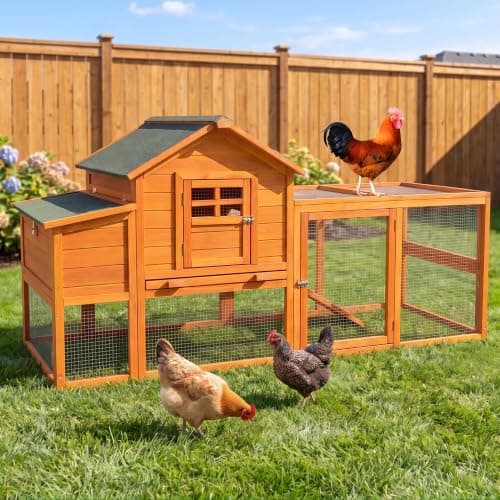 RUNSHED 76" Wooden Coop with Run11.9 sq ft against a claim of six. The smallest floor on this page carrying one of the largest claims. | Two hens and a tight budget | 2box says 6 |
Every other page on this site sizes coops for standard-size laying hens at 4 square feet a bird. Silkies break that model in both directions at once. They need less floor, because they are bantams. And they need a completely different coop, because almost nothing about how they use one matches a standard hen.
The result is that a coop which is genuinely good for six Rhode Island Reds can be a poor coop for six silkies, and the reason has nothing to do with square feet. It is the height of the roost bar.
What is actually published for bantams
This is one of the few places in backyard poultry where a bantam-specific number exists in print. Penn State Extension publishes a separate row for bantam chickens in its minimum space table, and separate perch guidance too.
| Measure | Bantam chickens | Large chickens | Laying hens |
|---|---|---|---|
| Coop floor per bird | 1 sq ft | 2 sq ft | 1.5 sq ft |
| Outdoor run per bird | 4 sq ft | 10 sq ft | 8 sq ft |
| Roost bar per bird | 4 in | 6 in | 6 in |
| Roost height above floor | 12-18 in | 18-24 in | 18-24 in |
| Feeder and water space | 1 linear in | 3-4 linear in | 3-4 linear in |
Why a silkie is not just a small chicken
Four breed traits change what you should buy, and only one of them is about size.
- They cannot fly. Silkie feathers lack the functioning barbicels that hook a normal feather together, so the plumage is closer to down than to a flight feather. That is the trait everyone buys them for, and it is also why a bird that wants to roost cannot reach a bar at standard height.
- The crest sits over the eyes. A well-crested silkie has restricted upward and forward vision. A ramp it can walk is worth far more than a pop door it has to judge a hop into.
- The plumage is not waterproof. Down-like feathers hold water rather than shedding it, so a silkie that gets soaked stays soaked. Dryness stops being a nice-to-have and becomes the main thing the coop is for.
- They go broody constantly. Silkie hens are used across the hobby to hatch other birds' eggs. A broody hen occupies a nest box for weeks, so box count and box access matter more than the flock size alone would suggest.
Roost height is the decision
Penn State puts bantam roosts at 12 to 18 inches off the floor, against 18 to 24 for standard birds. For most bantams that is a comfort figure. For silkies it is a hard ceiling, because a bird that cannot fly cannot flap up to a bar and cannot control a drop down from one.
What that means when you are looking at a listing: the coop's own roost bars are frequently too high, and almost as frequently the only thing you can do about it is replace them. It is a five-minute job with a length of timber, and it is worth checking whether the coop's interior even allows a bar to be mounted low, because a raised henhouse over a run often does not.
- Mount the bar 12 to 18 inches up, flat side upward, at least 2 inches wide - the same shape rule as any other chicken. Roost bar length, height and shape has the detail.
- Allow bar generously. Penn State's minimum is 4 inches a bantam; we use 6, the same margin we apply to floor area. Six silkies want 36 inches of bar, which is still less than most coops in this size class supply.
- Add a ramp to anything raised, with cleats. A silkie will use a ramp it can walk and will simply sleep on the floor rather than attempt a jump.
- Keep nest boxes below the roost, as always, or the flock sleeps in them - and a broody silkie in a nest box is hard enough to move without the whole flock joining her.
Dry beats warm, and it is not close
This site argues everywhere that moisture rather than temperature is what hurts chickens in winter. For silkies the argument is stronger still, because the plumage that makes them silkies is the plumage that holds water.
That pushes the material question in one direction. A coop that can be hosed out and dried, with no end grain to soak and no seams to hold damp, is doing the single most useful thing a silkie coop can do. It also pushes hard against a raised coop with an open mesh floor over a run, which is a design that works well for standard birds and leaves a ground-dwelling bantam standing on wet wire.
Ventilation still applies unchanged - high on the walls, above roost height, never blowing across the birds. Ventilation, not insulation is the whole of it, and nothing about a bantam changes that rule.
What we looked for
- A published footprint that supports the flock at 2 square feet a bantam - double the published minimum.
- An interior that allows a roost bar at 12 to 18 inches, rather than one fixed higher.
- A ramp, or somewhere a ramp can be added, on anything raised off the ground.
- A floor and litter that can be kept genuinely dry, and a material that does not soak.
- Enough nest box for a flock in which one hen is usually broody.
- The same three security upgrades every coop on this site needs, because a bantam is an easier target than a standard hen, not a harder one.
The ranked picks
Top pick · Two hens, or a bantam trio
Hatching Time SnapLock Formex Standard Coop
Same material logic as its bigger sibling, but the claim of four hens is the most overstated on this page relative to its size.
What the numbers say
39in x 42in = 11.4 sq ft of enclosed henhouse floor. At 4 sq ft per standard hen that is 2 birds, against a claim of 4.
Figures from Hatching Time published specifications (Amazon listing) · 39"L x 42"W x 29"H · Lightweight double-walled polyethylene
11.4 sq ft of enclosed floor is two standard hens. The listing says four.
For bantams, where the published guidance is nearer 2 sq ft a bird, four is defensible. For standard-size layers it is not, and the listing does not draw that distinction.
The material is the same double-walled polyethylene that makes the larger Snap Lock worth owning. The problem here is arithmetic, not build quality.
Good
- Genuinely easy to clean and impossible to rot
- Small enough for a courtyard or a side return
- Honest fit for a bantam trio
Not so good
- Two standard hens, not the four claimed
- Low roof height limits where you can put roost bars
- Run sold separately
Skip this if: you keep standard-size layers and want more than two. Buy the larger Snap Lock instead - the price step is smaller than the space step.
#ad · how this is funded · price as of October 17, 2026
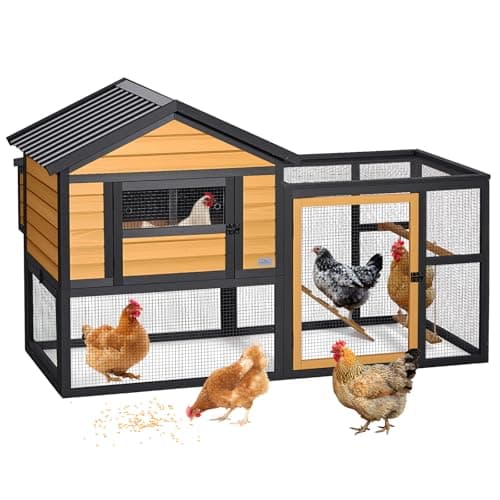
Pick 2 · Five hens, honestly
Petsfit Outdoor Coop with Run
20.7 sq ft against a claim of six - one bird out, which makes it one of the more honest small coops here.
What the numbers say
71in x 42in = 20.7 sq ft of whole-unit footprint, which includes the attached run and is therefore generous. At 4 sq ft per standard hen that is 5 birds, against a claim of 6.
Figures from Petsfit published specifications (Amazon listing) · 71"L x 42"W x 45"H · Fir
20.7 sq ft supports five standard hens. Petsfit claims four to six, so the arithmetic sits inside its stated range rather than outside it.
The 42in depth is why. Among the small coops on this site, depth is almost perfectly predictive of whether the claim survives contact with a tape measure.
Three nesting boxes for five hens is more than the one-per-four guidance requires, but not wastefully so.
Good
- Arithmetic lands inside the claimed range
- 42in depth is generous for this size class
- Predator-resistant hardware noted in the listing specification
Not so good
- Six is one bird past the floor
- Fir needs seasonal re-treating
- 45in height means stooping to clean
Skip this if: you are set on six birds. Five is what it holds, and the sixth is the one that gets pecked.
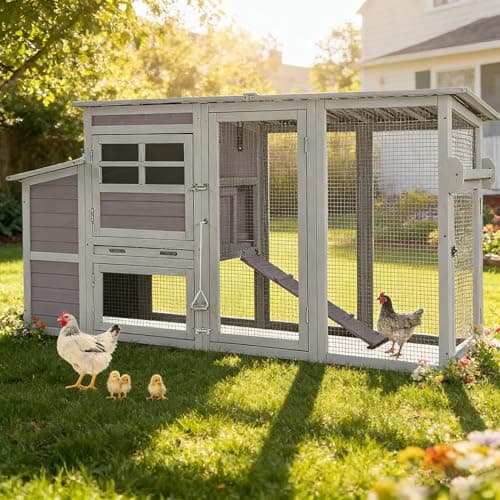
Pick 3 · A tidy two-hen setup in a small yard
Aivituvin AIR31 Wooden Hen House
Well made for the money and unusually honest by omission - Aivituvin publishes no bird count here at all.
What the numbers say
74.9in x 26in = 13.5 sq ft of whole-unit footprint, which includes the attached run and is therefore generous. At 4 sq ft per standard hen that is 3 birds. The maker publishes no bird count of its own to compare against.
Figures from Aivituvin published specifications (Amazon listing) · 74.9"L x 26"W x 39.4"H · Fir
13.5 sq ft across the whole unit, and that figure includes the open run beneath the raised house. The enclosed portion is a fraction of it.
Aivituvin does not claim a bird count for this model. That is worth noting in a category where almost every competitor prints one it cannot support - there is nothing here to correct.
Treat it as a two-hen coop and it is a good one. The pull-out tray and the ramp are better executed than on most fir coops at this size.
Good
- No inflated bird-count claim to correct
- Pull-out tray makes weekly cleaning quick
- Fir construction is solid for the price
Not so good
- Narrow 26in depth limits usable roost space
- Whole-unit footprint counts the run, not just the house
- Fir needs re-treating every couple of seasons
Skip this if: you have three or more standard hens. The depth is the constraint, and no amount of length fixes a 26in-wide house.
#ad · how this is funded · price as of October 17, 2026
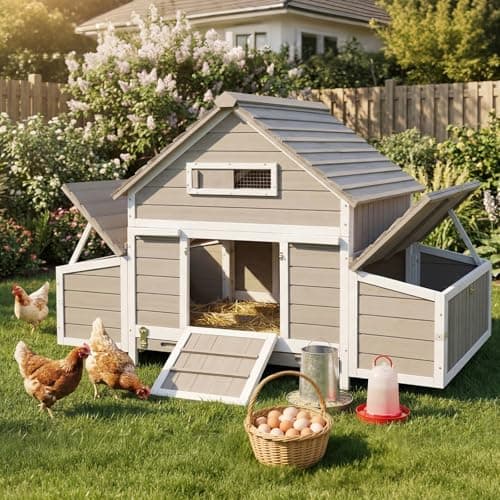
Pick 4 · Three hens in a compact footprint
Magazoopet Wooden Hen House with 6 Nesting Boxes
14.2 sq ft against a claim of six. Same pattern as the AECOJOY: real floor for three, nest boxes for a flock twice the size.
What the numbers say
61in x 33.5in = 14.2 sq ft of whole-unit footprint, which includes the attached run and is therefore generous. At 4 sq ft per standard hen that is 3 birds, against a claim of 6.
Figures from Magazoopet published specifications (Amazon listing) · 61"L x 33.5"W x 40.2"H · Fir
14.2 sq ft supports three standard hens. The claim is four to six.
33.5in of depth is respectable; 61in of length is simply not much coop. The two together produce a footprint that is honest for three birds and marketed for six.
The pull-out tray is the practical high point and the reason to prefer it over similarly sized coops without one.
Good
- Pull-out tray makes cleaning genuinely quick
- Sensible depth for the footprint
- Compact enough for a small yard
Not so good
- Six is double the honest count
- Six nest boxes for three hens of floor
- Fir at this price point will need re-treating
Skip this if: you keep more than three standard hens, or step up to something with a 50in-plus depth.
#ad · how this is funded · price as of October 17, 2026
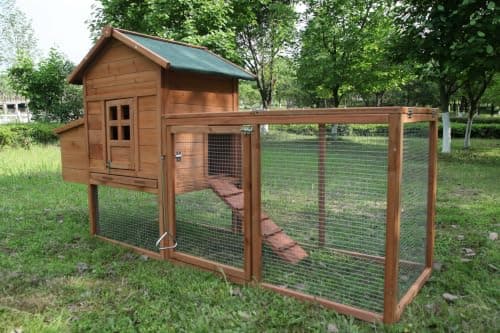
Pick 5 · A first coop for three hens
GOJOOASIS 80" Wooden Hen House
14.4 sq ft against a claim of four, so three hens - a small, honest-ish coop for a first flock.
What the numbers say
80in x 26in = 14.4 sq ft of whole-unit footprint, which includes the attached run and is therefore generous. At 4 sq ft per standard hen that is 3 birds, against a claim of 4.
Figures from GOJOOASIS published specifications (Amazon listing) · 80"L x 26"W x 44"H · Wood
14.4 sq ft supports three standard hens. The claim is two to four, so the arithmetic sits inside the range.
Makers that claim a range starting at two are generally more trustworthy than ones that print a single confident number, and this listing is an example.
The 26in depth is the constraint, as it is on every narrow coop here. Length past about 70in stops adding useful floor once the depth is this tight.
Good
- Claimed range brackets the honest number
- Small enough for a suburban yard
- Simple build with few failure points
Not so good
- 26in depth limits roost arrangement
- Four is one bird past the floor
- No wheels, so the ground beneath will bare off
Skip this if: you are already thinking about a fourth or fifth hen. Flocks grow, and this one has no margin at all.
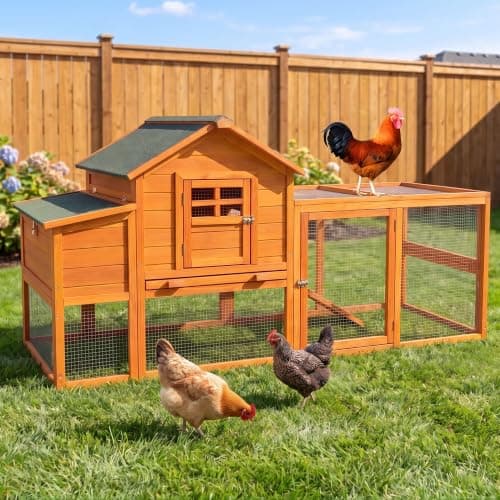
Pick 6 · Two hens and a tight budget
RUNSHED 76" Wooden Coop with Run
11.9 sq ft against a claim of six. The smallest floor on this page carrying one of the largest claims.
What the numbers say
76in x 22.5in = 11.9 sq ft of whole-unit footprint, which includes the attached run and is therefore generous. At 4 sq ft per standard hen that is 2 birds, against a claim of 6.
Figures from RUNSHED published specifications (Amazon listing) · 76"L x 22.5"W x 38.6"H · Fir with asphalt roof
11.9 sq ft supports two standard hens. The listing claims four to six.
At 22.5 inches this is the narrowest unit in the research pass, and the 76in length cannot compensate. Floor area is length times depth, and depth is doing none of the work here.
As a two-hen coop with a run attached, at this price, it is defensible. As the six-hen coop it is sold as, it is not.
Good
- Cheap way into a coop-plus-run in one purchase
- Asphalt roof and wire lock are sensible inclusions
- Light enough for one person to reposition
Not so good
- Six is three times the honest count
- 22.5in depth is the narrowest here
- Fir this thin will need re-treating quickly
Skip this if: you have more than two hens. This is the clearest example on the site of length being sold as capacity.
The same coops read as bantam coops
The table below is this page's own arithmetic. It takes each pick's published footprint and divides it by 2 square feet rather than 4, then applies this site's bantam figures for run area and roost bar - all three of which sit above Penn State's published minimums. The standard-hen table further down is the site-wide one, printed unchanged so the two can be compared.
| Coop | Published floor | Bantams at 2 sq ft | Run needed | Roost bar needed |
|---|---|---|---|---|
| Formex Snap Lock Standard | 11.4 sq ft | 5 | 25 sq ft | 30 in |
| Petsfit Coop with Run | 20.7 sq ft | 10 | 50 sq ft | 60 in |
| Aivituvin AIR31 | 13.5 sq ft | 6 | 30 sq ft | 36 in |
| Magazoopet Hen House | 14.2 sq ft | 7 | 35 sq ft | 42 in |
| GOJOOASIS 80in | 14.4 sq ft | 7 | 35 sq ft | 42 in |
| RUNSHED 76in | 11.9 sq ft | 5 | 25 sq ft | 30 in |
Two cautions on reading that table. Where a published figure covers a whole unit including an attached run, the enclosed henhouse is smaller than the number shown - so treat those rows as a generous upper bound, exactly as we do everywhere else. And a bantam count is not permission to crowd: the run figure matters more for silkies than for most birds, because a flightless ground-dweller uses horizontal space and cannot escape a bully upward.
The standard-hen figures, unchanged
| Coop | Published size | Floor area | Maker says | Arithmetic says |
|---|---|---|---|---|
| Hatching Time SnapLock Formex Standard Coop | 39"L x 42"W x 29"H | 11.4 sq ft | 4 hens | 2 hens |
| Petsfit Outdoor Coop with Run | 71"L x 42"W x 45"H | 20.7 sq ft | 6 hens | 5 hens |
| Aivituvin AIR31 Wooden Hen House | 74.9"L x 26"W x 39.4"H | 13.5 sq ft | no claim | 3 hens |
| Magazoopet Wooden Hen House with 6 Nesting Boxes | 61"L x 33.5"W x 40.2"H | 14.2 sq ft | 6 hens | 3 hens |
| GOJOOASIS 80" Wooden Hen House | 80"L x 26"W x 44"H | 14.4 sq ft | 4 hens | 3 hens |
| RUNSHED 76" Wooden Coop with Run | 76"L x 22.5"W x 38.6"H | 11.9 sq ft | 6 hens | 2 hens |
Floor area is the maker’s published footprint. Where a unit includes an attached run that figure spans the run too, which makes it a generous reading - the enclosed roosting floor is smaller still. How we work these out.
What to ignore
- Any coop listed as a silkie or bantam coop at a premium. Nothing in the construction differs; the label is a search term, not a specification.
- Nest box counts. Coops in this size class routinely ship six boxes with floor area for three standard birds, and the boxes come out of the same footprint. One per four hens is the guidance.
- Any claim that a coop is predator-proof. It is not a specification, and a small coop full of small birds needs the same half-inch hardware cloth, two-motion latches and ground apron as anything else.
- Heaters. A dry, draft-free, well-ventilated coop does more for a silkie than heat does, and a heated coop that loses power leaves unacclimated birds worse off. Coop heaters has the full argument.
Setting one up
- Replace the supplied mesh with half-inch hardware cloth before the birds go in, while the panels are still apart.
- Fit or lower a flat roost bar to 12-18 inches, allowing 4 inches per bird.
- Add a cleated ramp to any raised section, at the shallowest angle the space allows.
- Bed deep and keep it dry. Damp litter is worse for a silkie than for any standard breed on this site.
- Site the coop where it drains and where the run gets afternoon shade - where to put a coop covers the order these matter in.
- Plan for a broody hen occupying a box for weeks at a time, and for the rest of the flock still needing somewhere to lay.
- Check the trigger weight before buying a treadle feeder - a silkie may not weigh enough to open one. Feeders names the two that publish or adjust it, and the RentACoop feeder is the one whose threshold you can actually change.
Questions people actually ask
+How much space does a silkie chicken need in a coop?
+Can silkies use a normal chicken roost?
+Do silkies need a special coop?
+Why do silkies need to stay dry?
+How many nesting boxes do silkies need?
+Can silkies live with standard-size chickens?
Sources
- Penn State Extension - Small-scale poultry housing
- eXtension Small and Backyard Poultry - Space allowances in housing (3-4 sq ft indoor / 10 sq ft outdoor per laying hen; 5 sq ft indoor per duck; 6 sq ft indoor and 20 sq ft outdoor per turkey; states there is very little peer-reviewed research on backyard space allowances)
- University of Minnesota Extension - Raising chickens for eggs (3-5 sq ft indoor space per bird; one nest box per 4-5 birds)
- Silkie (chicken breed) - general breed reference for the feather structure that leaves the birds unable to fly
Read next
Chicken coops for 4 chickens
Four hens need 16 sq ft. The coops whose published dimensions genuinely reach it, ranked.
How much space one chicken needs
The per-bird floor figure by breed class and run access, with worked examples and the coops that actually meet it.
Roost bar length, height and shape
Per-bird bar length by breed, the flat-versus-round question, mounting height, and how to add bar without carpentry.
Aivituvin AIR31 against the Formex Snap Lock
Wood against plastic at the small end. One claims nothing, one over-claims - and both hold fewer birds than you think.
Chicken coops, sized by the tape measure
The main hub: flock-size roundups from four hens to twenty, each with the capacity arithmetic shown.
Chicken feeders, ranked on waste and rodents
Treadle, port and DIY feeders measured against the published 3 inches of feeder space per bird and 0.25 lb of feed per hen per day.