RentACoop Automatic Treadle Chicken Feeder, 25 lb
Every treadle feeder has a weight a bird must exceed to open it, and almost none of them publish it. This is the one that lets you change it.
We have not handled these coops, and we do not pretend to have. Here is what we did instead. Links to Amazon earn us a commission at no extra cost to you - disclosure.
| # | Coop | Best for | Honest count | Price |
|---|---|---|---|---|
| 1 | 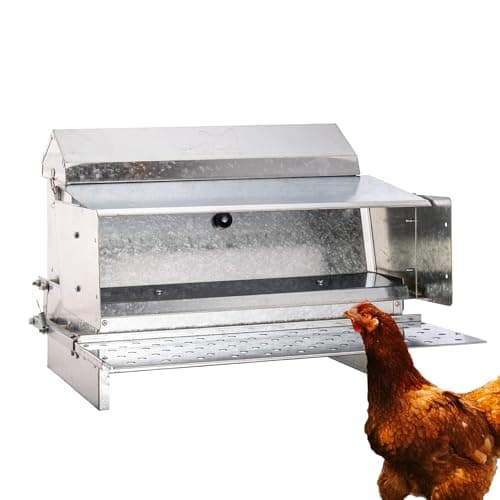 RentACoop Automatic Treadle Chicken Feeder, 25 lbTop pickA 25 pound treadle with a detachable step weight, so lighter birds can trigger it - the fix for the one thing treadle feeders reliably get wrong. | A treadle a bantam can actually open | not published |
Treadle feeders solve the two expensive problems in a coop at once: they close the feed off overnight so rodents get nothing, and they stop birds raking grain onto the floor. They also have one failure mode that nobody warns you about until it happens.
A treadle is a mechanism with a threshold. A bird has to weigh enough to depress the step, and if it does not, it stands next to the feeder and does not eat. This feeder is the one that treats that as a specification rather than an accident.
The detachable step weight
The listing states a detachable step weight that lets smaller, lighter birds - it names silkies and bantams specifically - trigger the treadle. Take the weight off and the threshold drops.
That matters more than it sounds in a mixed flock. Pecking order already decides who eats first; a feeder with a threshold your smallest birds cannot clear turns a social hierarchy into a nutritional one, and the birds at the bottom are the ones already getting least.
It also matters with pullets. Birds coming into lay are lighter than they will be at maturity, and a feeder set for full-grown hens is a feeder young birds cannot use during exactly the weeks they need to be eating well.
Capacity, against the published feed figure
Two honest caveats on that. Birds eat more in cold weather and less in heat, so treat sixteen days as an average rather than a schedule. And anything billed out of the trough comes off the total - which is what the grate is there to prevent.
What else the listing publishes
- The step locks shut overnight, which turns a feed-on-demand feeder into a closed container at exactly the hours rodents work. Rats in the chicken coop covers why feed denial does most of the work.
- A grate in the trough to stop billing out - birds raking feed sideways onto the ground, which is where most feed waste actually goes.
- An adjustable internal feed-flow plate, which limits how much feed sits exposed at once. That is the mechanical version of Penn State's advice to fill a trough only a third to a half full.
- Galvanized metal body with stainless-steel hardware, and a removable rain hood.
- Safety blinders that guide front-only feeding, and an anti-roost lid - both in the box rather than sold separately.
The anti-roost lid is not decoration. Anything flat at bird height in a coop becomes a perch, and a perch over a feeder means droppings in the feed.
The footprint problem
At 21 inches by 18.5 this is the largest feeder measured on this site, and it sits on the floor. That is a real cost in a coop where floor area is the thing this site spends most of its time telling people not to give away.
Put it in the run rather than the henhouse if you have a covered run - the rain hood exists for exactly that. In a small coop, the feeders roundup has narrower options, including a 12 pound treadle at 6.5 inches wide.
The training period
- Prop the lid open for the first several days so the feed is visible and the step is just somewhere to stand.
- Lower it gradually rather than all at once. A lid that suddenly stops opening is a feeder the flock abandons.
- Take the step weight off during training if you have light birds, and decide afterward whether to put it back.
- Keep the old feeder running alongside until you have watched every bird work the treadle. A bird that quietly stops eating is not something to discover late.
Who should buy it
- Mixed flocks with bantams, silkies or pullets alongside standard hens - this is the feeder built for that problem.
- Anyone with rats. Closing the feed off overnight removes the reason they came.
- Keepers with a covered run and floor space to give it, who want the longest refill interval available.
- Anyone whose feed bill has crept up without the flock growing - billing out is usually where it went.
Who should not
- Small coops. Twenty-one by eighteen and a half inches is a meaningful share of a small henhouse floor.
- Anyone buying on price - this is the second most expensive feeder measured here, and a port feeder controls waste for much less.
- Anyone who wants it working today. The training period is not optional on any treadle.
- Flocks of only large, heavy breeds, where the adjustable threshold is a feature you will never use.
The full write-up
Top pick · A treadle a bantam can actually open
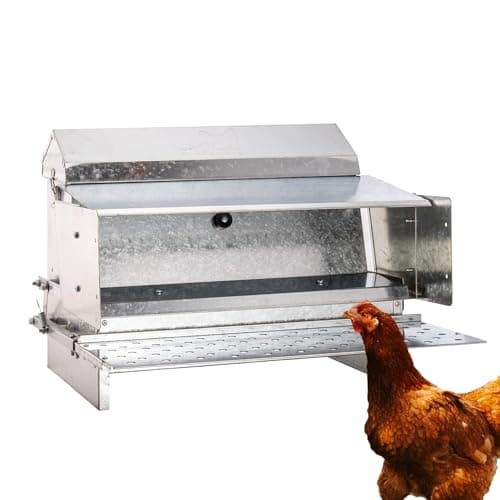
RentACoop Automatic Treadle Chicken Feeder, 25 lb
A 25 pound treadle with a detachable step weight, so lighter birds can trigger it - the fix for the one thing treadle feeders reliably get wrong.
What the numbers say
The manufacturer does not publish the dimensions this calculation needs, so we do not print a number.
Figures from RentACoop published specifications (Amazon listing) · 21"L x 18.5"W x 14"H, 25 lb capacity · Galvanized metal with stainless-steel hardware
The detachable step weight is the specification that matters. Every treadle feeder has a threshold a bird must exceed, and the usual failure is a flock of silkies or young pullets standing next to a feeder they cannot open. Making that threshold adjustable is the right answer.
The step also locks shut overnight, which turns a feed-on-demand feeder into a closed container at exactly the hours rodents are working.
A grate in the trough stops billing out, and an adjustable internal feed-flow plate lets you restrict how much feed sits exposed at once - which is the mechanical version of Penn State's advice to fill a trough only a third to a half full.
The box includes two blinders, a rain cover and an anti-roost lid. The anti-roost part is not decorative: anything flat at bird height in a coop becomes a perch, and a perch over a feeder means droppings in the feed.
Good
- Detachable step weight so bantams and light birds can trigger it
- Treadle locks shut overnight, closing the feeder to rodents entirely
- Adjustable feed-flow plate controls how much feed is exposed
- Ships with rain cover, anti-roost lid and blinders rather than selling them separately
Not so good
- Still expensive, even sitting below the category benchmark
- The largest footprint here at 21 by 18.5 inches - it needs real floor space
- Training period applies the same as any treadle
- Galvanized metal in a wet run will eventually show wear at the hinge
Skip this if: your coop floor is tight. Twenty-one inches by eighteen and a half is a meaningful share of a small coop's measured floor, and floor area is the thing this site spends most of its time telling people not to give away.
#ad · how this is funded · price as of September 27, 2026
The alternatives
Chicken feeders compares this against the category benchmark treadle, a budget treadle that publishes its 400 gram trigger weight, port feeders with and without closable covers, and a DIY port kit - on waste, rodents and the published 3 inches of feeder space per bird.
Questions people actually ask
+Can bantams use the RentACoop treadle feeder?
+How long does 25 lb of feed last?
+Does a treadle feeder stop rats?
+How big is the RentACoop treadle feeder?
+How long do chickens take to learn a treadle feeder?
+Is it worth more than a cheaper treadle feeder?
Sources
- Alabama Cooperative Extension - Feeding the laying hen (a laying hen eats 100-150 grams, roughly 0.25 lb, of feed per day; crumbles are wasted more than pellets)
- Penn State Extension - Management requirements for laying flocks (3 inches of feeder space per bird; feeder lip level with the birds' back height; trough filled only one-third to one-half full to prevent wastage; at least 5 gallons of water per 100 birds daily; 1 inch of water space per bird; never more than 12 hours without water; 14-16 hours of light per day; never decrease the lighting period on birds in production)
- University of Minnesota Extension - Common concerns with backyard or urban poultry keeping (remove wet feed and soiled bedding; cleanliness reduces house mice and Norway rats)
- Penn State Extension - Small-scale poultry housing
Read next
Chicken feeders, ranked on waste and rodents
Treadle, port and DIY feeders measured against the published 3 inches of feeder space per bird and 0.25 lb of feed per hen per day.
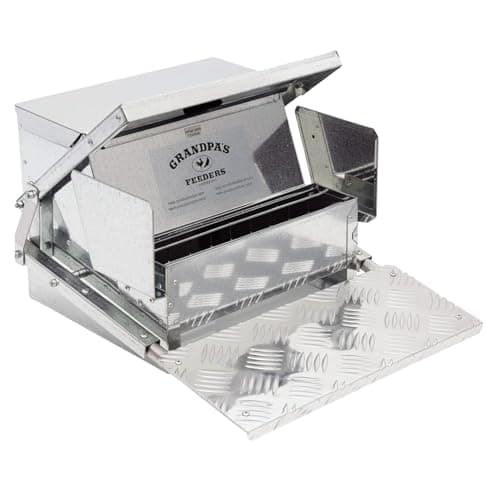
Grandpa's Feeders Automatic Chicken Feeder, 20 lb
A treadle feeder reviewed on rodent exclusion, feed waste and the one claim on this site that survived checking.

Rats in the chicken coop
Why rats colonize a coop, the half-inch figure that excludes them, and the three purchases that close off feed, entry and harborage.
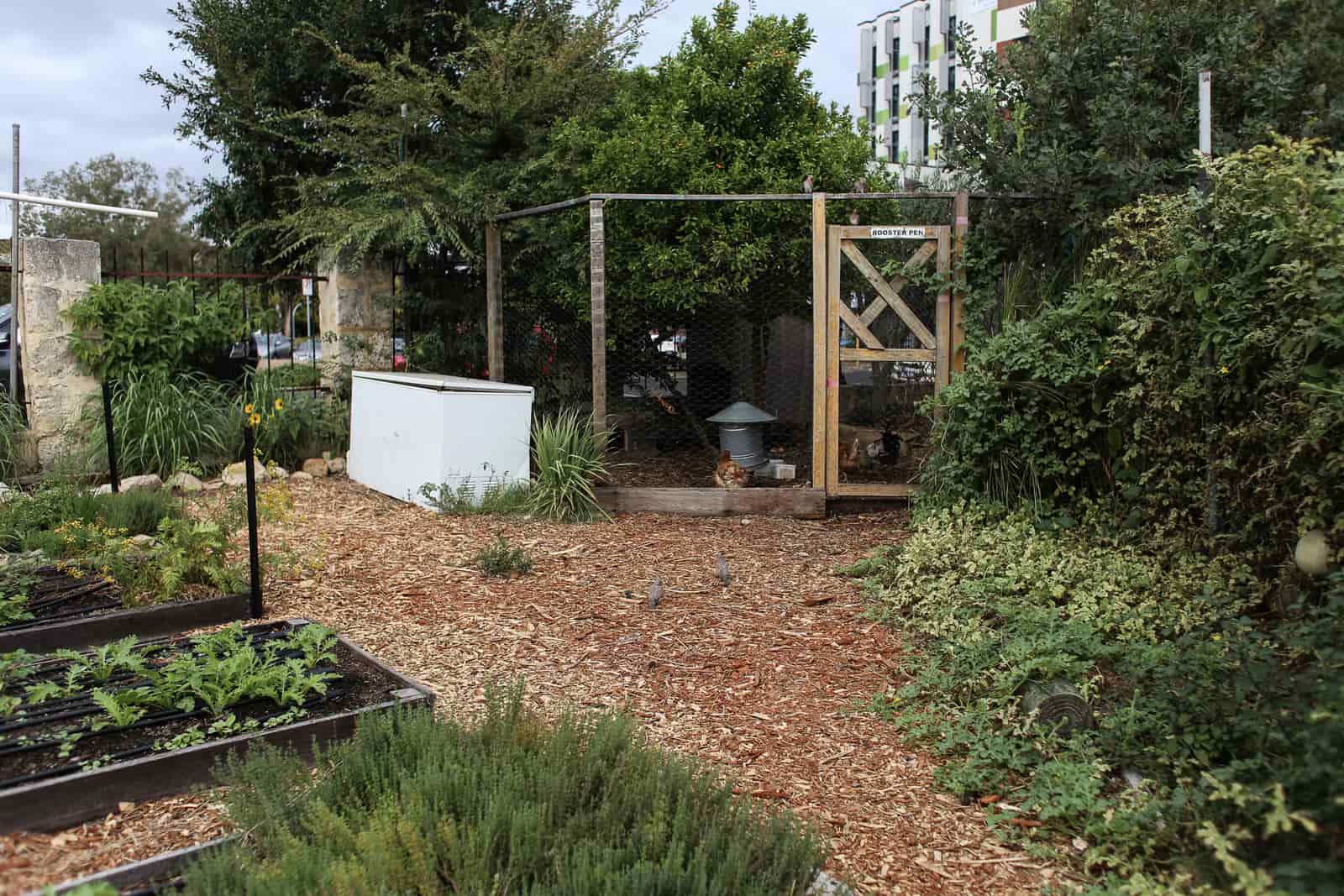
Chicken coops for silkies and bantams
Six small coops measured against the published bantam figures, with roost height and dryness treated as the deciding factors rather than floor area alone.
Single-model reviews
Individual coop reviews, each measured against the maker's own published dimensions rather than its marketing.
Chicken waterers, ranked on the published numbers
Heated, nipple and open waterers measured against the published 5 gallons per 100 birds daily, 1 inch of water space per bird, and the 12-hour rule.