Omlet Automatic Coop Door Opener
A 19.25-inch opening with closing safety sensors, from the one Omlet product you can actually buy on Amazon. The question is whether your coop wall can take it.
We have not handled these coops, and we do not pretend to have. Here is what we did instead. Links to Amazon earn us a commission at no extra cost to you - disclosure.
| # | Coop | Best for | Honest count | Price |
|---|---|---|---|---|
| 1 | 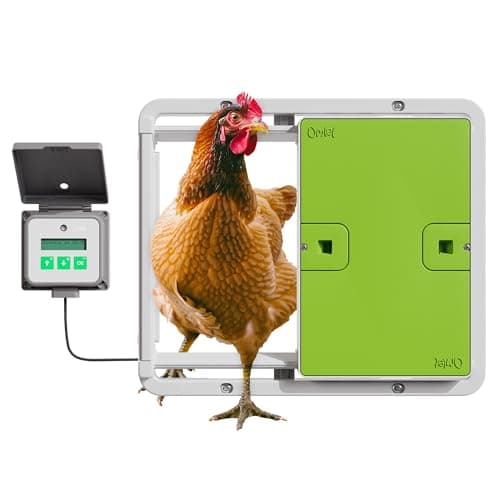 Omlet Automatic Coop Door OpenerTop pickThe biggest opening here at 19.25in, with safety sensors fitted - Omlet's door is on Amazon even though its coops are not. | Large openings and built-in safety sensors | not published |
Closing the pop door at dusk is the highest-value security habit in keeping chickens. Almost every predator that takes an adult bird takes it at night or at the edges of the day, and a flock shut behind a solid door is out of reach of nearly all of them. It is also the habit nobody keeps perfectly for years, which is the entire argument for automating it.
What separates one automatic door from another is not the concept. It is four specifications, and on two of them this unit is the outlier in the category.
Opening size is the decision
At 19.25 inches on the long side, this is substantially the largest door we track. That has two consequences and you should weigh both before ordering.
In its favor: larger birds pass through without ducking, and a flock of eight or ten gets out at dawn in a stream rather than a queue. Anyone who has watched a full-size Orpington negotiate a small pop door in the rain understands why this is not a trivial benefit. A wider opening also moves more air at the base of the coop on hot afternoons, which is a small bonus in a climate where that matters.
Against it: you need a flat, unobstructed panel big enough to take the cutout, plus clearance above for the door to travel. Several of the small flat-pack coops on this site do not have a flat wall of that size anywhere on them. This is a measuring job before it is a buying job.
Safety sensors, and the last-bird problem
This is the feature that justifies the price difference over the generic units. A light-triggered door closes on a schedule the flock has not agreed to. Most birds go in before full dusk on their own, and there is usually one that does not - a broody hen, a bird at the bottom of the pecking order waiting for the others to settle, or a pullet that has not learned the routine yet.
A door that closes on a slow bird is the failure mode people discover the hard way, and it is unpleasant. Sensors that stop or reverse the door when something is in the opening remove that risk in the mechanism rather than leaving it to your threshold setting.
That said, treat the sensors as a backstop, not a substitute for setup. Set the closing threshold late enough for the slowest hen, check the coop every evening for the first week, and confirm with your own eyes that the door stops when you put a hand in the opening. Verify the safety feature works on your unit before you rely on it for years.
Trigger and power
- Light sensor operation tracks the actual season without you touching anything, which is the point of the exercise. Dawn and dusk move by hours across the year and a fixed schedule does not follow them.
- Timer operation is available and is the right choice in one specific case: a coop sited under heavy tree cover or against a building, where ambient light at ground level is a poor proxy for actual dusk.
- Check the power arrangement against your coop before ordering. Power is the specification that most often turns a good door into an annoying one, because battery capacity drops noticeably in hard cold and a dead battery means an open coop at 3am.
- If you have mains power at the coop already, use it. If you do not, and the coop gets real sun for most of the day, a solar unit is the lower-maintenance route - see solar coop doors.
What this door does not do
It closes one opening. Your main access door, the nest-box lid and the clean-out tray all still need a latch a raccoon cannot open - a two-motion latch, not a hook and eye or a spinning turn-button. Raccoons solve single-motion latches, reliably and quickly, and a nest-box lid is the easiest way into most coops on the market.
It also does nothing about mesh. If the run or coop panels are chicken wire, a closed pop door has moved the weak point rather than removed it. Half-inch hardware cloth is the fix, and it is covered in hardware cloth vs chicken wire.
And it does not stop anything that digs. A ground apron - mesh laid flat outward at the perimeter and pinned down - is what handles that, and it is the cheapest part of the job. Digging predators has the method.
Who should buy this one
- Anyone with a coop wall that can genuinely take a 19-inch cutout - a walk-in, a shed conversion, or a large wooden kit.
- Keepers with large or heavy breeds, where a small pop door is a daily bottleneck.
- Anyone who has already had a near miss with a door closing on a bird, or who worries about it.
- Flocks of eight or more, where the dawn queue at a narrow door is a real friction point.
Who should not
- Owners of the small flat-pack coops in the 12-to-21 square foot class. Measure, but expect to find nowhere to put it.
- Anyone without power at the coop who does not want to manage batteries through winter.
- Anyone choosing purely on price - the generic solar units cost meaningfully less and do the core job.
The full write-up
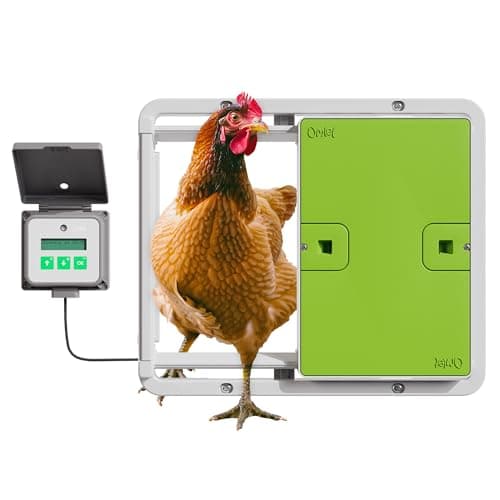
Top pick · Large openings and built-in safety sensors
Omlet Automatic Coop Door Opener
The biggest opening here at 19.25in, with safety sensors fitted - Omlet's door is on Amazon even though its coops are not.
What the numbers say
The manufacturer does not publish the dimensions this calculation needs, so we do not print a number.
Figures from Omlet published specifications (Amazon listing) · 19.25"L x 2.25"W x 16.5"H
At 19.25 inches this is much the largest unit here, which matters if you keep larger birds or want the flock through the door quickly at dawn.
Built-in safety sensors are the feature worth paying for. A door that closes on a slow bird is the failure mode people discover the hard way.
Worth noting that Omlet's coops are sold direct rather than on Amazon, but this door is not - so unlike the Eglu, it is something we can actually link.
Good
- Largest opening of the doors here
- Built-in safety sensors on closing
- Light sensor or timer operation
Not so good
- Needs a coop wall big enough to take it
- More expensive than the generic solar units
- Physically the bulkiest option
Skip this if: your coop wall cannot take a 19in cutout. Measure the flat panel area before ordering - several of the small coops on this site cannot accept it.
#ad · how this is funded · price as of September 13, 2026
The alternatives
Automatic coop doors compares this against a light-sensor guillotine, a solar unit and a budget option on trigger, power and opening size. If your winter is the deciding factor, cold-weather coop doors covers what actually fails below freezing.
Questions people actually ask
+How big is the Omlet automatic coop door?
+Does the Omlet door have safety sensors?
+Will the Omlet door fit a small flat-pack coop?
+Can you buy Omlet products on Amazon?
+Does an automatic door replace latches?
Sources
Read next
Automatic chicken coop doors
Automatic pop doors compared on trigger, power source, opening size and what happens when it is 10 degrees out.
Automatic coop doors for cold weather
Pop doors judged on what actually breaks them in winter - battery chemistry, track geometry and whether you can tell it failed.
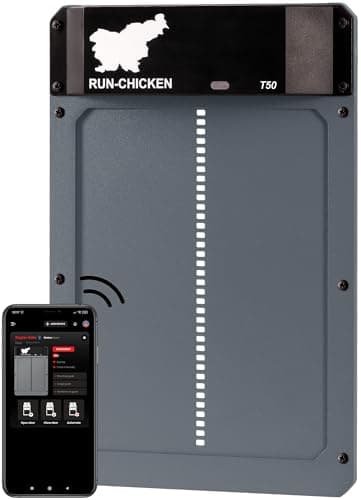
RUN-CHICKEN Door T50 Automatic Opener
An automatic pop door reviewed on what actually matters - trigger, power, opening size and cold-weather behavior.
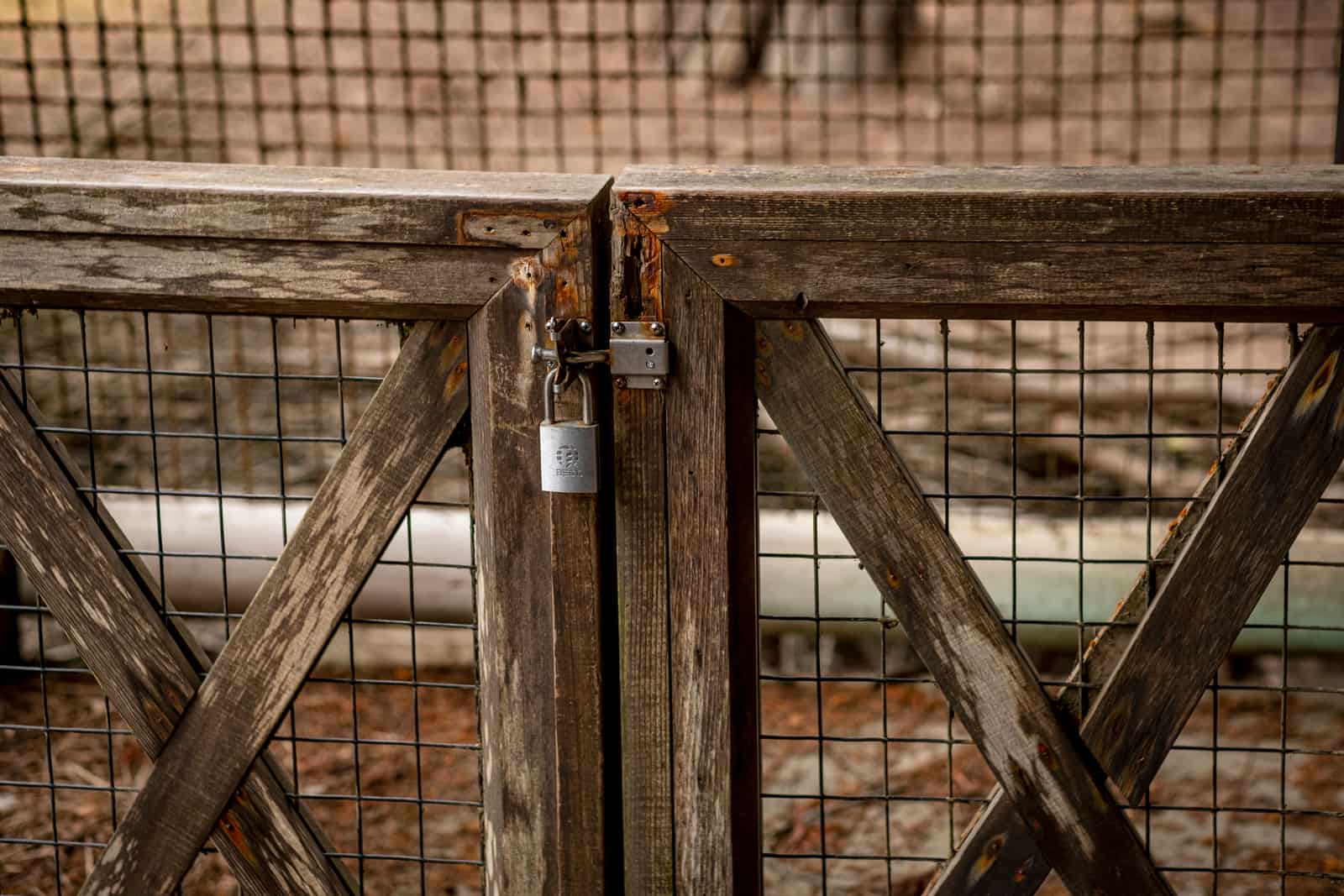
Latches a raccoon cannot open
Why hook-and-eye and spring catches fail, the two-motion principle that works, and where every coop needs a latch it did not ship with.
Single-model reviews
Individual coop reviews, each measured against the maker's own published dimensions rather than its marketing.
Predator-proofing a coop, step by step
The full walkthrough: mesh, latches and apron, with a materials list and the openings that get missed.