Roll-away nest boxes, measured against the published nest
The egg rolls out of reach seconds after it is laid. That genuinely solves three problems - and quietly breaks one piece of published nest guidance, which no listing mentions.
We have not handled these coops, and we do not pretend to have. Here is what we did instead. Links to Amazon earn us a commission at no extra cost to you - disclosure.
| # | Coop | Best for | Honest count | Price |
|---|---|---|---|---|
| 1 | 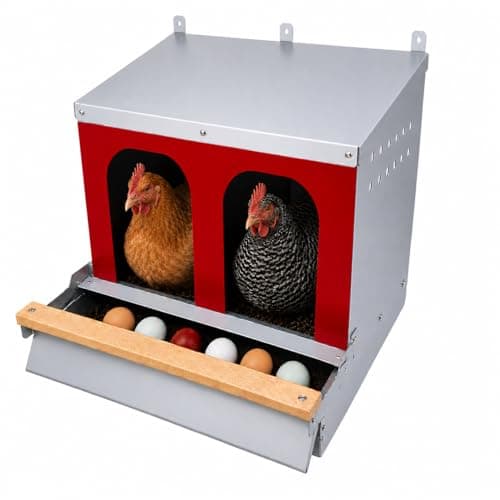 Hen's Choice Reversible Roll Out Nest Box, 2 Compartment 21inTop pickFully galvanized, reversible so you can collect from outside the coop, and the only pick here with a hinged perch that shuts hens out of the box at night. | The two problems a roll-away box should solve at once | not published | |
| 2 | 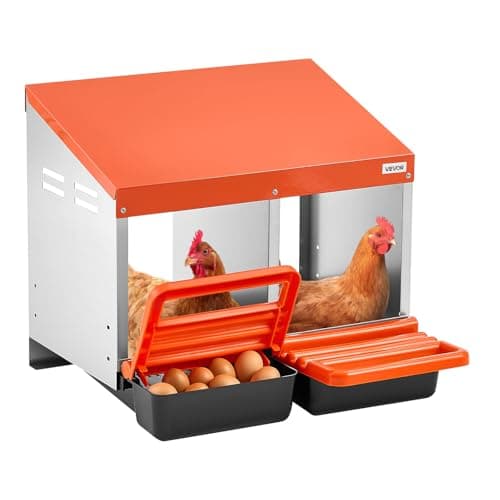 VEVOR Chicken Nesting Boxes, 2 Compartments, Roll AwayAngled trays, drainage holes and detachable trays for cleaning, at roughly a third of the premium price - with compartments narrower than the published nest size. | The cheapest way into the format from a known brand | not published | |
| 3 | 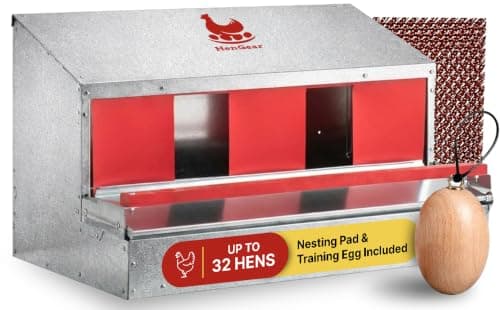 HenGear Nesting Boxes for Chickens, Roll Away Laying Boxes, MediumG90 galvanized, reversible, with a full-size pad that runs into the rollout tray - and an open interior instead of divided compartments, which is a deliberate and unusual choice. | An open community nest rather than compartments | not published | |
| 4 | 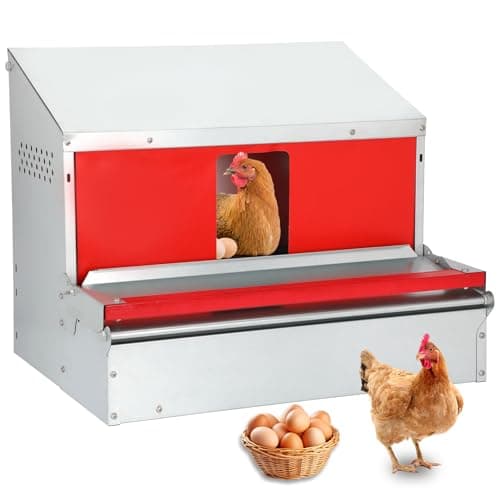 Redants Chicken Nesting Box with Roll Away Egg Collection, ReversibleReversible, curtained and fitted with two sets of double predator locks on the cover plate - and carrying a hen-count claim that does not survive the published arithmetic. | Locks on the collection lid | not published | |
| 5 | 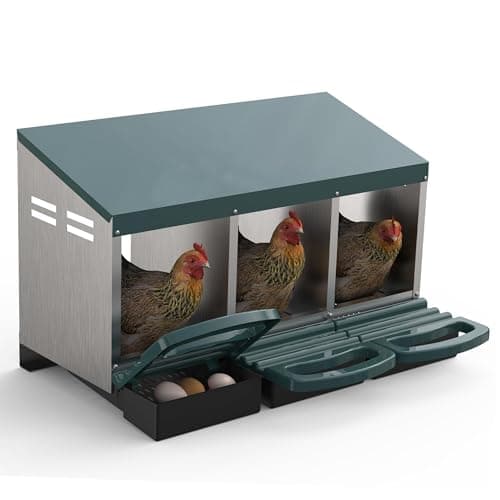 LEISULIF Metal Chicken Nesting Box with Easy-Collect Tray and LidSloped floor into a protected tray, galvanized frame, and a choice of compartment layouts - the cheapest entry to the format on this page. | Trying a roll-away box at the lowest price here | not published | |
| 6 | 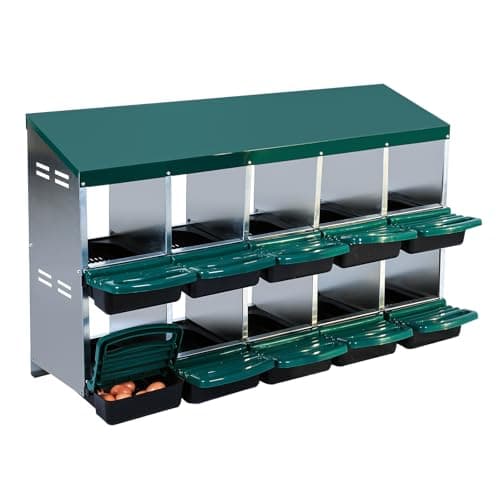 Mochalight 10 Compartment Metal Roll Away Nest BoxTen compartments in a 58 inch bank, freestanding on legs or wall mounted. On the published ratio that is a box for forty to fifty hens. | A genuinely large flock, and nobody else | not published |
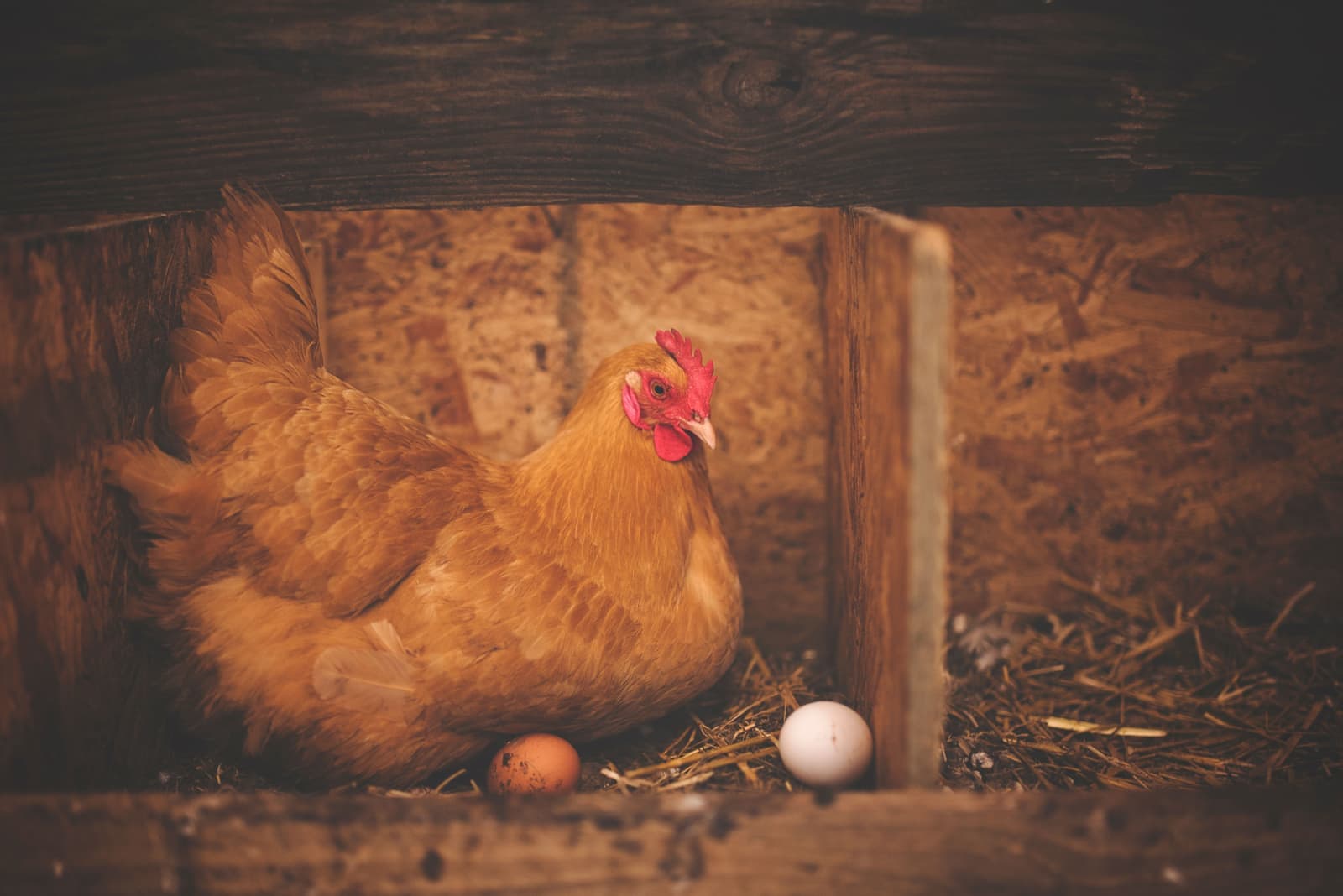
The idea is simple enough that it barely needs explaining. The floor of the nest slopes, so an egg rolls forward into a covered tray a few seconds after it is laid. By the time the hen stands up, the egg is somewhere she cannot reach.
That is a real mechanism rather than a marketing angle, and it addresses three separate problems at once. It is also more complicated than the listings suggest, in ways worth knowing before you spend three figures.
What it actually fixes
- Egg eating. Penn State Extension says egg breakage is a major reason hens start, and eXtension says it usually starts from accidental breakage - a curious hen pecks at a broken egg and develops a taste for it. An egg out of reach cannot be pecked.
- Breakage. Both sources name accidental breakage as what starts egg eating, and an egg that has left the nest is no longer underneath the next hen to climb in. The tray holds collected eggs in one covered layer instead.
- Dirty eggs. An egg that leaves the nest immediately never sits under a hen who has been scratching in the run, and never spends the afternoon in bedding that has been slept in.
All three are genuine, and none of them is the reason most people buy one. Most people buy one because they already have an egg eater, and that is the case where expectations need managing.
What the extension services actually say to do
If egg eating is the problem you are solving, the published prevention list is worth doing first, because most of it is free.
| Measure | Published figure |
|---|---|
| Nesting material | Keep 2 inches of clean, dry material in the nests at all times, as protective egg padding |
| Collection | Collect eggs often and early - most hens lay before 10:00 a.m. |
| Nest size | One 12 inch by 12 inch nest per four or five hens |
| Minimum boxes | Never fewer than 4 (Penn State) or never fewer than 6 (eXtension) - the two disagree |
| Nest placement | At least 2 feet off the ground and at least 4 feet away from the roosts |
| Cure | Prevention is the only proven treatment. eXtension says to cull a confirmed egg eater |
Read the last row carefully before buying anything. Penn State's position is that prevention is the only proven treatment, and eXtension's advice for a hen you have actually caught eating eggs is to remove her from the flock, because the others imitate her. A roll-away box removes the opportunity; it does not unteach the habit.
Two of those rows also disagree with each other, and we are not going to pick a winner. The ratio is consistent across sources at one nest per four to five hens. The minimum box count is not - Penn State says never fewer than four, eXtension says never fewer than six - and both floors read as though written for flocks larger than a backyard six. This site's per-flock tables use the ratio, and how many nesting boxes explains why.
The bedding problem nobody mentions
Here is the conflict at the center of this category. Both extension sources say to keep two inches of clean, dry nesting material in the nest at all times, and eXtension spells out why: as protective egg padding.
Two inches of loose shavings is also precisely what stops an egg rolling anywhere. A roll-away box full of bedding is just a nest box with a slope in it.
The industry answer is a washable nesting pad - a thin, grass-like mat that gives the hen something to sit on and the egg something to roll across. Two of the picks below include one. The rest expect you to know, and do not say so anywhere in the listing.
How we judged
- Whether a washable nesting pad is included, since the published two inches of bedding cannot be used in a roll-away box.
- Compartment size against the published 12 inch by 12 inch nest - and whether the listing publishes a figure to check at all. Most do not.
- Compartment count against the published one nest per four or five hens, because these are sold in banks and the arithmetic decides whether you are buying five nests you will never use.
- Reversibility. Collecting eggs from outside the coop is the practical difference between a good morning and a muddy one.
- Whether the box can be closed off at night. A nest slept in is a tray of dirty eggs, which is the problem you were trying to solve.
- Security on the collection lid. A roll-away box puts every egg in an outside-accessible tray, which is convenient for you and for everything else.
The honest downsides
- No broody hen can hatch in one. The eggs leave within seconds, every time. If you ever want a hen to sit a clutch, keep a conventional nest as well.
- Hens may refuse them at first. A metal box with a sloped floor and no deep bedding is not what a hen is looking for, and some birds take weeks. Curtains and a pad both help.
- The tray needs cleaning. Eggs sit in it until you collect, and anything that rolls in with them - droppings, feathers, a cracked egg - sits there too.
- It has to be level. A box mounted out of true either fails to roll or rolls too fast, and neither is obvious until eggs start cracking.
- It does not stop hens sleeping in the nest unless it can be closed off. That habit is the actual cause of most dirty eggs, and roost bar length is usually the real fix.
Sizing it, with the published ratio
This matters more here than on a conventional nest box because roll-away boxes are expensive per compartment. Buying a ten-nest bank for six hens is not over-provisioning, it is spending several times what the job needed on a five-foot object that will not fit in most coops on this site.
The ranked picks
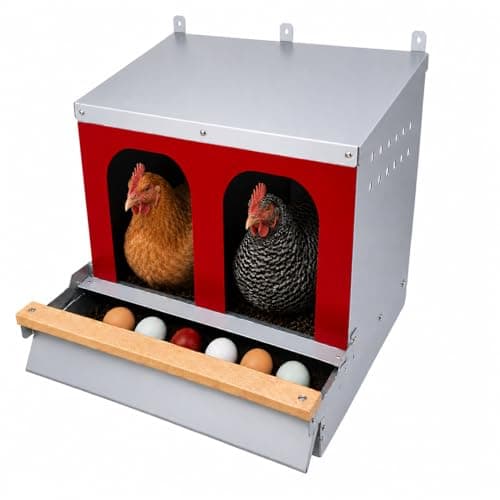
Top pick · The two problems a roll-away box should solve at once
Hen's Choice Reversible Roll Out Nest Box, 2 Compartment 21in
Fully galvanized, reversible so you can collect from outside the coop, and the only pick here with a hinged perch that shuts hens out of the box at night.
What the numbers say
The manufacturer does not publish the dimensions this calculation needs, so we do not print a number.
Figures from Hen's Choice published specifications (Amazon listing) · 21"L x 19"W x 20"H, 2 compartments · Fully galvanized steel, no plastic or painted parts
The hinged wood perch is the feature worth paying for and almost nobody else fits one. Birds that sleep in a nest box foul it overnight, and that is where dirty eggs come from - a perch you can flip up in the evening closes the box without you removing anything.
Reversible assembly means the collection lid can face into the coop or out of it. Collecting from outside is the difference between a two-minute job in the rain and a trip inside in muck boots.
It ships with a washable nesting pad, which matters more than it sounds. Penn State says to keep two inches of clean, dry nesting material in a nest at all times - and two inches of loose bedding is exactly what stops an egg rolling. A pad is how a roll-away box resolves that conflict, and a box that does not include one leaves you to buy it.
No plastic and no painted metal is a real durability claim in a coop, where damp and droppings find every coating. The cost is weight and price - this sits at the premium end of the format.
Good
- Hinged perch flips up to keep hens out of the box overnight
- Reversible - collect eggs from inside or outside the coop
- Washable nesting pad included, which a roll-away actually needs
- Fully galvanized with no plastic or painted parts
Not so good
- Premium pricing for two compartments
- Two compartments is more box than a small flock needs on the published ratio
- Heavy, and it has to be mounted level for the roll to work
- A flipped-up perch is a nightly habit, not an automatic feature
Skip this if: you want a broody hen to hatch a clutch. Every roll-away box takes the eggs away from her within seconds, and no amount of sitting will change that.
#ad · how this is funded · price as of September 19, 2026
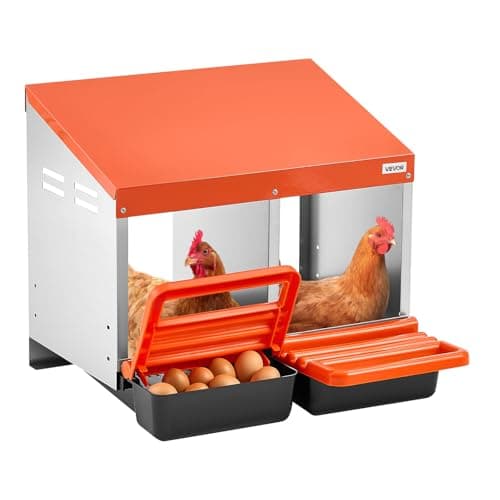
Pick 2 · The cheapest way into the format from a known brand
VEVOR Chicken Nesting Boxes, 2 Compartments, Roll Away
Angled trays, drainage holes and detachable trays for cleaning, at roughly a third of the premium price - with compartments narrower than the published nest size.
What the numbers say
The manufacturer does not publish the dimensions this calculation needs, so we do not print a number.
Figures from VEVOR published specifications (Amazon listing) · 21.06"L x 20.67"W x 18.7"H, two 10.4in compartments · Galvanized steel with high-strength plastic trays
The listing publishes its compartment width, which is unusually honest and lets you check it: 10.4 inches. Penn State and eXtension both specify a 12 inch by 12 inch nest, so these compartments are narrower than the published figure on one dimension.
Whether that matters depends on your birds. Large fowl in a 10.4 inch compartment is tight; standard hens and bantams are a different question. It is a real gap against the published guidance rather than a fatal one, and no other listing here gives you the number to check.
Detachable trays with drainage holes are the right design for the part of a roll-away box that actually gets dirty. The collection tray is where eggs sit until you fetch them, and it is the bit people forget to clean.
Galvanized steel with plastic trays is the standard construction at this price. It is not the all-galvanized build of the premium boxes, and the plastic is what will age first.
Good
- Publishes its compartment width, so the published nest size can be checked
- Detachable trays with drainage holes for cleaning
- Wall mountable, so it takes no coop floor area
- Much the cheapest 2-compartment box from a recognized brand
Not so good
- 10.4in compartments are narrower than the published 12in nest
- Plastic trays rather than the all-galvanized premium build
- No nesting pad included, and a roll-away needs one
- No perch that can be closed off at night
Skip this if: you keep large fowl. The published nest figure is 12 inches square and these compartments are listed at 10.4 inches wide, which is a real squeeze for a big bird.
#ad · how this is funded · price as of September 19, 2026
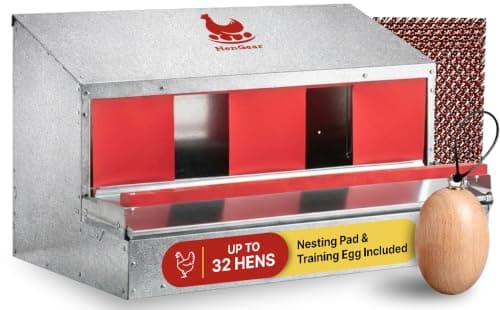
Pick 3 · An open community nest rather than compartments
HenGear Nesting Boxes for Chickens, Roll Away Laying Boxes, Medium
G90 galvanized, reversible, with a full-size pad that runs into the rollout tray - and an open interior instead of divided compartments, which is a deliberate and unusual choice.
What the numbers say
The manufacturer does not publish the dimensions this calculation needs, so we do not print a number.
Figures from HenGear published specifications (Amazon listing) · 34"L x 19.5"W x 20"H, open community interior · G90 galvanized steel
The community-style open interior is the thing to understand before buying. Instead of dividing the box into nests, it gives the flock one open space to settle in, which the maker argues reduces crowding.
That design sits outside the published guidance rather than against it. Penn State and eXtension both describe a 12 inch by 12 inch nest per four or five hens, and an open box is not measurable in those terms - so you cannot check it the way you can check a compartment.
A full-size pad that extends into the rollout tray is the detail that separates this from cheaper boxes. Eggs stay on a surface the whole way rather than crossing bare metal, which is what keeps them clean and uncracked.
G90 is a stated galvanizing weight rather than the word galvanized on its own, and stating it is the kind of specification worth rewarding in a category where most listings do not.
Good
- Publishes its galvanizing grade (G90) rather than just saying galvanized
- Full-size pad extends into the rollout tray, so eggs never cross bare metal
- Reversible front or rear collection, with a hinged back for access
- Open community interior avoids hens queuing for one favorite compartment
Not so good
- The highest-priced pick here by a clear margin
- An open nest cannot be checked against the published 12in-square nest figure
- No compartment count, so the published boxes-per-hen ratio does not apply cleanly
- Ships flat and needs assembling
Skip this if: you want to apply the published nest-per-hen arithmetic to your coop. An open community box is a different design philosophy, and the numbers this site runs on do not describe it.
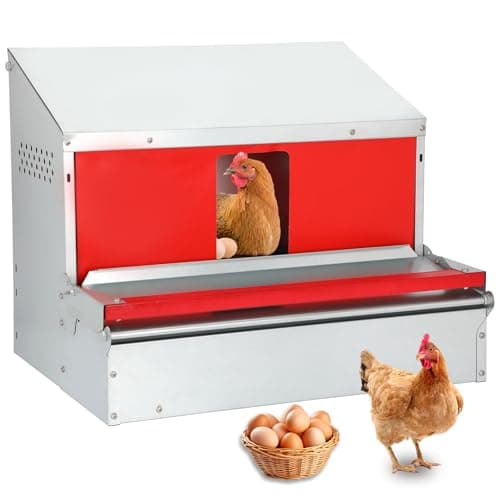
Pick 4 · Locks on the collection lid
Redants Chicken Nesting Box with Roll Away Egg Collection, Reversible
Reversible, curtained and fitted with two sets of double predator locks on the cover plate - and carrying a hen-count claim that does not survive the published arithmetic.
What the numbers say
The manufacturer does not publish the dimensions this calculation needs, so we do not print a number.
Figures from Redants published specifications (Amazon listing) · 24"L x 19.5"W x 20"H · Galvanized steel
Start with the claim. The listing says up to 20+ hens. Penn State and eXtension both publish one 12 inch by 12 inch nest per four or five hens, so twenty hens is four or five nests on the published figure - not one box. Buy this for the box it is, not the flock it names.
The double predator locks on the cover plate are a genuinely good idea and rare in this category. A roll-away box puts every egg in an outside-accessible tray, which is a convenience for you and an open invitation to anything that can lift a lid.
Curtains on the nest entrance are the other real feature. Hens prefer a dark, private nest, and a curtain is the cheapest way to get one - the listing says they are adjustable, which matters because some birds refuse a curtain at first.
At 24 inches wide it is the largest single box here that still states a size, and it wall mounts, so it costs no coop floor.
Good
- Two sets of double predator locks on the egg collection lid
- Adjustable entrance curtains for a darker, more private nest
- Reversible - mountable for front or rear collection
- Wall mountable, so it uses no coop floor area
Not so good
- The 20+ hens claim is four to five times what the published nest ratio supports
- No nesting pad mentioned, and a roll-away needs one
- No perch that closes the box off at night
- Expensive for what the published guidance counts as one or two nests
Skip this if: you are buying on the hen count in the title. Measured against the published one-nest-per-four-or-five-hens figure it is a box for a handful of birds, and a flock of twenty needs several.
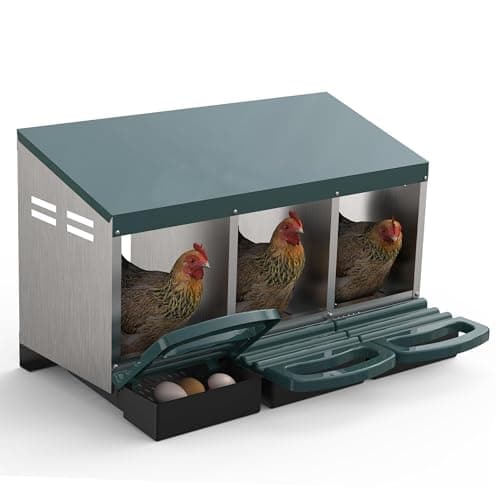
Pick 5 · Trying a roll-away box at the lowest price here
LEISULIF Metal Chicken Nesting Box with Easy-Collect Tray and Lid
Sloped floor into a protected tray, galvanized frame, and a choice of compartment layouts - the cheapest entry to the format on this page.
What the numbers say
The manufacturer does not publish the dimensions this calculation needs, so we do not print a number.
Figures from LEISULIF published specifications (Amazon listing) · 30.71"L x 20.08"W x 20.08"H, 3/4/2x2 compartment options · Galvanized steel frame with a plastic collection tray
Three or four compartments, or two-by-two, covers a flock of roughly twelve to twenty on the published one-per-four-or-five figure. That is a more realistic size than the ten-compartment bank and more box than a three-hen coop needs.
Wall mount or freestanding is the right flexibility at this price, and keyhole slots make the wall option a genuine ten-minute job rather than a project.
It is the cheapest here and the specification reflects that: a galvanized frame with a plastic tray, and no pad, perch or lock in the box. Those are the things the premium boxes add.
Per-compartment dimensions are not published, which means the 12 inch nest figure cannot be checked against it before it arrives.
Good
- Lowest price of any roll-away box here
- Choice of 3, 4 or 2x2 compartment layouts
- Wall mount or freestanding, with keyhole slots for quick mounting
- Sloped floor into a covered collection tray
Not so good
- No nesting pad, perch or predator lock included
- Per-compartment dimensions are not published
- Plastic collection tray rather than an all-metal build
- Even three compartments is more than a small flock needs on the published ratio
Skip this if: you want the box to solve hens sleeping in the nest. There is no perch to close it off at night, and a roll-away box that gets slept in is a tray of dirty eggs in the morning.
#ad · how this is funded · price as of September 19, 2026
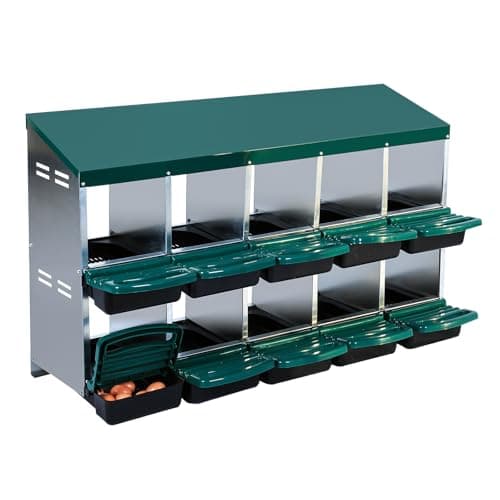
Pick 6 · A genuinely large flock, and nobody else
Mochalight 10 Compartment Metal Roll Away Nest Box
Ten compartments in a 58 inch bank, freestanding on legs or wall mounted. On the published ratio that is a box for forty to fifty hens.
What the numbers say
The manufacturer does not publish the dimensions this calculation needs, so we do not print a number.
Figures from Mochalight published specifications (Amazon listing) · 58.27"L x 16.93"W x 10.63"H, 10 compartments · Galvanized steel sides and roof
Do the arithmetic before the price tempts you. At the published one nest per four to five hens, ten compartments serves forty to fifty birds. If you keep six hens, you are buying eight compartments you will never use and mounting a five-foot bank in a coop that probably cannot take it.
For an actual large flock it is good value per compartment - by some distance the cheapest per nest on this page, which is exactly what you would expect from a bank rather than a single box.
Legs or wall mounting is a useful option at this size. Five feet of loaded nest box is not something to hang off thin cladding, and the included legs let it stand on its own.
The compartment dimensions are not broken out in the listing, and the figures it does give do not obviously describe an assembled ten-nest bank. We are not going to derive a per-nest width from numbers we cannot interpret - ask the maker for the compartment size before assuming it meets the published 12 inch nest.
Good
- Cheapest per compartment of anything here
- Freestanding legs or wall mount, so it does not need cladding to hold it
- Galvanized steel sides and roof with ventilation holes
- Lid cover protects the collected eggs
Not so good
- Ten compartments suits 40-50 hens on the published ratio - far more than a backyard flock
- A 58 inch bank will not fit most coops on this site
- Per-compartment width is not published anywhere in the listing
- No nesting pad included
Skip this if: you keep fewer than about twenty hens. It is not a bargain at that size, it is a large object you will mount once and mostly leave empty - and coop floor and wall space are things this site spends most of its time defending.
#ad · how this is funded · price as of September 19, 2026
What we did not weigh
We have not handled any of these boxes and have not watched an egg roll in one. What is above is the published specification, the published extension guidance on nests and egg eating, and the arithmetic between them.
Only one listing here publishes a compartment width. The rest give an external size or nothing, so the published 12 inch nest cannot be checked before delivery - and we say so on each pick rather than assuming a pass. Hen-count claims are attributed to the makers who make them, including one that names four to five times the flock the published ratio supports.
Where to go next
- Nesting boxes - the conventional format, and what a good box looks like
- How many nesting boxes - the ratio, and why more is not better
- Roost bar length and height - the actual fix for hens sleeping in the nest
- A cleaning routine that gets done - including the collection tray
Questions people actually ask
+Do roll away nest boxes stop egg eating?
+Can you put bedding in a roll away nest box?
+How many roll away nest boxes do I need?
+Will hens use a roll away nest box?
+Can a broody hen use a roll away nest box?
+Are roll away nest boxes worth it?
+Why are my eggs dirty even with a roll away box?
Sources
- Penn State Extension - Prevention of egg eating in chickens (one 12in x 12in nest per 4-5 hens, never fewer than 4 boxes; nests 2ft off the ground and 4ft from roosts; 2 inches of nesting material at all times; collect eggs early; prevention is the only proven treatment)
- eXtension Small and Backyard Poultry - Egg eating by chickens in small and backyard flocks (egg eating usually starts from accidental breakage; one 12in nest per 4-5 hens, never fewer than six boxes; 2 inches of nesting material as protective padding; cull a confirmed egg eater)
- University of Minnesota Extension - Raising chickens for eggs (3-5 sq ft indoor space per bird; one nest box per 4-5 birds)
- Penn State Extension - Small-scale poultry housing
Read next
Nesting boxes, and the six-box three-hen coop
How many boxes a flock needs, why coops oversupply them, and what to do when you genuinely are short.
How many nesting boxes a flock needs
The per-flock box count, why coops oversupply boxes at the cost of floor area, and how to fix hens that will not use them.
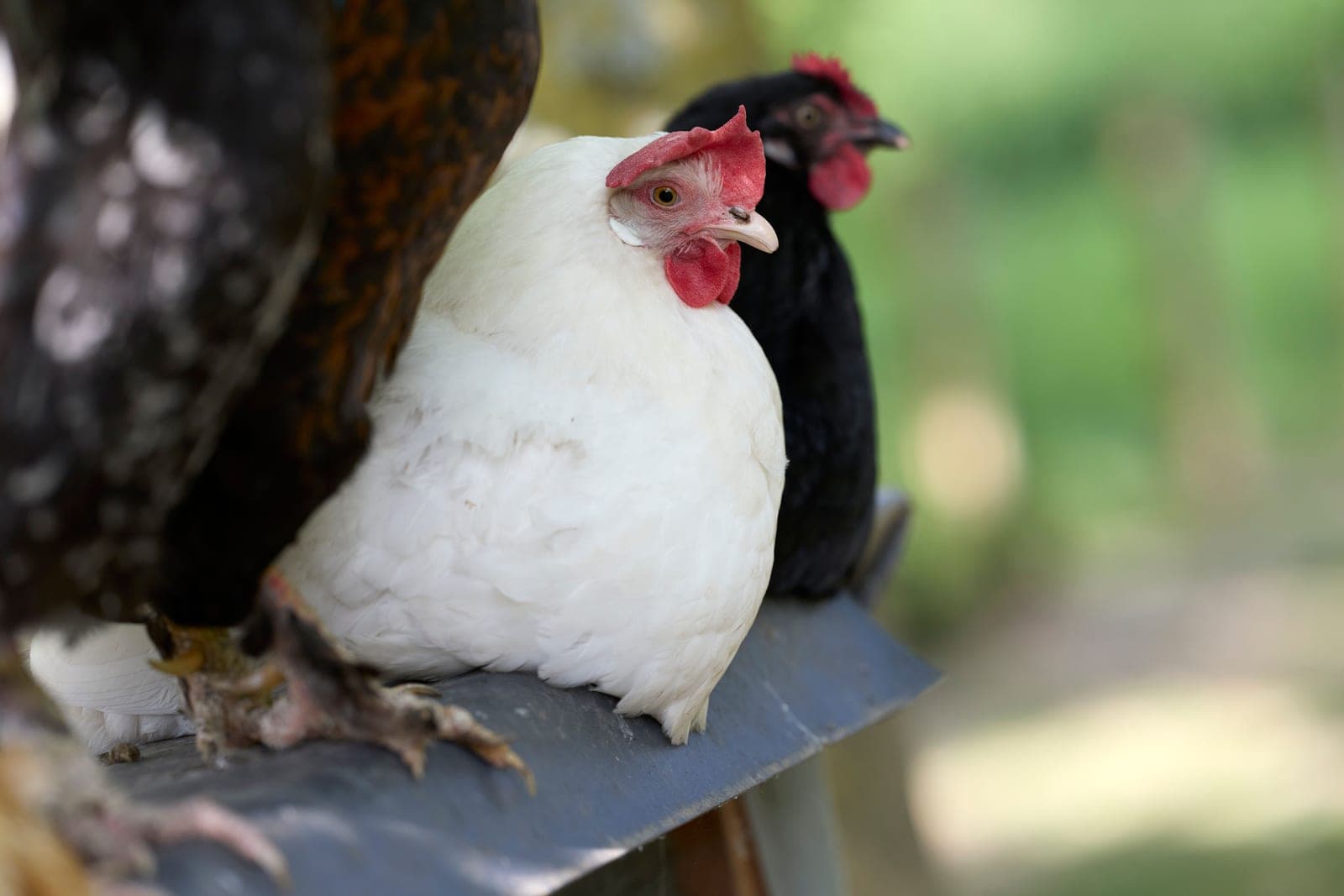
Roost bar length, height and shape
Per-bird bar length by breed, the flat-versus-round question, mounting height, and how to add bar without carpentry.
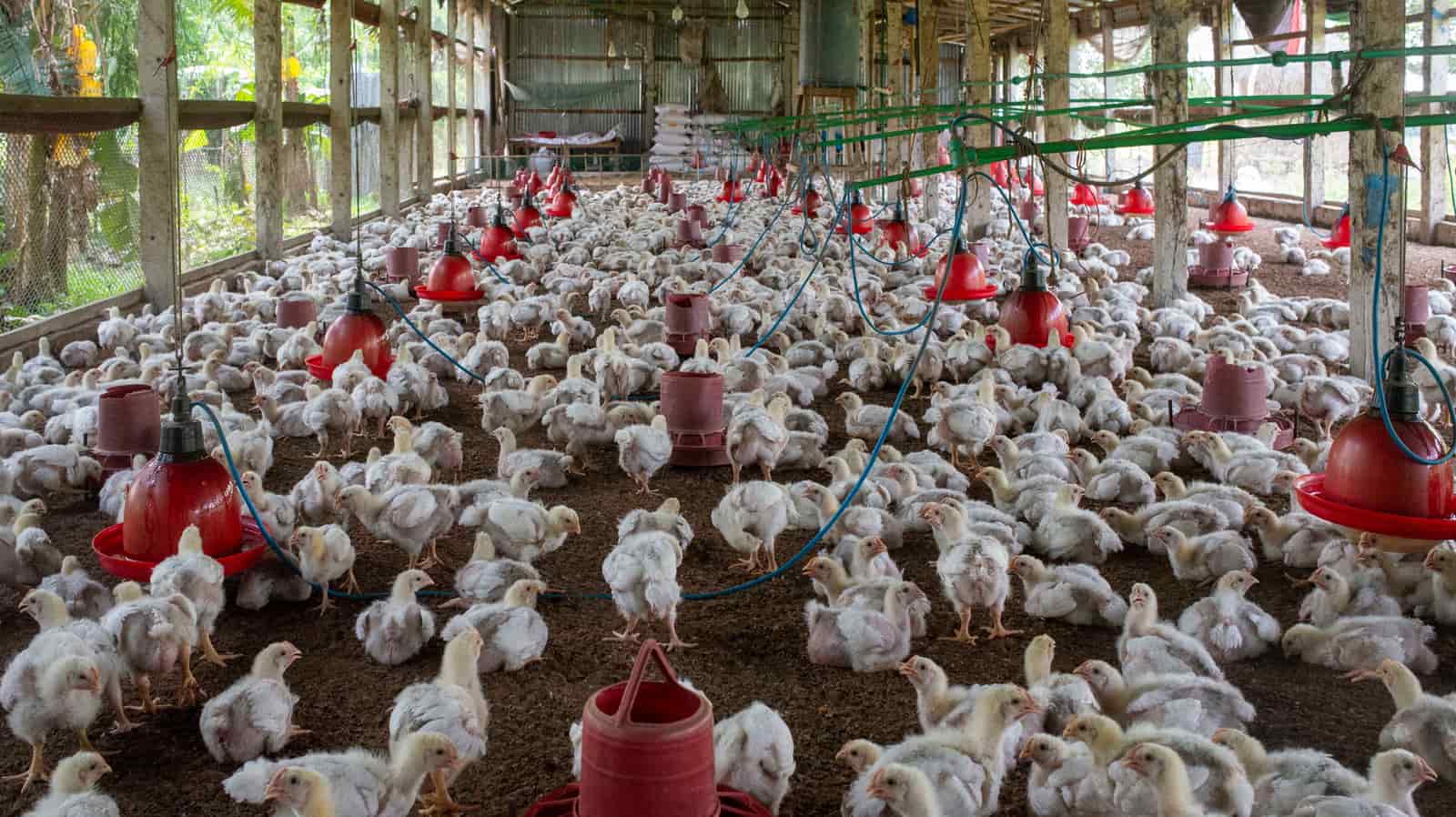
Coop gear, ranked by the problem it solves
The gear that fixes what coops arrive without - doors, mesh, roosts, boxes, heat and airflow - in buying order.
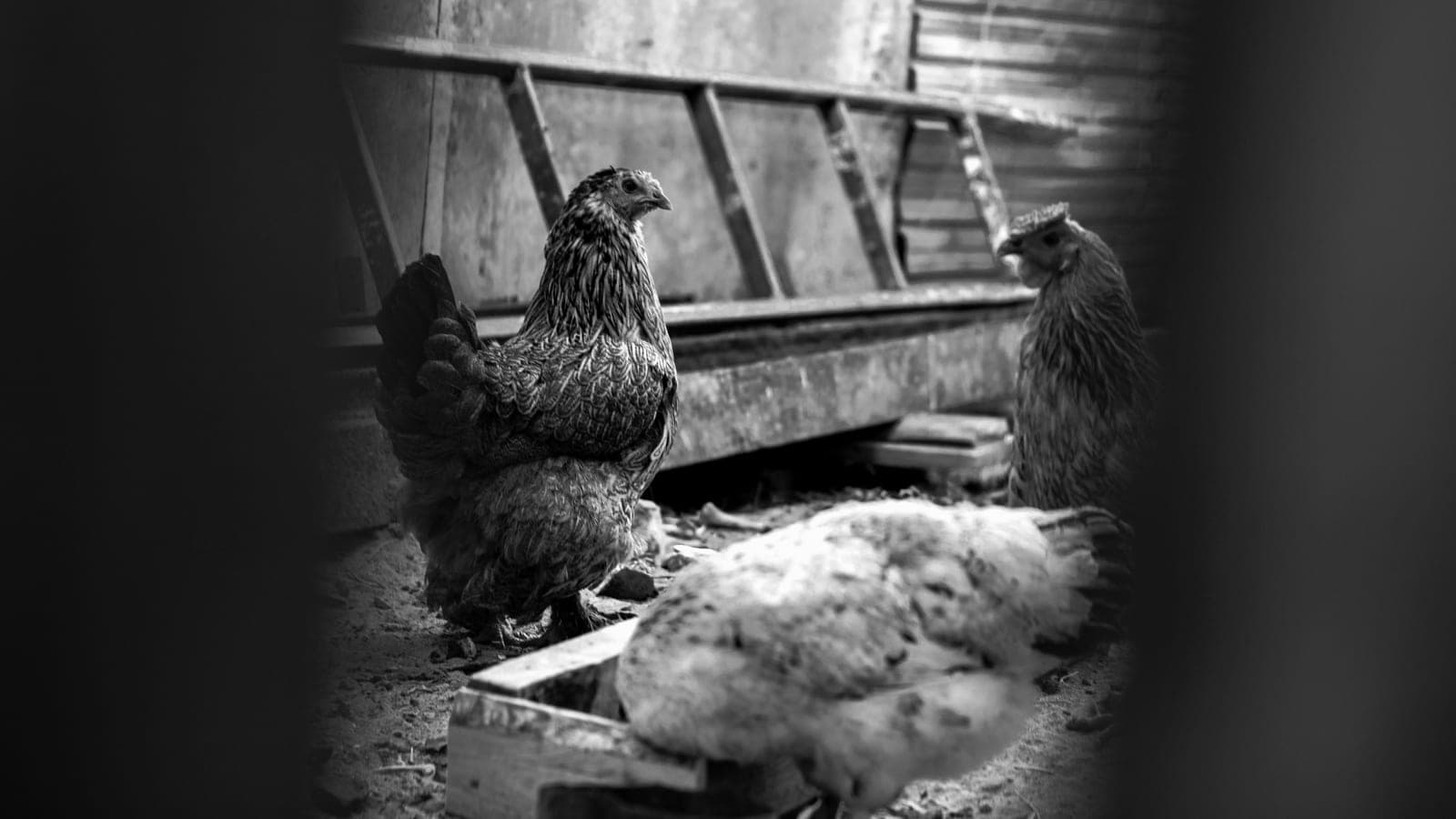
A cleaning routine you will actually keep
Daily, weekly and seasonal jobs sized so they get done, plus the mite inspection nobody schedules until it is too late.
Coop bedding, judged on moisture
Shavings, straw, sand and hemp compared on absorbency and running cost, plus how the deep litter method actually works.