Nesting pads, and the two inches they replace
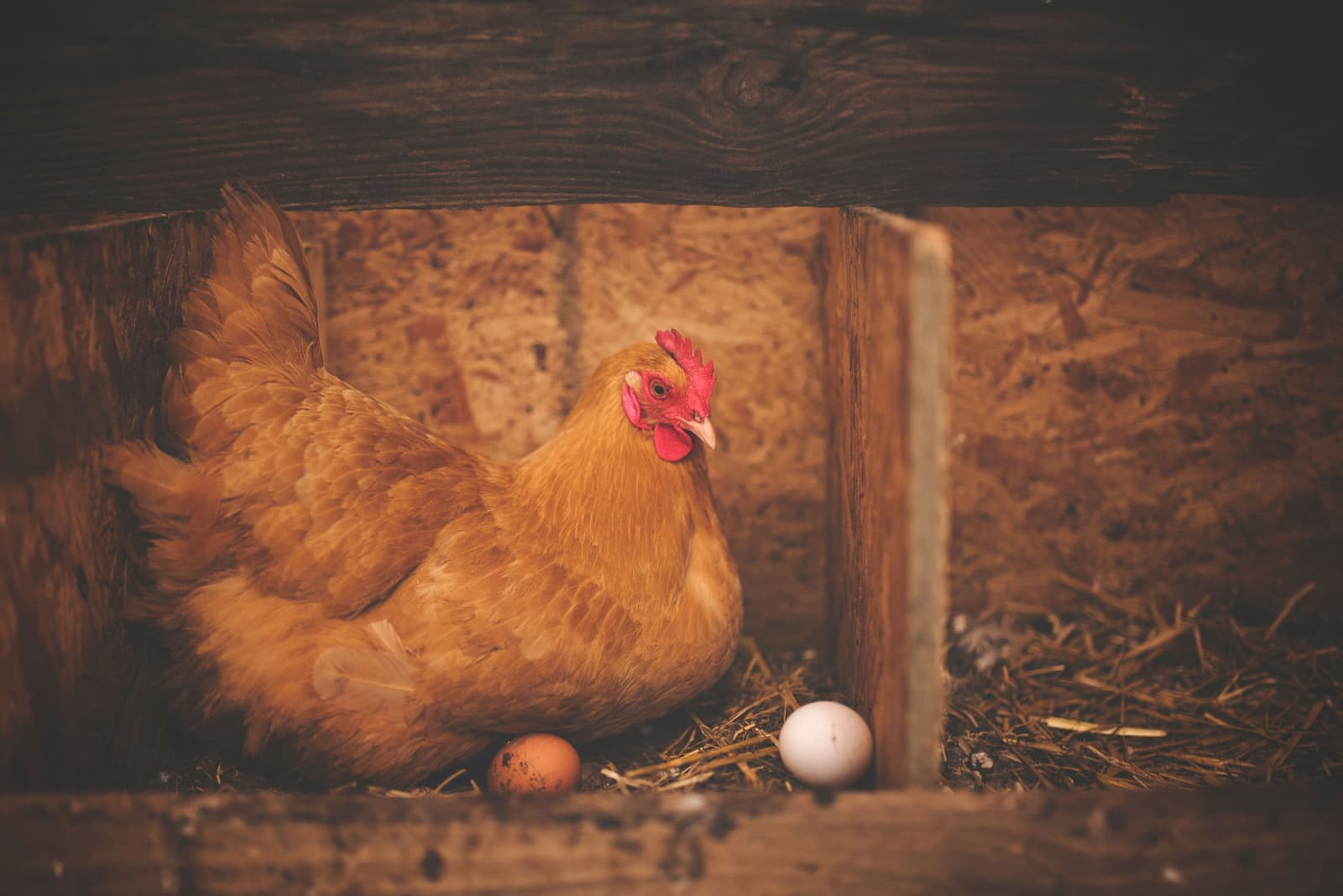
Every pad in this category is thinner than the nesting material the extension services ask for. That is not a flaw - it is a different approach, and it is the right one in some boxes and the wrong one in others.
We have not handled these coops, and we do not pretend to have. Here is what we did instead. Links to Amazon earn us a commission at no extra cost to you - disclosure.
| # | Coop | Best for | Honest count | Price |
|---|---|---|---|---|
| 1 | 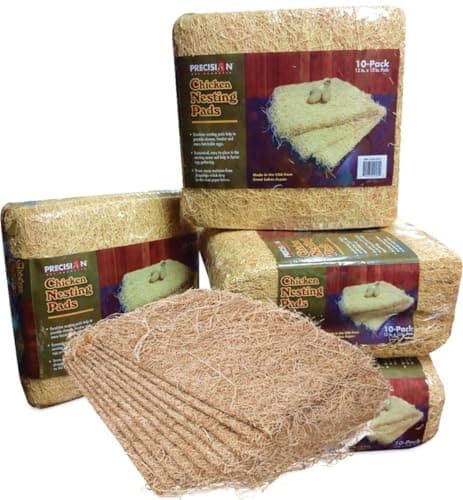 PRECISION PET Chicken Nesting Pads by Petmate, 13in x 13in, 10-PackTop pickThin wood shavings on a paper backing, cut to 13 inches square - which is the one nest dimension the extension services actually publish. | The default pad, at the published nest size | not published | |
| 2 | 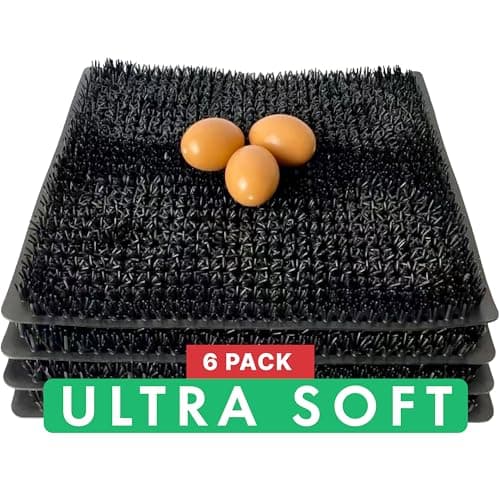 LUMERAM Ultra Soft Washable Chicken Nesting Pads, 6 PackSilicone rather than excelsior, so it washes and goes back in. The right answer for a roll-away nest box, where loose bedding cannot be used at all. | Roll-away boxes, and anyone tired of buying pads | not published | |
| 3 | 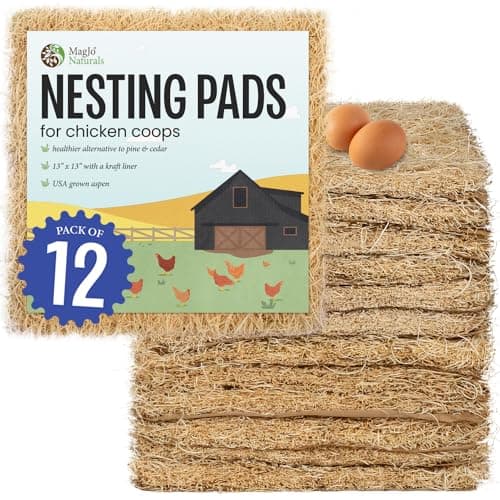 MagJo Aspen Nesting Pads, 13x13, 12 PackTwelve USA-grown aspen pads with a kraft backing, and a listing that explains the one thing that matters - droppings fall through rather than sitting on the egg. | Buying a year at a time | not published | |
| 4 | 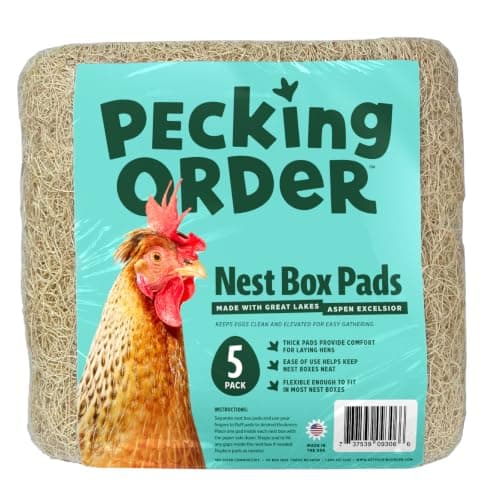 Pecking Order Nest Box Pads, 13 x 13, Aspen Excelsior, 5 PackFive USA-grown aspen pads at the published nest size - the cheapest way to find out whether your hens take to a pad at all. | Trying pads without committing to a bulk pack | not published |
Nest pads are the least interesting purchase on this site and one of the easiest to get right, because the whole category has standardized on a single dimension for a reason worth knowing.
Why they are all 13 inches square
Penn State Extension and eXtension both publish a nest of 12 inches by 12 inches, one per four or five hens. Every excelsior pad in this roundup is cut to 13 inches square - one inch of tolerance so it drops into a published-size nest and sits flat rather than curling up the walls.
That makes pads unusually easy to buy. If your nest is roughly the published size, a 13-inch pad fits. If your coop shipped with boxes smaller than that - and plenty do - the pad will need trimming, which excelsior takes fine and silicone does not.
The two-inch problem
Here is the honest tension. Both extension sources say to keep two inches of clean, dry nesting material in the nest at all times, and eXtension says why: as protective egg padding. Egg breakage is what starts egg eating, and padding is what prevents breakage.
No pad in this category is two inches thick. A pad is a thinner, tidier, more absorbent approach that trades some cushioning for a dry surface, a visible egg and a two-second swap. In a dry nest with calm hens that is a good trade. In a nest where eggs are already cracking, it is not - add loose material on top of the pad, or use both.
Excelsior against washable
| Excelsior (aspen shavings) | Washable (silicone) | |
|---|---|---|
| Moisture | Wicks it down to the paper backing | Does not absorb - wipes clean instead |
| Cost shape | Repeating - a running cost forever | Bought once, rinsed thereafter |
| Hen acceptance | Familiar - they rework the surface | Smooth; some birds take longer to settle |
| Roll-away boxes | Too thick and too loose | The correct choice |
| Trimming to fit | Cuts with scissors | Harder to cut cleanly |
| Disposal | Composts with the litter | Nothing to dispose of |
There is no winner in that table, which is why both are here. Excelsior is the better answer in a conventional nest that sees any damp; silicone is the better answer in a roll-away box, or for anyone who resents buying the same consumable forever.
How we judged
- Size against the published 12-inch nest. Every pick states 13 inches square except the silicone mat, whose listing publishes no dimensions at all - and we say so on the pick.
- What the pad does with moisture, because a dry surface under the egg is most of the point.
- Cushioning, read against the published two inches of material rather than against the other pads.
- Quantity against realistic use. Most flocks have one or two nests in service on the published ratio, so a forty-pack is storage rather than value.
- Whether the wood is named. Cedar is the one to avoid in an enclosed coop; aspen and pine are both fine, and every excelsior pick here states aspen.
The picks
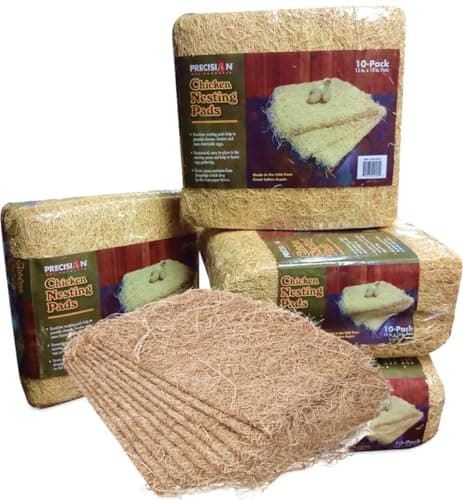
Top pick · The default pad, at the published nest size
PRECISION PET Chicken Nesting Pads by Petmate, 13in x 13in, 10-Pack
Thin wood shavings on a paper backing, cut to 13 inches square - which is the one nest dimension the extension services actually publish.
What the numbers say
The manufacturer does not publish the dimensions this calculation needs, so we do not print a number.
Figures from PRECISION PET published specifications (Amazon listing) · 13"x13" pads, 10 per pack · Wood shavings on a paper backing
Thirteen inches square is not a coincidence. Penn State and eXtension both publish a 12 inch by 12 inch nest, and the whole excelsior pad category is cut to sit in one with an inch to spare.
The listing describes the mechanism honestly: the shavings draw moisture down to the paper backing, leaving a dry surface for the egg. That is the job - a nest pad is a moisture layer with a cushion on top.
The cushion matters more than it sounds. Both extension sources name accidental egg breakage as what starts egg eating, and they specifically call two inches of nesting material protective egg padding. A pad is the thin version of that.
Hens rework a pad the way they rework loose bedding, and the listing says the shavings can be modified while the pad holds shape. That is the difference between a pad they accept and a mat they stand on the edge of.
Good
- Cut to 13 inches square, matching the published nest size
- Shavings wick moisture down to the backing, keeping the surface dry
- Hens can rearrange the surface without destroying the pad
- Ten per pack, which is a season for a small flock
Not so good
- Disposable - you are buying these again, unlike a washable mat
- Thinner than the two inches of loose material the sources call for
- Paper backing goes soft if the nest is genuinely wet
- Beige shows soiling immediately, which is honest but unlovely
Skip this if: your nests stay bone dry and your hens have never cracked an egg. Loose bedding is cheaper by volume, and a pad is buying tidiness rather than solving a problem you do not have.
#ad · how this is funded · price as of September 21, 2026
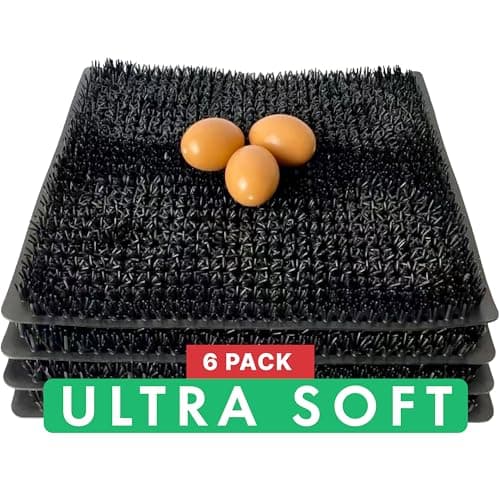
Pick 2 · Roll-away boxes, and anyone tired of buying pads
LUMERAM Ultra Soft Washable Chicken Nesting Pads, 6 Pack
Silicone rather than excelsior, so it washes and goes back in. The right answer for a roll-away nest box, where loose bedding cannot be used at all.
What the numbers say
The manufacturer does not publish the dimensions this calculation needs, so we do not print a number.
Figures from LUMERAM published specifications (Amazon listing) · Food-grade silicone
This is the pad type a roll-away nest box needs. Those boxes work by letting the egg roll out, and the published two inches of loose nesting material is exactly what stops that - so a thin washable mat is the only bedding that fits the design.
Washable changes the arithmetic. Excelsior pads are a running cost forever; a silicone mat is bought once and rinsed, which over a few seasons is the cheaper route even at a higher sticker price.
The listing claims the surface stops eggs rolling and breaking. Read that carefully against your own setup - in a conventional nest that is exactly what you want, and in a roll-away box it is the opposite of the mechanism you paid for.
Silicone is not absorbent, which is the trade against excelsior. It wipes rather than wicks, so a wet nest stays wet until you deal with it.
Good
- Washable and reusable rather than a repeat purchase
- The correct bedding for a roll-away box, where loose material cannot be used
- Food-grade silicone stands up to pecking and scratching
- No shavings to end up on the coop floor
Not so good
- Does not absorb moisture the way excelsior does - it wipes clean instead
- Highest price per pad here
- The listing does not publish pad dimensions to check against the 12in nest
- Some hens take longer to accept a smooth mat than a shavings pad
Skip this if: your nest boxes get genuinely damp. Silicone does not wick moisture away from the egg, and in a wet nest an absorbent excelsior pad does more for you.
#ad · how this is funded · price as of September 21, 2026
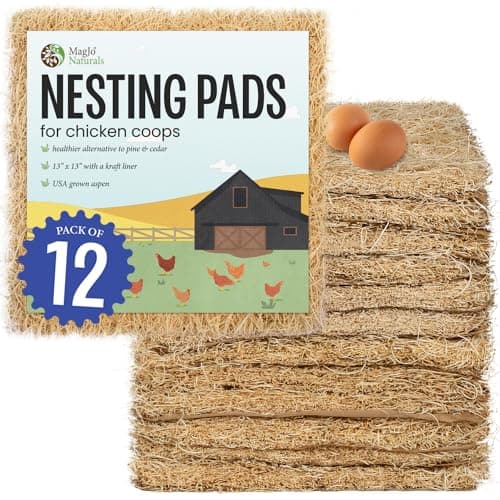
Pick 3 · Buying a year at a time
MagJo Aspen Nesting Pads, 13x13, 12 Pack
Twelve USA-grown aspen pads with a kraft backing, and a listing that explains the one thing that matters - droppings fall through rather than sitting on the egg.
What the numbers say
The manufacturer does not publish the dimensions this calculation needs, so we do not print a number.
Figures from MagJo published specifications (Amazon listing) · 13"x13" pads, 12 per pack · Aspen excelsior on a kraft paper backing
The construction detail in the listing is the useful part: the kraft backing holds the shavings together while letting droppings fall through and get trapped underneath, rather than collecting on the surface the egg lands on.
Twelve pads is roughly a year of monthly swaps on a two-nest coop, which is the realistic replacement rate for a small flock that is not dealing with wet litter.
Aspen is named specifically, and the listing argues it is healthier than pine or cedar. Cedar is genuinely the one to avoid in an enclosed coop; the pine question is less clear cut, and we are not going to referee it beyond what the listing claims.
There are no published pad dimensions beyond 13x13 in the listing, and no thickness figure. Against the published two inches of nesting material, every pad in this category is thinner - the pad is a different approach, not a compliant one.
Good
- Twelve per pack - roughly a year for a small flock
- Kraft backing lets droppings fall through instead of sitting on the egg
- Aspen rather than pine or cedar, stated on the listing
- 13 inches square, matching the published nest size
Not so good
- Still a disposable, repeating cost
- No published thickness to compare against the two-inch guidance
- Bulk pack takes dry storage you may not have
- More pads than a one or two nest coop needs at once
Skip this if: you run roll-away boxes. Those need a thin washable mat that an egg can roll across, and a thick excelsior pad is working against the mechanism.
#ad · how this is funded · price as of September 21, 2026
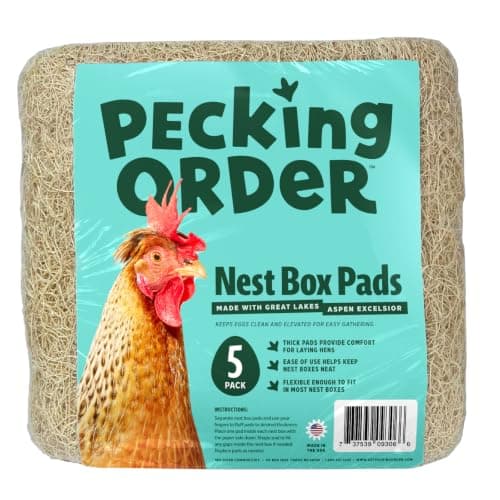
Pick 4 · Trying pads without committing to a bulk pack
Pecking Order Nest Box Pads, 13 x 13, Aspen Excelsior, 5 Pack
Five USA-grown aspen pads at the published nest size - the cheapest way to find out whether your hens take to a pad at all.
What the numbers say
The manufacturer does not publish the dimensions this calculation needs, so we do not print a number.
Figures from Pecking Order published specifications (Amazon listing) · 13"x13" pads, 5 per pack · Aspen excelsior on a kraft paper backing
Five pads is the right quantity for an experiment. Most flocks have one or two nests in use on the published one-per-four-or-five-hens ratio, so five pads is a season of swaps rather than a garage full of stock.
The listing makes a point worth repeating: eggs get buried in straw or pine shavings, and an excelsior pad keeps them on top where you can see them. Collecting early is published egg-eating prevention, and you cannot collect what you cannot find.
Aspen rather than pine is the stated wood. Our bedding guide explains why cedar is the one to avoid outright; aspen and pine are both acceptable, and aspen is the lower-resin option.
Kraft paper backing is the same construction as the bigger brands. At this size the differences between excelsior pads are small, and price per pad is a fair way to choose.
Good
- Cheapest entry to the format - five pads rather than ten or twenty
- 13 inches square, matching the published nest size
- Keeps eggs visible on top rather than buried in loose bedding
- USA-grown aspen, stated on the listing
Not so good
- Five pads runs out fast if you swap them often
- Disposable, so the cost repeats
- Per-pad price is higher than the bulk packs
- Thinner than the two inches of material the published guidance calls for
Skip this if: you already know pads work for you. The bulk packs cost less per pad, and buying five at a time is paying a premium for caution you no longer need.
#ad · how this is funded · price as of September 21, 2026
What a pad will not fix
If your eggs are dirty, a pad is treating the surface. The usual cause is hens sleeping in the nest boxes and fouling them overnight, and that is a roost problem - roost bar length is the fix, and Penn State's nest guidance is to site boxes at least four feet from the roosts for the same reason.
If hens are laying on the floor instead, a fresh pad helps a little by making the box smell and feel like a nest, but how many nesting boxes covers the actual reasons a box gets rejected.
Where to go next
- Roll-away nest boxes - where a washable pad is compulsory rather than optional
- Nesting boxes - the boxes themselves, and what a good one looks like
- How many nesting boxes - the ratio, and why more is not better
- Coop bedding - the floor litter question, judged on moisture
Questions people actually ask
+What are chicken nesting pads for?
+What size are chicken nesting pads?
+Are nesting pads better than shavings?
+Do I need nesting pads for a roll-away nest box?
+Are washable nesting pads worth it?
+How often should nesting pads be changed?
Sources
- Penn State Extension - Prevention of egg eating in chickens (one 12in x 12in nest per 4-5 hens, never fewer than 4 boxes; nests 2ft off the ground and 4ft from roosts; 2 inches of nesting material at all times; collect eggs early; prevention is the only proven treatment)
- eXtension Small and Backyard Poultry - Egg eating by chickens in small and backyard flocks (egg eating usually starts from accidental breakage; one 12in nest per 4-5 hens, never fewer than six boxes; 2 inches of nesting material as protective padding; cull a confirmed egg eater)
- University of Minnesota Extension - Raising chickens for eggs (3-5 sq ft indoor space per bird; one nest box per 4-5 birds)
- Penn State Extension - Small-scale poultry housing
Read next
Roll-away nest boxes, measured against the published nest
Roll-out nest boxes judged on the published 12in nest, one per four to five hens, and the two inches of bedding a roll-away box cannot hold.
Nesting boxes, and the six-box three-hen coop
How many boxes a flock needs, why coops oversupply them, and what to do when you genuinely are short.
How many nesting boxes a flock needs
The per-flock box count, why coops oversupply boxes at the cost of floor area, and how to fix hens that will not use them.
Coop bedding, judged on moisture
Shavings, straw, sand and hemp compared on absorbency and running cost, plus how the deep litter method actually works.
Coop gear, ranked by the problem it solves
The gear that fixes what coops arrive without - doors, mesh, roosts, boxes, heat and airflow - in buying order.
Roost bar length, height and shape
Per-bird bar length by breed, the flat-versus-round question, mounting height, and how to add bar without carpentry.