Nesting boxes, and the six-box three-hen coop
Extra nest boxes look like generosity in a listing. They are taken out of the same footprint, which means they cost you floor.
We have not handled these coops, and we do not pretend to have. Here is what we did instead. Links to Amazon earn us a commission at no extra cost to you - disclosure.
| # | Coop | Best for | Honest count | Price |
|---|---|---|---|---|
| 1 | 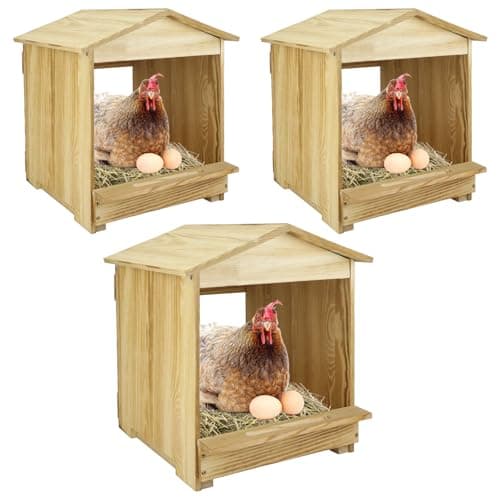 Generic 3-Compartment Wall-Mount Nesting BoxTop pickThree compartments, wall-mounted. At the published one-box-per-four-hens figure that covers a twelve-bird flock. | Twelve hens' worth of boxes | not published | |
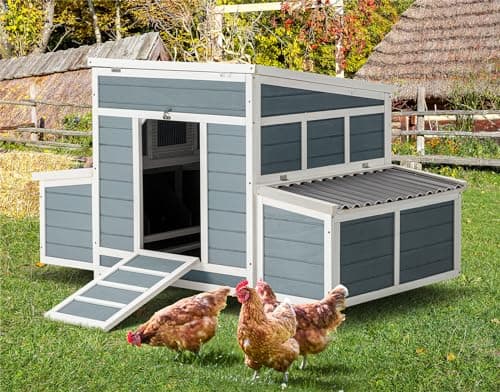
| 2 | 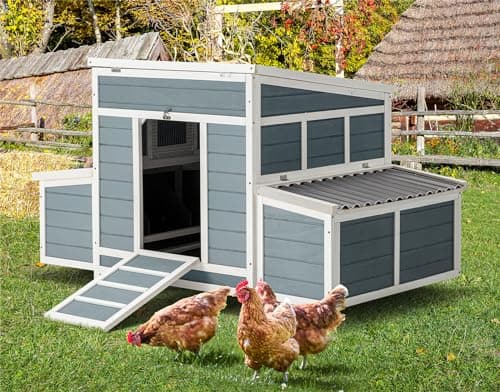 AECOJOY 56" Coop with 6 Nesting Boxes13.5 sq ft against a claim of six. Three hens of floor and six nesting boxes is exactly backwards. | Nest boxes, if that is what you are short of | 3box says 6 | Check price#ad |
Nest boxes are the most oversold component in the category. A listing that advertises six of them reads as generous, and the boxes come out of the same molded or framed volume as the henhouse. On a coop that measures 13.5 square feet whole-unit, six boxes are a substantial fraction of the space the birds could otherwise stand in.
How many you actually need
| Hens | Boxes needed |
|---|---|
| 1-4 hens | 1 |
| 5-8 hens | 2 |
| 9-12 hens | 3 |
| 13-16 hens | 4 |
| 17-20 hens | 5 |
Published extension guidance puts it at one box per four to five birds, and we use the conservative end. The behavioral reality underneath the number is that hens do not distribute themselves evenly across boxes: a flock of ten with three boxes will often produce most of its eggs in one of them, and adding a fourth box changes nothing about that.
What a good box looks like
- Roughly 12 by 12 by 12 inches for standard hens - big enough to turn in, small enough to feel enclosed.
- Dim. Hens prefer a dark, private box, and a bright one gets used less.
- Below roost height. If boxes are the highest place in the coop, the flock sleeps in them.
- With a lip at the front so bedding and eggs stay in.
- Accessible from outside if you can, for collection - but that lid then needs a proper latch.
- Removable or wipeable. Boxes need cleaning more often than the coop floor.
When you genuinely are short
The case that does come up is a large flock in a metal walk-in with a small henhouse, or a coop whose boxes are too small for heavy breeds. A wall-mounted multi-compartment box adds capacity without taking floor from the henhouse, which is the right way round.
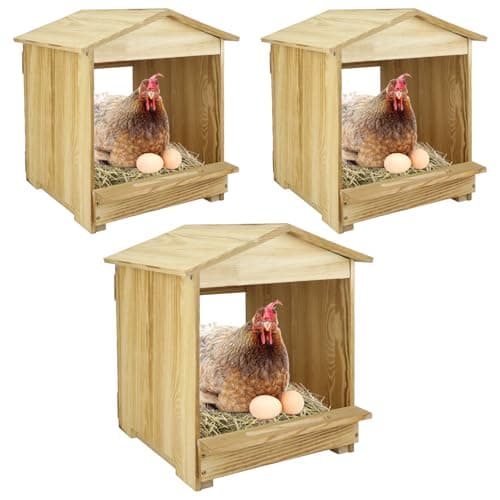
Top pick · Twelve hens' worth of boxes
Generic 3-Compartment Wall-Mount Nesting Box
Three compartments, wall-mounted. At the published one-box-per-four-hens figure that covers a twelve-bird flock.
What the numbers say
The manufacturer does not publish the dimensions this calculation needs, so we do not print a number.
Figures from Generic published specifications (Amazon listing)
One nest box per four hens is the published guidance, so three boxes covers twelve birds. Most coops here ship with more boxes than their floor area justifies.
Wall-mounting is what recovers floor area - an external or wall-hung box keeps the coop floor for standing and roosting.
Hens queue for a favorite box regardless of how many you provide. Adding boxes past the guidance does not stop that; it just adds cleaning.
Good
- Wall mounting keeps floor area free
- Three boxes suits a flock up to twelve
- Simple to retrofit to an existing coop
Not so good
- Needs a sound wall to carry the weight
- Wooden boxes need liners or pads to stay clean
- Fixed compartment size
Skip this if: you keep four hens or fewer. One box is genuinely enough, and you would be cleaning three.
Pick 2 · Nest boxes, if that is what you are short of
AECOJOY 56" Coop with 6 Nesting Boxes
13.5 sq ft against a claim of six. Three hens of floor and six nesting boxes is exactly backwards.
What the numbers say
56.3in x 34.5in = 13.5 sq ft of whole-unit footprint, which includes the attached run and is therefore generous. At 4 sq ft per standard hen that is 3 birds, against a claim of 6.
Figures from AECOJOY published specifications (Amazon listing) · 56.3"L x 34.5"W x 34"H · Wood
13.5 sq ft is three standard hens. The listing claims four to six, so the top of the range is double what the floor supports.
Six nesting boxes for three hens of floor space is the clearest case on this site of a spec sheet optimizing for the wrong number. Hens share boxes; the published guidance is one per four birds. Two would be generous here.
34.5in of depth is decent for the size class - the length is what is missing.
Good
- Good depth-to-length ratio for a compact coop
- Genuinely fits a small yard
- Plenty of nest boxes if you are expanding later
Not so good
- Six is double the honest count
- Six nest boxes is four more than three hens need
- 34in height means cleaning on your knees
Skip this if: the six-bird figure is why you are looking at it. Three is the number, and the nest-box count is not evidence to the contrary.
Bedding and box hygiene
Nest bedding gets changed more often than floor litter - it is where eggs sit, and a soiled box produces dirty eggs and encourages birds to lay elsewhere. Straw, shavings or a washable nest pad all work. See coop bedding for the materials comparison. If dirty or eaten eggs are the reason you are here, roll-away nest boxes move the egg out of the nest within seconds - at the cost of the two inches of bedding the published guidance asks for.
Questions people actually ask
+How many nesting boxes do I need for 6 chickens?
+What size should a chicken nesting box be?
+Why won't my chickens use the nesting boxes?
+Do more nesting boxes mean more eggs?
Sources
Read next
Coop gear, ranked by the problem it solves
The gear that fixes what coops arrive without - doors, mesh, roosts, boxes, heat and airflow - in buying order.
Roosting bars, and how much bar a flock needs
The published per-bird roost length, why flat beats round, and how to add bar without carpentry.
How many nesting boxes a flock needs
The per-flock box count, why coops oversupply boxes at the cost of floor area, and how to fix hens that will not use them.
Coop bedding, judged on moisture
Shavings, straw, sand and hemp compared on absorbency and running cost, plus how the deep litter method actually works.

Latches a raccoon cannot open
Why hook-and-eye and spring catches fail, the two-motion principle that works, and where every coop needs a latch it did not ship with.
The best chicken coops, ranked by what they actually hold
The flagship roundup. Twelve coops ranked on measured floor area against the maker's own bird-count claim.