Chicken coop lights, checked against the published schedule
Egg production drops in winter because the days get short, and a light on a timer can hold it up. Most coop lights are sold on brightness. The published guidance is about timing, color and darkness.
We have not handled these coops, and we do not pretend to have. Here is what we did instead. Links to Amazon earn us a commission at no extra cost to you - disclosure.
| # | Coop | Best for | Honest count | Price |
|---|---|---|---|---|
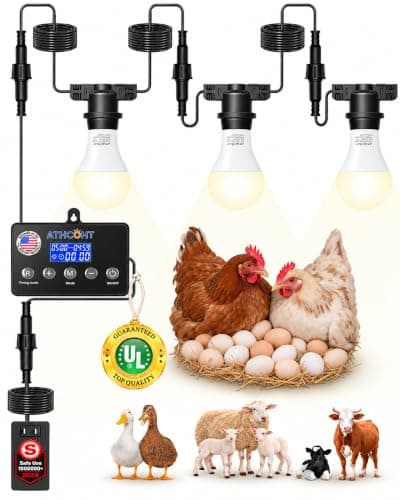
| 1 | 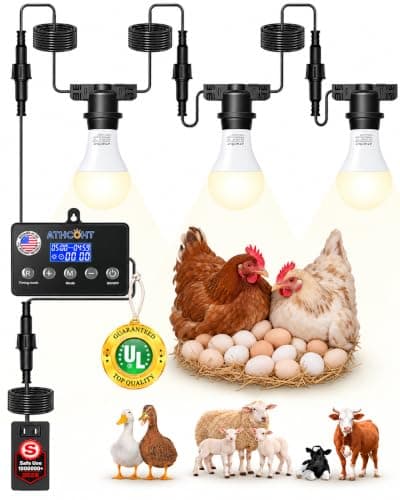 ATHCOHT Chicken Coop Light with Timer, Automatic LED Daylight BoostTop pickCustom start and stop times, ten brightness levels and a gradual dawn fade - the plug-in light here that can actually run the morning schedule Penn State describes. | Adding morning light on a real clock schedule | not published | |
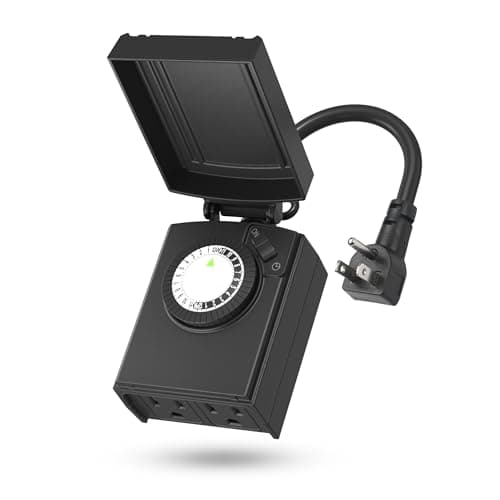
| 2 | 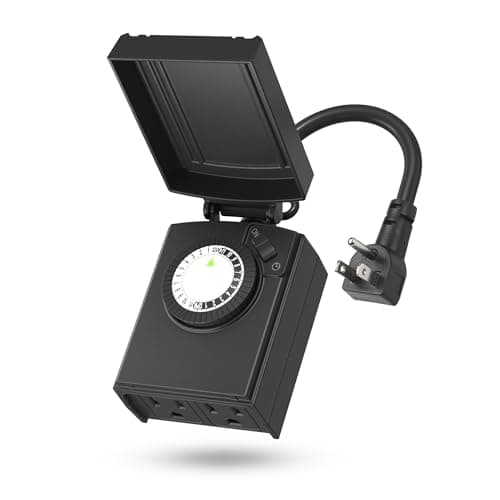 BN-LINK Outdoor 24-Hour Mechanical Timer Outlet, 2 Grounded OutletsPenn State says an inexpensive time clock is how to add morning light. This is one - ETL listed, rated outdoors, and it keeps its settings through a power cut. | The time clock the extension guidance actually describes | not published | |
| 3 | 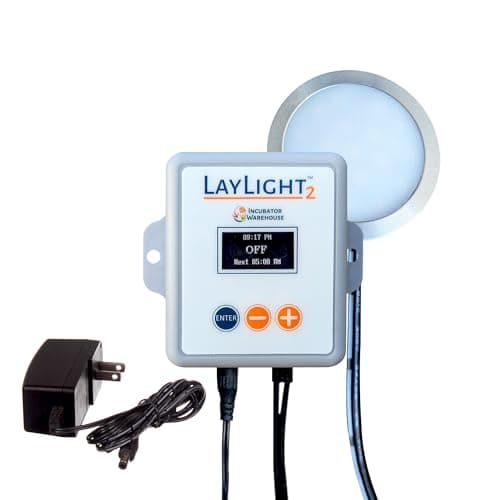 Incubator Warehouse AutoCoop LayLight2 with Smart TimerA compact 18-LED light with a programmable timer from a brand that sells poultry equipment rather than general lighting. Sized by its maker for coops up to 50 square feet. | Small coops, from a poultry-specific maker | not published | |
| 4 | 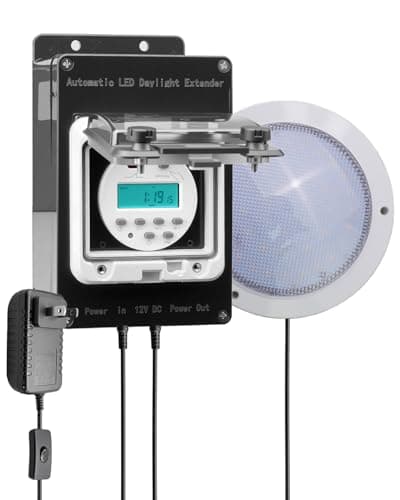 DYVBXS Automatic Chicken Coop LED Light Timer Daylight ExtenderA 9 watt warm LED panel with a programmable timer and an IP65 controller - the cheapest plug-in light here that says warm at all. | A warm light and a timer at the lowest plug-in price | not published | |
| 5 | 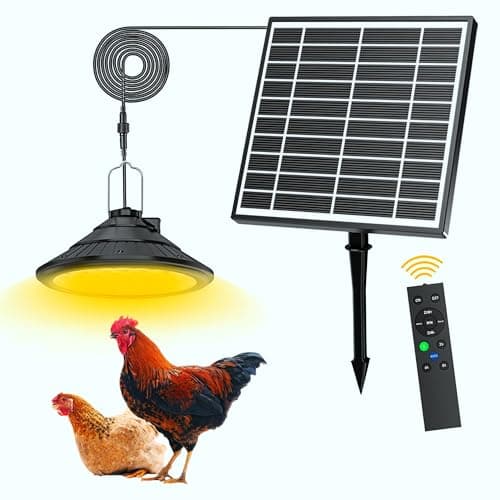 TSJKPAYL Solar Chicken Coop Light with Timer, 3-Color DimmableA warm-white solar light with a 16.4 foot cord and a published -4F rating. The honest option for a coop with no power - provided you understand what its timer can and cannot do. | No power at the coop, used with care | not published |
Every autumn the same thing happens in backyard flocks. The days shorten, and egg production falls away or stops. Nothing is wrong with the birds - laying is driven by day length, and a short day is a signal to stop.
Supplemental light is how laying hens are kept in production through winter - eXtension describes exactly that - and it works in a backyard coop too. It is also a decision rather than a requirement. If you do not add light, the consequence the extension sources describe is fewer eggs in winter. That is the whole trade, and it is a legitimate choice either way.
If you do want winter eggs, the useful thing to know is that almost every buying mistake in this category is a timing mistake rather than a brightness one.
What the extension services publish
Three extension services cover this, and they agree on the shape of it. The figures below are read off their pages.
| Measure | Published figure | Source |
|---|---|---|
| Hours of light a day | Aim for 16 for mature layers; 14-16 for year-round production | Penn State Extension |
| Hours of light a day | About 14 for optimal production | University of Minnesota Extension |
| When to add it | Early morning, letting the natural sunset send birds to roost | Penn State; Minnesota |
| How fast to change it | No more than 1 hour difference each week | Penn State Extension |
| Minimum intensity | Half a foot-candle (5 lux) | Penn State; eXtension |
| Bulb color | Warm, rated under 3500K | Penn State Extension |
| Darkness | Hens still need a dark period - they need sleep | Penn State Extension |
| Never | Decrease the lighting period on birds in production | Penn State Extension |
Two of those rows deserve attention because they are where most setups go wrong: add light in the morning, and never let the total fall.
Why the light goes in the morning
University of Minnesota Extension gives the reason in five words: chickens can not see well in the dark. Hens go to roost as natural light fades. If you extend the day at the evening end instead, the light switches off at a fixed time and the flock is plunged into darkness wherever it happens to be standing - on the floor, in the run, away from the roost.
Adding light before dawn avoids that entirely. The birds wake to the artificial light, the real sunrise takes over, and the real sunset sends them up to roost gradually the way it always did. Penn State describes exactly this arrangement: light in the early morning, and let the natural sunset tell the birds when to come back to the coop.
Working out your own schedule
Two refinements matter. First, do not jump straight to the target. Penn State says to change the photoperiod by no more than one hour a week, so if your natural day is currently twelve hours, reaching sixteen takes four weeks of stepping the timer earlier. Second, Minnesota Extension points out that after December 20 the days start lengthening again, so the timer needs adjusting to keep the total steady rather than letting it drift.
Never let the total fall
Penn State's laying-flock guide is blunt about this: never decrease the lighting period on birds in production, or they will stop laying. That turns a lighting setup from a convenience into something that has to be reliable, because a light that fails for a few days is not neutral - it is a decrease.
- A timer that loses its settings in a power cut and comes back blank has decreased the day. The mechanical timer on this page states that it keeps its settings through a power failure - check any other timer for the same.
- A solar light whose battery runs flat in a gray December week has decreased the day, in the one month solar charging is weakest. The same physics limits solar coop doors - see solar coop doors.
- Stopping the light abruptly in spring because the eggs are back has decreased the day. Step it down by no more than an hour a week, the same as stepping it up.
Brightness: less than you think
Penn State publishes a minimum of half a foot-candle, or 5 lux, to stimulate egg production, and eXtension gives the same half foot-candle figure for birds past the brooding stage. That is a low light level. A coop does not need to be lit like a workshop, and the brightest light on the shelf is not the best one for the job.
No coop light listing we found publishes the light level it produces at bird height, because that depends on your coop - its size, the mounting height and the color of the walls. Listings give LED counts, watts and coverage claims instead. The practical check is a light meter at roost height, or a phone lux app as a rough guide.
Penn State also says to use bulbs of no more than 30 to 40 watts. That figure is written in the terms of older bulbs, and it does not translate into LED watts - a modern LED produces far more light per watt. We are not going to publish a conversion we cannot source. Treat it as confirmation that the target is modest, and set dimmable lights low.
Color: warm, under 3500K
Penn State recommends warm bulbs rated under 3500K, and eXtension notes that hens need warm-white lamps for the correct spectral output, with more orange and red. Cool white is aimed at chicks, not layers.
This is where listings are least helpful. Most coop lights we checked either describe themselves as warm with no Kelvin figure, or say nothing about color at all. At least one coop light sold specifically for egg production states 4000K - above the published ceiling. Where a listing gives no number, we say so on the pick rather than assuming it passes.
The dark period is not optional
Penn State says it in plain words: make sure hens still get a dark period - they need sleep, too. It also warns that too long a photoperiod causes stress, and that light-stressed birds become restless and flighty and may peck at each other.
That rules out one feature common on solar coop lights: dusk-to-dawn mode, where the light switches on when it gets dark and off when it gets light. For a yard or a shed that is sensible. In a coop it means light all night and no dark period at all, which is the opposite of the published guidance. If a light you own has that mode, do not use it in the coop.
How we judged
- Clock-time scheduling. Can it switch on at a set time in the morning without you there? This outranks everything else, because without it the published schedule cannot be run.
- A published color temperature under 3500K - or, where none is published, an honest note that the listing does not say.
- Dimming, because the published minimum is low and a light stuck at full brightness overshoots it.
- Reliability of the schedule. Does it hold its settings through a power cut? Does a flat battery shorten the day?
- Power. Mains is the reliable option; solar is the option for coops with no power, and its limits are stated.
- Safety. Rated housings and a real certification where one is published, given the fire risk in a dry, dusty coop.
Plug-in against solar, honestly
| Plug-in on a clock timer | Solar with a countdown timer | |
|---|---|---|
| Morning schedule | Yes - set a start time and leave it | Only if you start it by hand before dawn |
| Holds the day length | Yes, if the timer keeps its settings | Only while the battery holds out |
| December performance | Unaffected | Weakest charging of the year |
| Dark period | Controlled by the timer | Lost entirely if dusk-to-dawn mode is used |
| Installation | Needs safe mains power at the coop | No wiring - panel outside, light inside |
If you can run power safely to the coop, a plug-in light on a clock timer is the setup the published guidance describes, and it is the reliable one. Solar is the right answer only for a coop with no power, and it works best as an understood compromise rather than a set-and-forget solution.
The ranked picks
Top pick · Adding morning light on a real clock schedule
ATHCOHT Chicken Coop Light with Timer, Automatic LED Daylight Boost
Custom start and stop times, ten brightness levels and a gradual dawn fade - the plug-in light here that can actually run the morning schedule Penn State describes.
What the numbers say
The manufacturer does not publish the dimensions this calculation needs, so we do not print a number.
Figures from ATHCOHT published specifications (Amazon listing) · 5"L x 4"W x 6"H · LED with an IPX7 controller
The specification that matters is custom start and stop times on the controller. Penn State's advice is to add light in the early morning and let the natural sunset send birds to roost, and that needs a timer that switches on at a clock time - not one that counts down from when you pressed a button.
Gradual transitions of 15, 30 or 60 minutes are a genuine help at the edges. The listing frames it as not startling the birds, and a slow fade is simply a gentler thing to do in a coop full of roosting hens than a switch.
Ten brightness levels from 10% to 100% let you set the light for the coop you have rather than the one the maker imagined. Penn State's published minimum is half a foot-candle at the birds, which is dim - brighter is not better.
The listing does not publish a color temperature, and Penn State recommends warm bulbs rated under 3500K. That is the question to ask before buying, and the listing does not answer it. The 50 to 100 chicken coverage figure is the maker's claim.
Good
- Custom start and stop clock times - can run a true morning schedule
- Ten brightness levels, so it can be set dim rather than blinding
- 15, 30 or 60 minute gradual dawn and dusk transitions
- IPX7-rated controller with sealed joints
Not so good
- No published color temperature, so the under-3500K guidance cannot be checked
- The most expensive light on this page
- Needs mains power run safely to the coop
- The 50-100 chicken coverage figure is the maker's, not a measured one
Skip this if: you have no power at the coop and no plan to run it properly. An extension cord across a run to a light in a dry, dusty coop is exactly the fire risk Penn State warns about.
#ad · how this is funded · price as of September 17, 2026
Pick 2 · The time clock the extension guidance actually describes
BN-LINK Outdoor 24-Hour Mechanical Timer Outlet, 2 Grounded Outlets
Penn State says an inexpensive time clock is how to add morning light. This is one - ETL listed, rated outdoors, and it keeps its settings through a power cut.
What the numbers say
The manufacturer does not publish the dimensions this calculation needs, so we do not print a number.
Figures from BN-LINK published specifications (Amazon listing) · 3"L x 2.25"W x 11.5"H · Rainproof outdoor housing
Penn State Extension's own wording is that an inexpensive time clock can be installed to turn lights on in the morning hours and let the birds go to roost with the natural sunset. That is precisely what a 24-hour mechanical timer does, and nothing more complicated is required.
Forty-eight pins give 30-minute steps. That is coarse, and for this job it is enough - you are setting a morning start time, not scheduling a light show.
The listing states it retains its pin settings if the power fails. That matters more than it sounds, because Penn State is blunt that the lighting period should never be decreased on birds in production, and a timer that resets to nothing after an outage does exactly that.
It is only half of a lighting setup. You still need a fixture and a warm bulb, and Penn State's advice is bulbs rated under 3500K and no more than 30 to 40 watts - with a clear warning about fire risk from any wiring in a coop.
Good
- Exactly the inexpensive time clock Penn State Extension describes
- Clock-time start, so it can add light in the morning rather than the evening
- ETL listed and rated for outdoor use
- Keeps its settings through a power failure
Not so good
- It is a timer only - no light, fixture or bulb in the box
- 30-minute steps, with no gradual dawn fade
- Pins have to be moved by hand as the seasons change
- The listing says to mount it upright two feet above ground, which constrains siting
Skip this if: you do not already have, or want to install, a safe enclosed light fixture in the coop. A timer switching a bare bulb hanging near dry bedding solves the schedule and creates a fire hazard.
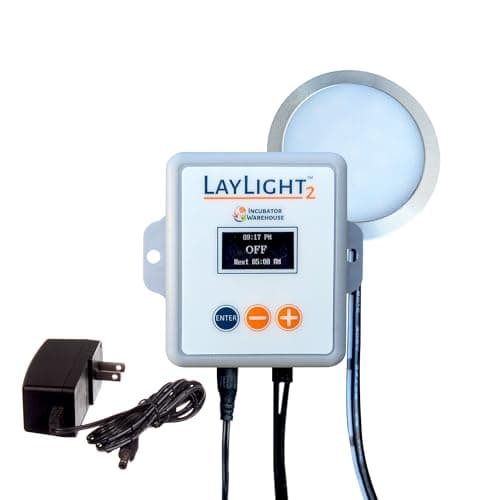
Pick 3 · Small coops, from a poultry-specific maker
Incubator Warehouse AutoCoop LayLight2 with Smart Timer
A compact 18-LED light with a programmable timer from a brand that sells poultry equipment rather than general lighting. Sized by its maker for coops up to 50 square feet.
What the numbers say
The manufacturer does not publish the dimensions this calculation needs, so we do not print a number.
Figures from Incubator Warehouse published specifications (Amazon listing) · 2.63 in diameter light head; maker states coops up to 50 sq ft · LED
The flat-pack coop-and-run kits measured on this site mostly fall between about 12 and 21 square feet on the whole-unit basis, comfortably inside the 50 square feet the maker states for this light. That makes it a better fit for a typical backyard kit than lights sized for barns.
The listing describes a programmable timer with multiple settings and a manual on switch. It does not spell out whether it can be set to a clock-time morning start, and that is the one thing worth confirming in the manual before relying on it for the morning schedule.
At 2.63 inches across the light head is small, which is useful in a low coop where there is nowhere out of reach of the birds to mount a large fixture.
The listing does not publish a color temperature. Penn State recommends warm bulbs rated under 3500K, so that is an open question rather than a known pass.
Good
- Maker sizes it for coops up to 50 sq ft - typical backyard scale
- Programmable timer plus a manual on switch
- Very small light head, easy to mount out of reach
- From a poultry equipment brand rather than a general lighting one
Not so good
- Listing does not confirm a clock-time morning start - check the manual
- No published color temperature
- 50 sq ft ceiling means it is undersized for a walk-in coop
- Needs mains power at the coop
Skip this if: your coop is a walk-in or larger than 50 square feet. The maker sizes it for small coops, and an undersized light in a large henhouse leaves corners dim.
#ad · how this is funded · price as of September 17, 2026
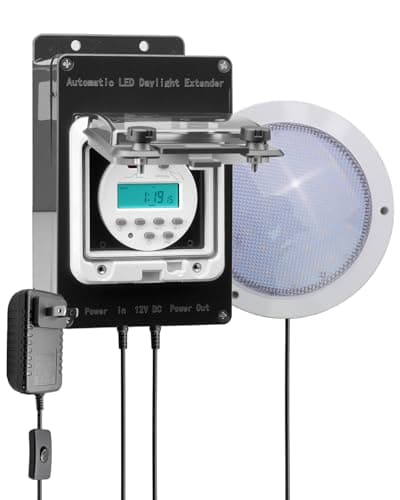
Pick 4 · A warm light and a timer at the lowest plug-in price
DYVBXS Automatic Chicken Coop LED Light Timer Daylight Extender
A 9 watt warm LED panel with a programmable timer and an IP65 controller - the cheapest plug-in light here that says warm at all.
What the numbers say
The manufacturer does not publish the dimensions this calculation needs, so we do not print a number.
Figures from DYVBXS published specifications (Amazon listing) · 9W warm LED panel, 42 LEDs · LED panel with aluminum backplate
The listing describes the light as warm, which is the right direction against Penn State's guidance of warm bulbs under 3500K. It does not give a Kelvin figure, so warm is the maker's word rather than a number you can check.
Nine watts of LED is not comparable to the 30 to 40 watt figure in Penn State's guidance, which is written in the terms of older bulbs. We are not going to invent a conversion - wattage stopped describing brightness when LEDs arrived.
The timer is described as programmable with manual on and off. As with any light here, confirm it can start at a set morning time rather than only counting down from when you switch it on.
An aluminum backplate for heat dissipation and an IP65-rated controller are sensible specifications for a dusty, damp building, and both are stated rather than implied.
Good
- Cheapest plug-in coop light here that describes itself as warm
- Programmable timer with manual on and off
- IP65-rated controller
- Aluminum backplate for heat dissipation
Not so good
- Warm is stated with no Kelvin figure to check
- No dimming or gradual dawn transition listed
- Listing does not confirm clock-time scheduling
- Needs mains power at the coop
Skip this if: you want to dim the light down to the low level Penn State says is sufficient. It lists a timer and on/off control but no brightness adjustment.
#ad · how this is funded · price as of September 17, 2026
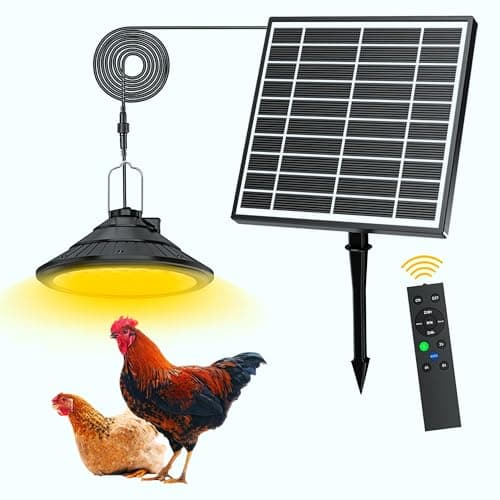
Pick 5 · No power at the coop, used with care
TSJKPAYL Solar Chicken Coop Light with Timer, 3-Color Dimmable
A warm-white solar light with a 16.4 foot cord and a published -4F rating. The honest option for a coop with no power - provided you understand what its timer can and cannot do.
What the numbers say
The manufacturer does not publish the dimensions this calculation needs, so we do not print a number.
Figures from TSJKPAYL published specifications (Amazon listing) · 5W panel, 4500mAh battery, 16.4ft cord; rated -4F to 122F · LED with IP66 sealed housing and 5W solar panel
It offers a warm-white-only mode, which is the setting to use against Penn State's under-3500K guidance - though, like every light here, it publishes no Kelvin figure.
The timer is a countdown of 2, 4 or 8 hours rather than a clock. To add light in the morning you would have to start it before dawn, which nobody does for long. In practice a countdown timer adds light in the evening, which is the opposite of the published advice.
Avoid the dusk-to-dawn mode for this purpose. A light that stays on all night gives the birds no dark period at all, and Penn State says plainly that hens need one - they need sleep, too.
The battery figure is 48 hours after 6 hours of sun, at 10% brightness. December is the month with the least sun and the most need for light, and Penn State warns never to decrease the lighting period on laying birds - which is what a flat battery in a gray week does.
Good
- No wiring - the only honest option for a coop with no power
- Warm-white-only mode available
- Published operating range of -4F to 122F
- 16.4 foot cord lets the panel sit in sun while the light stays inside
Not so good
- Countdown timer, not a clock - cannot easily add morning light
- Dusk-to-dawn mode removes the dark period hens need
- 48 hour battery figure is at only 10% brightness
- Solar charging is weakest in exactly the months lighting is used
Skip this if: you have, or can safely run, mains power to the coop. A plug-in light on a clock timer does the published schedule reliably; a solar light does it only on good weeks, and a lighting period that drops is what stops hens laying.
#ad · how this is funded · price as of September 17, 2026
What we did not weigh
We have not handled any of these lights, and we have not measured the light any of them produce in a coop. What is above is the published specification, the published extension guidance and the comparison between them. Coverage figures and flock sizes on the picks are attributed to the makers who state them.
We have also left out any claim that more light means more eggs beyond what the sources say. The extension guidance is about holding production up through short days, within limits - more light than 16 hours is described as a stressor, not a bonus.
Where to go next
- Coop heaters - the other device that needs power at the coop, and the fire risk
- Cold climate coops - the rest of winter keeping, which matters more than any light
- Solar coop doors - the same December charging problem, applied to the pop door
- Coop gear in buying order - where a light sits against the things a coop actually needs
Questions people actually ask
+Do chickens need a light in the coop in winter?
+How many hours of light do laying hens need?
+Should I add light in the morning or the evening?
+What color light is best for a chicken coop?
+How bright should a chicken coop light be?
+Can I leave a light on in the chicken coop all night?
+Do solar chicken coop lights work in winter?
+When should I stop using a coop light?
Sources
- Penn State Extension - Artificial lighting for winter egg production (16 hours of light for mature layers; change no more than 1 hour a week; add light in the morning; minimum 1/2 foot-candle / 5 lux; warm bulbs under 3500K; hens still need a dark period)
- Penn State Extension - Management requirements for laying flocks (3 inches of feeder space per bird; feeder lip level with the birds' back height; trough filled only one-third to one-half full to prevent wastage; at least 5 gallons of water per 100 birds daily; 1 inch of water space per bird; never more than 12 hours without water; 14-16 hours of light per day; never decrease the lighting period on birds in production)
- University of Minnesota Extension - Caring for chickens in cold weather (about 14 hours of light daily; add light in the morning before sunrise because chickens cannot see well in the dark; adjust the timer after December 20)
- eXtension Small and Backyard Poultry - Lighting for small and backyard poultry flocks (half a footcandle after brooding; warm-white lamps for hens; LEDs are dimmable with good uniformity)
Read next
Coop heaters, and whether you need one
Flat radiant panels compared, with an honest answer first on whether heat is the right intervention at all.
Chicken coops for cold climates
Cold-climate coops ranked on the things that matter below freezing - dryness, roof geometry, ventilation and floor area per bird.
Solar automatic chicken coop doors
Solar pop doors ranked on opening size, mode range and safety stop - with the gray-week caveat stated plainly.
Coop gear, ranked by the problem it solves
The gear that fixes what coops arrive without - doors, mesh, roosts, boxes, heat and airflow - in buying order.
Chicken waterers, ranked on the published numbers
Heated, nipple and open waterers measured against the published 5 gallons per 100 birds daily, 1 inch of water space per bird, and the 12-hour rule.

Ventilation, not insulation
Why sealing a coop causes frostbite, where vents belong, and how to tell whether yours has enough.