Chicken swings and enrichment, in the right order
Enrichment is real and it is fourth on the list. Penn State names overcrowding, excessive light and inadequate feeder space as the causes of feather pecking - a swing redirects the behavior those create.
We have not handled these coops, and we do not pretend to have. Here is what we did instead. Links to Amazon earn us a commission at no extra cost to you - disclosure.
| # | Coop | Best for | Honest count | Price |
|---|---|---|---|---|
| 1 | 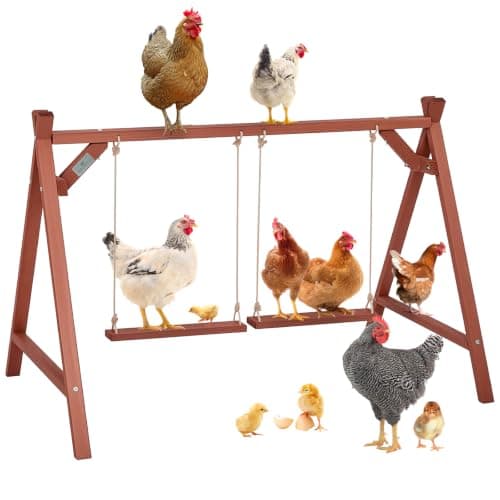 Petsfit Wooden Chicken Perch with 2 Swings for 6-8 ChickensTop pickThree roosting bars at different heights plus two swings, in fir - the only pick here that adds real perch length rather than just a toy. | Enrichment and roost bar in one structure | not published | |
| 2 | 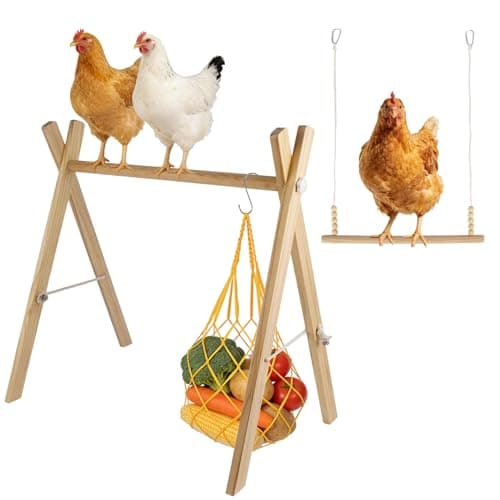 Dmnnlp Chicken Perch and Swing Set with Feeding NetA perch, a swing and a feeding net in one package - and the net is the part that matches the published enrichment advice most closely. | Enrichment with a greens feeder built in | not published | |
| 3 | 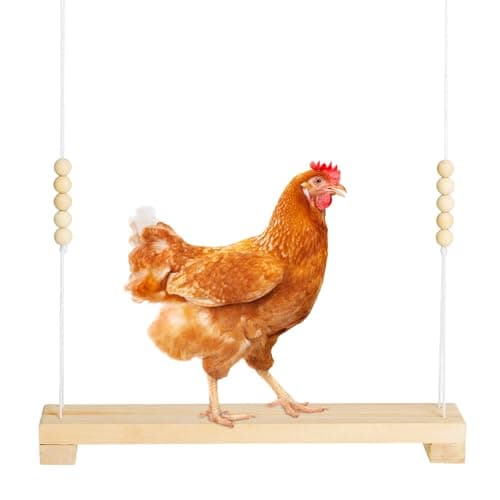 Jorewood 40cm Natural Wooden Chicken Swing Perch with BeadsA plain wooden swing with movable beads and a hanging toy, rated to hold 15kg - the low-cost way to find out if your birds use one at all. | The cheapest honest test of whether your flock cares | not published | |
| 4 | 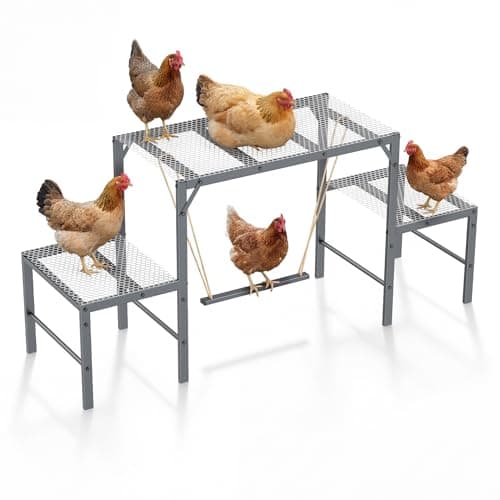 Magicfly Chicken Perch and Roosting Bar57.5in of metal roosting bar. Roost length is the spec people forget, and it is 8in per standard hen. | Adding roost length without carpentry | not published |
Search for a chicken swing and everything you find is charming. Search for why you might need one and you land somewhere less charming: a flock pecking each other's feathers out, and an owner looking for something to break the cycle.
Enrichment genuinely helps with that. It is also the fourth thing on a published list of four, and the first three are free.
The published list, in order
Penn State Extension's guidance on cannibalism names the causes plainly, and identifies stress as usually the main factor behind an outbreak.
| Cause | Published figure | What it costs |
|---|---|---|
| Overcrowding | 2 sq ft per bird from 16 weeks on | Free to diagnose, expensive to fix |
| Excessive light | No more than 16 hours of light per day | Free - change the timer |
| Inadequate feeder and waterer space | Competition at the feeder increases pecking | The price of a second feeder |
| Unbalanced nutrition | Diets short of protein and methionine promote pecking | The price of the right ration |
| Then: enrichment | Perches and toys redirect pecking | The products on this page |
Note the light row, because it connects two pages on this site. The same Penn State figure that caps supplemental lighting at 16 hours on the coop lights page appears here as a cause of pecking when it is exceeded. A flock lit too long is a flock under stress.
Note the crowding row too. The 2 square feet per bird figure in the cannibalism guidance is a floor for birds from 16 weeks, and this site works from 4 square feet per standard hen - the midpoint of the range Minnesota Extension publishes. If a coop is below either number, that is the problem, and no swing addresses it.
What the published advice actually recommends
Penn State's enrichment suggestions for backyard flocks are specific and cheap: perches in the coop, toys for mental stimulation, fresh greens like clover grass or weeds, and baled green leafy hay.
Two of those are free if you have a lawn. That shapes the picks below - the items that hold greens at bird height rank above the ones that are purely ornamental, because hanging a handful of weeds is the published advice and a net is how you do it without it being trampled into the litter.
Swings, honestly
- Some flocks use a swing constantly. Some ignore it for a year. Nobody can tell you in advance which you have, which is the argument for starting cheap.
- A swing is not roost bar. Birds sleep on something stable; a swinging perch is a daytime object, and the published 8 inches of bar per standard hen still has to come from somewhere.
- Hang it low the first week. A swing at head height is something birds walk under; one they can step onto from the ground gets investigated.
- Rope is the part that fails outdoors. Expect to replace it before the wood, and check it when you check the latches.
How we judged
- Whether it does anything beyond entertainment - added roost bar or a greens feeder both map onto published advice in a way a plain toy does not.
- Footprint against coop floor. Anything that lives inside the henhouse is competing with the floor area the birds needed.
- Published load or hook ratings where a maker gives them, because a perch that fails with a bird on it is worse than no perch.
- Materials that survive a run - treated or weather-rated wood, and hardware that will not rust out in a season.
- Price against the likelihood your flock ignores it entirely, which is a real outcome.
The picks
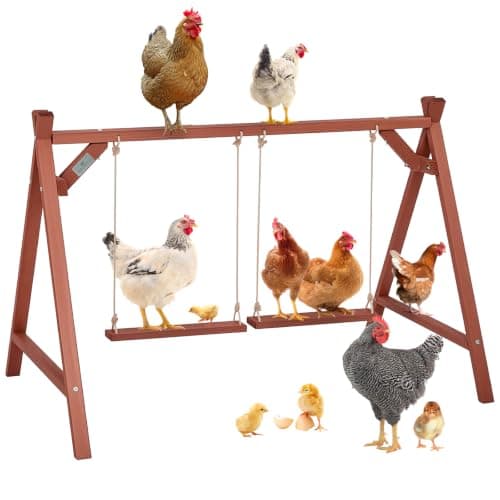
Top pick · Enrichment and roost bar in one structure
Petsfit Wooden Chicken Perch with 2 Swings for 6-8 Chickens
Three roosting bars at different heights plus two swings, in fir - the only pick here that adds real perch length rather than just a toy.
What the numbers say
The manufacturer does not publish the dimensions this calculation needs, so we do not print a number.
Figures from Petsfit published specifications (Amazon listing) · 50"L x 30"W x 34"H, maker states 6-8 hens · Weather-resistant fir wood
Penn State Extension's cannibalism guidance names adding perches to the coop alongside toys for mental stimulation, and lists overcrowding as a leading cause of feather pecking. This unit is the one here that addresses both at once.
Three bars at different heights is genuinely useful beyond enrichment. The published figure this site works from is 8 inches of roost bar per standard hen, and most coops ship short - see our roosting bars page.
Fifty inches by thirty is a real footprint. In a run that is fine; inside a small coop it is floor area you were told to defend, so site it outside the henhouse if the henhouse is tight.
The 6-8 hen figure is the maker's. Measure the actual bar length against 8 inches a bird before treating it as your roost solution rather than an addition to one.
Good
- Adds roost bar as well as enrichment, which no other pick here does
- Three heights lets birds sort themselves by preference
- Fir, weather-rated for use out in the run
- Two swings on one structure for a flock that shares
Not so good
- Largest footprint here at 50 by 30 inches
- The 6-8 hen claim is the maker's, not measured bar length
- Fir needs re-treating outdoors like any softwood
- The most expensive enrichment pick on this page
Skip this if: your coop floor is already tight. Fifty inches by thirty of structure inside a small henhouse takes the floor area the birds needed more than they needed a swing.
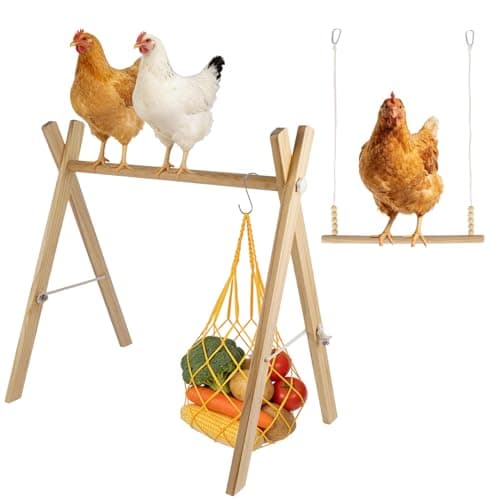
Pick 2 · Enrichment with a greens feeder built in
Dmnnlp Chicken Perch and Swing Set with Feeding Net
A perch, a swing and a feeding net in one package - and the net is the part that matches the published enrichment advice most closely.
What the numbers say
The manufacturer does not publish the dimensions this calculation needs, so we do not print a number.
Figures from Dmnnlp published specifications (Amazon listing) · 22.8"L x 10"W x 25.2"H perch; swing 15.7" x 17.7" · Solid wood, sanded
The feeding net is the most useful item in the box. Penn State's enrichment advice for backyard flocks names fresh greens like clover grass or weeds and baled green leafy hay - a net is how you hang those at bird height instead of leaving them on the floor to be trampled.
A perch and a swing together is a sensible pairing. Birds that will not use a swinging bar will use a fixed one, and the flock sorts out which it prefers without you buying twice.
At 22.8 inches the perch is short of a roost solution for any real flock - treat it as enrichment that happens to include a bar, not as roost bar length.
Pre-drilled for tool-free assembly and small enough to hang in most runs. The trade for compactness is that a flock of eight will queue for it.
Good
- Includes a feeding net for greens, which matches the published enrichment advice
- Perch and swing together, so birds pick what they like
- Compact enough for a small run
- Pre-drilled, assembles without tools
Not so good
- 22.8in perch is far too short to count as roost bar
- One swing, so a larger flock takes turns
- No published load rating
- Wood will need re-treating if it lives outdoors
Skip this if: you already have enough roost bar and just want the greens feeder. A net on its own costs a fraction of this, and the perch length here is not solving anything.
#ad · how this is funded · price as of September 21, 2026
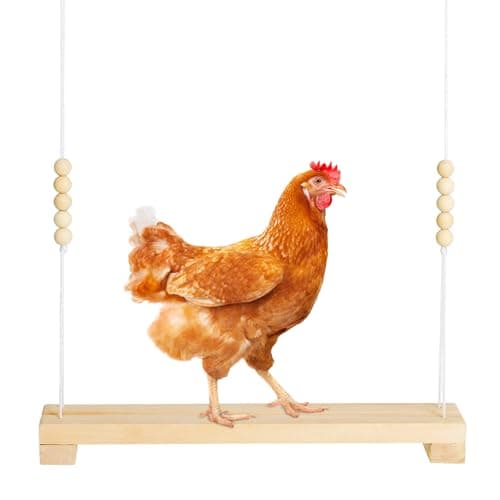
Pick 3 · The cheapest honest test of whether your flock cares
Jorewood 40cm Natural Wooden Chicken Swing Perch with Beads
A plain wooden swing with movable beads and a hanging toy, rated to hold 15kg - the low-cost way to find out if your birds use one at all.
What the numbers say
The manufacturer does not publish the dimensions this calculation needs, so we do not print a number.
Figures from Jorewood published specifications (Amazon listing) · 40cm bar; 3"L x 3"W x 16"H; listing states hooks hold up to 15kg · Treated wooden poles with rope
Some flocks use a swing constantly and some ignore it entirely, and nobody can tell you in advance which you have. At this price finding out is cheap, which is the strongest argument for this pick.
The published 15kg hook rating is worth noting because it is the only load figure in the category, and it means more than one bird can be on it without the fixing being the question.
Movable beads and a dangling toy give the pecking something to aim at. Penn State's cannibalism guidance is that redirecting pecking is the point of enrichment - stress and overcrowding are the causes, and a toy is a redirect rather than a cure.
Treated poles and reinforced hooks are claimed for weather resistance. A rope-hung swing outdoors is still a consumable; expect to replace the rope before the wood.
Good
- Cheapest way to test whether your flock uses a swing
- Publishes a 15kg hook rating, which nothing else here does
- Beads and a hanging toy give pecking a target
- Small enough to hang in a run without taking floor
Not so good
- Adds no roost bar - it is enrichment only
- Rope is the part that will fail first outdoors
- 40cm is short, so it is a one or two bird perch
- Some flocks simply ignore it
Skip this if: your birds are pecking each other. Penn State lists overcrowding, excessive light, and inadequate feeder space as the causes - a swing is the last item on that list, and fixing the first three matters far more.
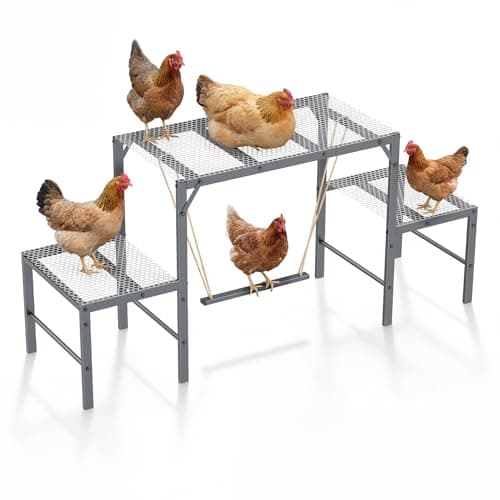
Pick 4 · Adding roost length without carpentry
Magicfly Chicken Perch and Roosting Bar
57.5in of metal roosting bar. Roost length is the spec people forget, and it is 8in per standard hen.
What the numbers say
The manufacturer does not publish the dimensions this calculation needs, so we do not print a number.
Figures from Magicfly published specifications (Amazon listing) · 57.48"L x 16.92"W x 26.96"H · Metal
57.5 inches of bar is roughly seven standard hens at the 8in-per-bird figure our calculator uses.
Roost space is the constraint people discover in winter, when birds huddle and the ones pushed off the bar sleep in the nest boxes - which is how you end up with dirty eggs.
Freestanding, so it works in a coop where you cannot easily fix a bar to the walls.
Good
- Adds real roost length with no carpentry
- Freestanding, so no wall fixing needed
- Metal will not harbor mites the way rough timber does
Not so good
- Takes up floor area you may not have
- Metal bars are colder underfoot than timber
- Not adjustable in height
Skip this if: your coop already has adequate roost length. Work it out first at 8in a bird - our calculator prints the figure.
The last pick is a plain roost perch rather than a swing. It is here because on the published list, perches come before toys - and if you are buying one thing for a bored flock in a coop that is short on bar, that is the one to buy.
Where to go next
- Roosting bars - the 8 inches per bird figure, and how most coops fall short
- Coop lights - where the 16-hour figure comes from, and why exceeding it is a stressor
- How much space one chicken needs - the first row of the table above
- Chicken feeders - feeder space, which is the third row
Questions people actually ask
+Do chickens actually use swings?
+Does enrichment stop chickens pecking each other?
+What is the best enrichment for chickens?
+Can a chicken swing replace a roosting bar?
+How high should a chicken swing hang?
+Are chickens bored in a small coop?
Sources
- Penn State Extension - Poultry cannibalism: prevention and treatment (overcrowding, excessive light, inadequate feeder and waterer space and unbalanced nutrition cause feather pecking; 2 sq ft per bird from 16 weeks; no more than 16 hours of light; perches, toys and greens redirect pecking)
- University of Minnesota Extension - Raising chickens for eggs (3-5 sq ft indoor space per bird; one nest box per 4-5 birds)
- Penn State Extension - Small-scale poultry housing
- eXtension Small and Backyard Poultry - Space allowances in housing (3-4 sq ft indoor / 10 sq ft outdoor per laying hen; states there is very little peer-reviewed research on backyard space allowances)
Read next
Roosting bars, and how much bar a flock needs
The published per-bird roost length, why flat beats round, and how to add bar without carpentry.
Chicken coop lights, checked against the published schedule
Plug-in and solar coop lights measured against Penn State's 16 hours, morning-only light, half a foot-candle and under-3500K guidance.
How much space one chicken needs
The per-bird floor figure by breed class and run access, with worked examples and the coops that actually meet it.
Chicken feeders, ranked on waste and rodents
Treadle, port and DIY feeders measured against the published 3 inches of feeder space per bird and 0.25 lb of feed per hen per day.
Coop gear, ranked by the problem it solves
The gear that fixes what coops arrive without - doors, mesh, roosts, boxes, heat and airflow - in buying order.
Roost bar length, height and shape
Per-bird bar length by breed, the flat-versus-round question, mounting height, and how to add bar without carpentry.