RUN-CHICKEN T50 against the Omlet door
The two automatic pop doors people actually cross-shop. One is compact and self-contained; the other is much larger and the only one here with closing safety sensors.
We have not handled these coops, and we do not pretend to have. Here is what we did instead. Links to Amazon earn us a commission at no extra cost to you - disclosure.
| # | Coop | Best for | Honest count | Price |
|---|---|---|---|---|
| 1 | 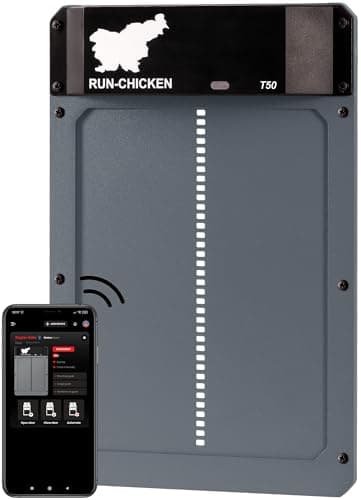 RUN-CHICKEN Door T50 Automatic OpenerTop pickBattery-powered aluminum with app and timer control. The one automatic door here that does not depend on winter sun. | The door that just keeps working | not published | |
| 2 | 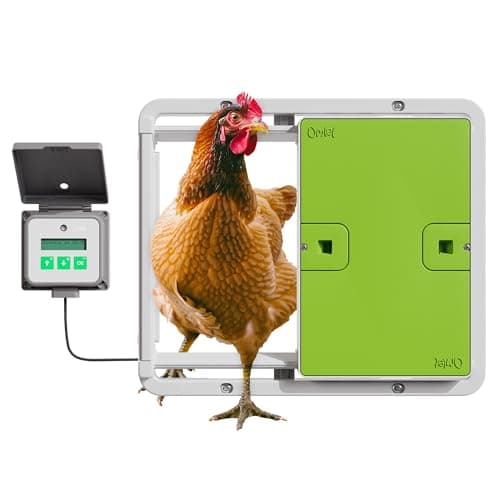 Omlet Automatic Coop Door OpenerThe biggest opening here at 19.25in, with safety sensors fitted - Omlet's door is on Amazon even though its coops are not. | Large openings and built-in safety sensors | not published |
These are the two automatic pop doors people put side by side, and the comparison is unusually clean because they are not really competing on quality. They are competing on size, and on one safety feature.
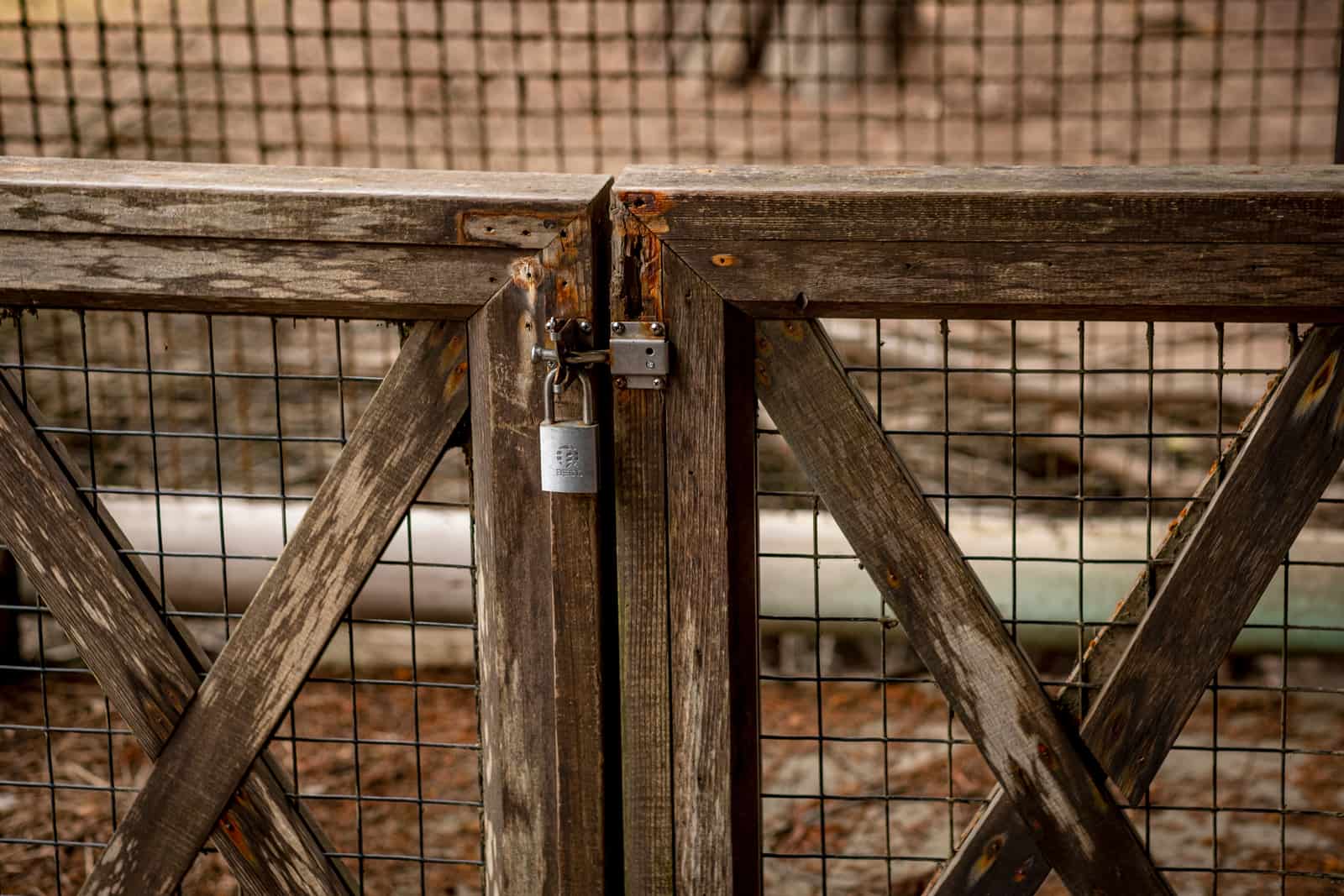
Everything below assumes you have already decided you want an automatic door at all. If you have not, automatic coop doors makes that case: shutting the flock in at dusk is the highest-value security habit in keeping chickens, and it is the one nobody keeps perfectly for years.
The specification that decides it
| RUN-CHICKEN T50 | Omlet Automatic Door | |
|---|---|---|
| Published dimensions | Compact, self-contained unit | 19.25"L x 2.25"W x 16.5"H |
| Opening size | Standard pop-door scale | The largest of any door we track |
| Safety sensors on closing | Not published | Built in |
| Trigger | Light sensor | Light sensor or timer |
| Fits a small flat-pack coop | Usually | Often not - measure first |
| Bulk | Low | Physically the bulkiest option here |
That first column is deliberately thin, and we are not going to pad it. The T50's own listing does not publish an opening figure the way Omlet's does, so we are not inventing one to make a tidier table.
Why opening size is not a small detail
A 19.25 inch opening is a genuinely different object from a standard pop door. In its favor: heavy breeds pass through without ducking, and a flock of eight or ten leaves at dawn in a stream rather than a queue.
Against it: you need a flat, unobstructed panel large enough to take the cutout, plus clearance above for the door to travel. Several of the small flat-pack coops measured on this site have no flat wall of that size anywhere on them, and no amount of wanting the bigger door changes that.
The safety sensor question
A light-triggered door closes on a schedule the flock has not agreed to. Most birds go in before full dusk on their own, and there is usually one that does not - a broody hen, a bird low in the pecking order waiting for the others to settle, or a pullet that has not learned the routine.
Omlet's door has sensors that stop or reverse it when something is in the opening. That addresses the failure in the mechanism rather than leaving it to how well you set the threshold, and it is the strongest single argument for it over anything else in the category.
It is a backstop rather than a substitute for setup, though. Set the closing threshold late enough for the slowest hen either way, check the coop every evening for the first week, and confirm with your own hand in the opening that the safety feature works on your unit before relying on it.
How we judged
- Whether it fits. Nothing else matters if the cutout does not exist on your coop wall.
- Safety on closing, because the last-bird problem is the failure that actually upsets people.
- Trigger options - a light sensor tracks the real season, a timer suits a coop under heavy tree cover where ground-level light is a poor proxy for dusk.
- Bulk and mounting, since a larger unit needs more panel and more clearance.
- What each leaves unsolved, which for both is everything other than the pop door.
Which one to buy
- Small or mid-size flat-pack coop - the T50, in most cases, because the Omlet will not fit the wall.
- Walk-in, shed conversion or large wooden coop - the Omlet, for the opening and the sensors.
- Large or heavy breeds - the Omlet, where a narrow pop door is a daily bottleneck.
- You have had a near miss with a door closing on a bird - the Omlet, for the sensors.
- Choosing mainly on price - neither; the generic solar units cost less and do the core job. Solar coop doors covers those.
The two doors
Top pick · The door that just keeps working
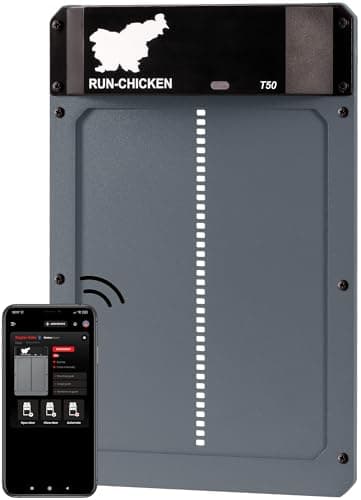
RUN-CHICKEN Door T50 Automatic Opener
Battery-powered aluminum with app and timer control. The one automatic door here that does not depend on winter sun.
What the numbers say
The manufacturer does not publish the dimensions this calculation needs, so we do not print a number.
Figures from RUN-CHICKEN published specifications (Amazon listing) · 13.8"L x 9.4"W x 1.3"H · Aluminum
Battery rather than solar is the important choice. A solar door's worst performance and your longest nights arrive in the same week, which is exactly when a door failing open costs you a flock.
Aluminum construction rather than plastic matters at the door itself, because this is the part a raccoon works at.
App and timer control both present, so it works whether or not you want it on your phone.
Good
- Battery power is unaffected by December daylight
- Aluminum door rather than plastic
- Timer and app control both supported
Not so good
- Batteries need replacing on a schedule you must remember
- Costs more than the solar units
- Opening size fixed by the unit
Skip this if: you have no way to check on it. Any automatic door needs an occasional look; a battery one needs its cells thought about before winter.
#ad · how this is funded · price as of September 21, 2026
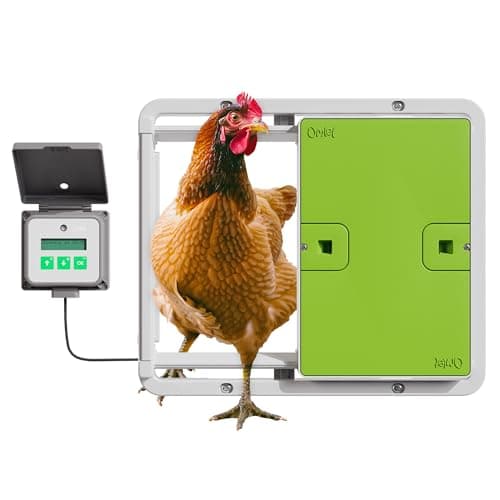
Pick 2 · Large openings and built-in safety sensors
Omlet Automatic Coop Door Opener
The biggest opening here at 19.25in, with safety sensors fitted - Omlet's door is on Amazon even though its coops are not.
What the numbers say
The manufacturer does not publish the dimensions this calculation needs, so we do not print a number.
Figures from Omlet published specifications (Amazon listing) · 19.25"L x 2.25"W x 16.5"H
At 19.25 inches this is much the largest unit here, which matters if you keep larger birds or want the flock through the door quickly at dawn.
Built-in safety sensors are the feature worth paying for. A door that closes on a slow bird is the failure mode people discover the hard way.
Worth noting that Omlet's coops are sold direct rather than on Amazon, but this door is not - so unlike the Eglu, it is something we can actually link.
Good
- Largest opening of the doors here
- Built-in safety sensors on closing
- Light sensor or timer operation
Not so good
- Needs a coop wall big enough to take it
- More expensive than the generic solar units
- Physically the bulkiest option
Skip this if: your coop wall cannot take a 19in cutout. Measure the flat panel area before ordering - several of the small coops on this site cannot accept it.
#ad · how this is funded · price as of September 21, 2026
What neither of them does
Both close one opening. Your main access door, the nest-box lid and the clean-out tray still need a latch a raccoon cannot open, inadequate mesh is still inadequate, and nothing about a pop door stops anything that digs under the perimeter.
Automating the pop door removes the routine failure. It does not remove the hardware requirement, and a coop that is otherwise open is not made secure by a door that closes on time.
Where to go next
- Automatic coop doors - the wider field, including budget and solar units
- The Omlet door reviewed in full - opening size, sensors and the cutout it demands
- The RUN-CHICKEN T50 reviewed - trigger, power and cold-weather behavior
- Cold-weather coop doors - if your winter is the deciding factor
Questions people actually ask
+Is the Omlet door better than the RUN-CHICKEN T50?
+How big is the Omlet automatic coop door?
+Which automatic coop door has safety sensors?
+Will the Omlet door fit a small chicken coop?
+Do I still need latches if I have an automatic door?
Sources
- Penn State Extension - Small-scale poultry housing
- University of Minnesota Extension - Raising chickens for eggs (3-5 sq ft indoor space per bird; one nest box per 4-5 birds)
- University of Maine Cooperative Extension - Small flock poultry publication 2227e
- Michigan State University Extension - Backyard poultry housing
Read next
Automatic chicken coop doors
Automatic pop doors compared on trigger, power source, opening size and what happens when it is 10 degrees out.
Omlet Automatic Coop Door Opener
Omlet automatic pop door reviewed on opening size, safety sensors, trigger, power and the cutout it demands.
RUN-CHICKEN Door T50 Automatic Opener
An automatic pop door reviewed on what actually matters - trigger, power, opening size and cold-weather behavior.
Automatic coop doors for cold weather
Pop doors judged on what actually breaks them in winter - battery chemistry, track geometry and whether you can tell it failed.
Solar automatic chicken coop doors
Solar pop doors ranked on opening size, mode range and safety stop - with the gray-week caveat stated plainly.
Latches a raccoon cannot open
Why hook-and-eye and spring catches fail, the two-motion principle that works, and where every coop needs a latch it did not ship with.