Coop wheel kits, and the gap underneath
A wheel kit turns a static coop into a movable one for a fraction of buying a tractor. The choice that matters is whether the wheels stay down - because a coop permanently off the ground is a coop with harborage under it.
We have not handled these coops, and we do not pretend to have. Here is what we did instead. Links to Amazon earn us a commission at no extra cost to you - disclosure.
| # | Coop | Best for | Honest count | Price |
|---|---|---|---|---|
| 1 | 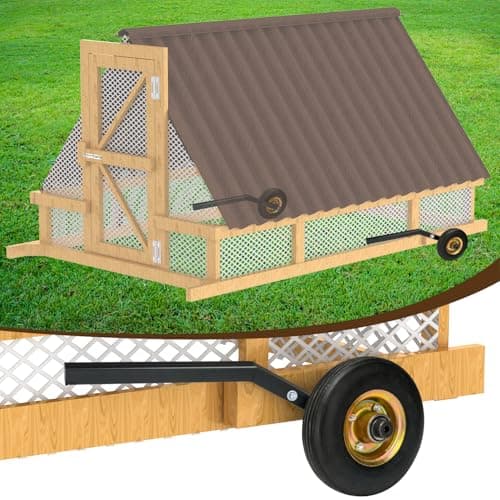 TOPOWN Chicken Coop Wheel Lift Kit, Set of 2Top pickA swing-arm lift: pull the arm and the coop rises onto its wheels, push it back and the coop sits on the ground again. The mechanism the cheap kits do not have. | Wheels that lift the coop, then get out of the way | not published | |
| 2 | 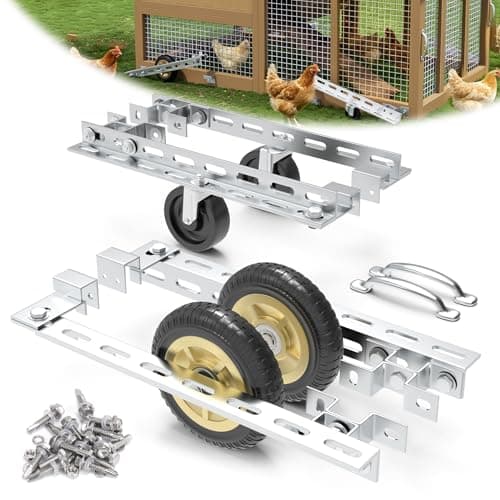 Pearwow Chicken Coop Wheels Kit with Handles, 4 Pack Heavy Duty CastersFour wheels rather than two, and the only kit here that publishes what it will carry - 360 pounds, with 4 inch swivel casters and 5 inch rear wheels. | A published load rating, on four wheels | not published | |
| 3 | 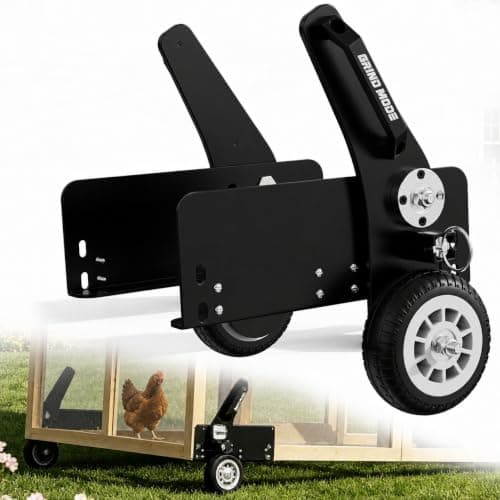 GRIND MODE Chicken Tractor Wheel Lift Kit, Set of 2Six-inch lifting wheels on solid puncture-proof tires, with spring locking latches to stop the coop shifting once it is down. | Rough ground, and puncture-proof tires | not published | |
| 4 | 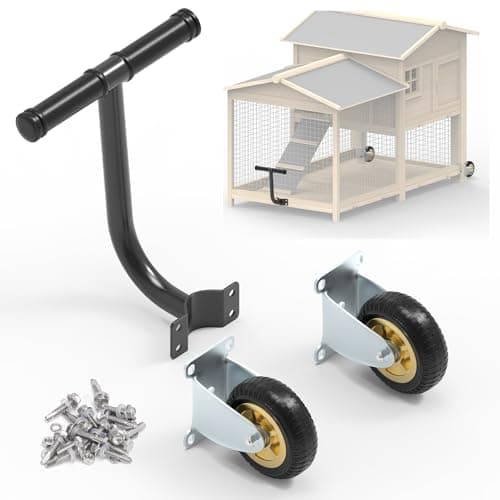 Flehomo Chicken Coop Wheels Kit, 2 Pack 4in Casters with Lifting HandleTwo four-inch casters and a lifting handle, with a no-drill mounting option - the entry price for turning a coop you already own into one you can move. | The cheapest way to make a static coop movable | not published |
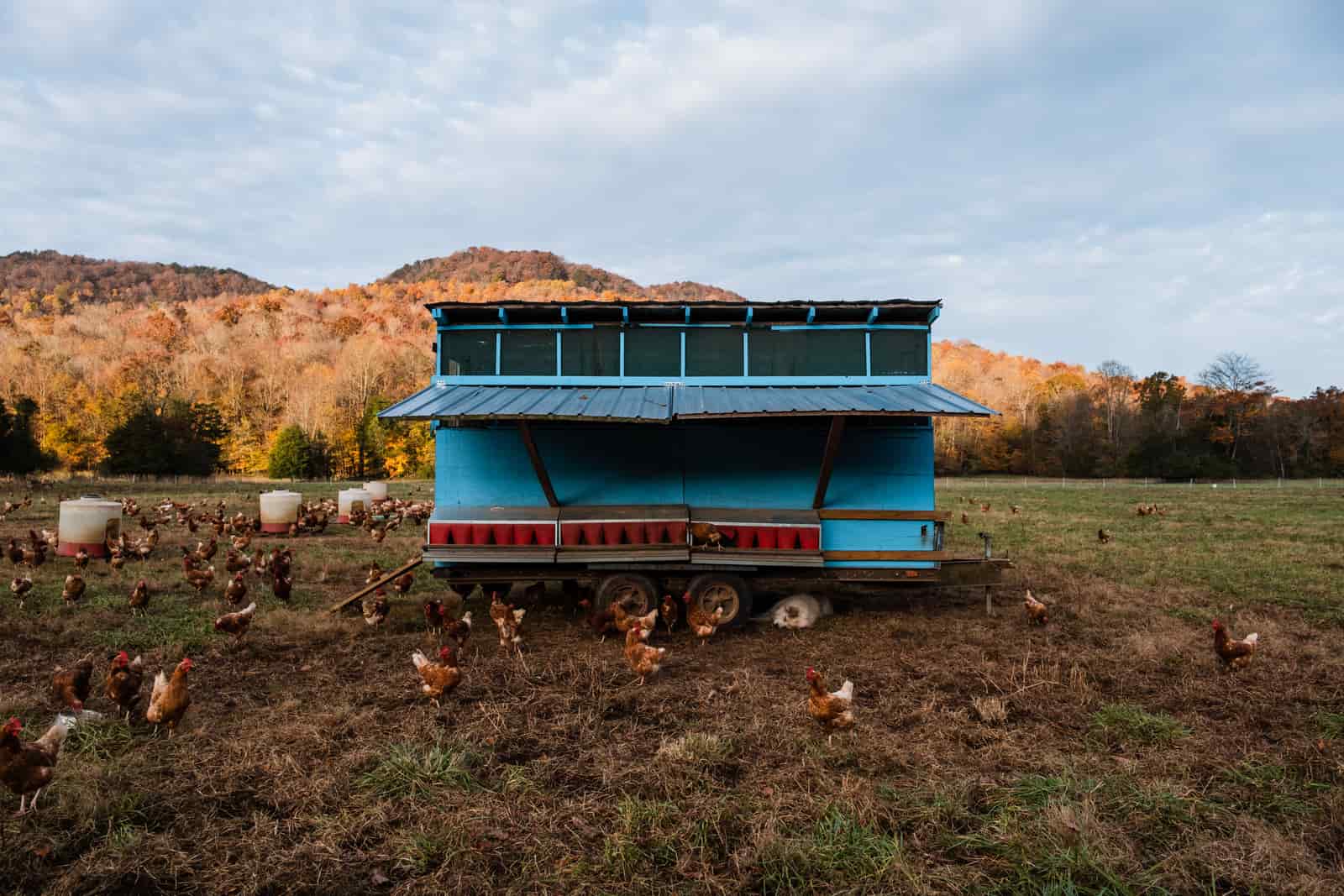
The case for moving a coop is the same case mobile tractors make: a static coop turns its patch to bare mud, keeps the parasite cycle running in one place, and concentrates droppings where the birds stand. Moving it fixes all three, and grass recovers.
The trouble with buying a tractor for that is the ceiling. Anything one person can genuinely move caps out around 21 square feet on the measured coops on this site, which is three or four birds. A wheel kit sidesteps that entirely - you keep the coop you have and make it movable.
Casters or a lift - this is the whole decision
| Fixed casters | Lift kit | |
|---|---|---|
| How it moves | Always on wheels - push it | Swing an arm to raise, move, lower again |
| Between moves | Coop stays up on the wheels | Coop sits back down on the ground |
| Gap underneath | Permanent | Only while you are moving it |
| Cost | Lower | Higher |
| Moving parts | Wheels only | A mechanism that lives outdoors |
| Best for | Light coops on firm level ground | Anything you want sealed to the ground at night |
The gap row is the one people discover late. A coop resting on permanent casters sits a few inches off the ground, and that space is dry, sheltered and undisturbed - which is a precise description of what a rat colony is looking for. Rats in the chicken coop covers why harborage matters as much as feed.
That does not make caster kits wrong. It makes them a kit you pair with a skirt, or accept the gap on a coop you move often enough that nothing settles under it.
Load rating is the specification almost nobody publishes
One kit on this page publishes a figure - 360 pounds. The other three publish nothing at all, and that is the single biggest gap in this category. A loaded coop is heavier than people estimate: the structure, the litter, the feeder, the waterer and the birds.
Where no rating exists, judge conservatively and look at what the kit is made of rather than what the listing claims. Thickened alloy or galvanized steel with rubber tires is a different proposition from a plastic castor, and every pick here is the former.
How we judged
- Whether the coop returns to the ground. A lift mechanism ranks above fixed casters here because of harborage, not convenience.
- Published load rating, and honesty about its absence. One kit publishes a figure; we say so on the three that do not.
- Wheel diameter. Bigger wheels cross rough and soft ground; small casters stop at the first tussock and bog down in turf.
- Tire type. Solid rubber cannot puncture and cannot go flat over winter, which matters more than rolling resistance on a coop.
- Whether it can move between coops, which changes the arithmetic for anyone running more than one mobile unit.
- Mounting flexibility - drill and no-drill options, and whether the hardware is included.
The picks
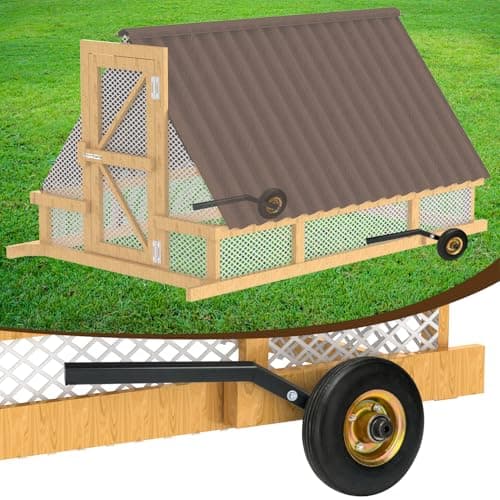
Top pick · Wheels that lift the coop, then get out of the way
TOPOWN Chicken Coop Wheel Lift Kit, Set of 2
A swing-arm lift: pull the arm and the coop rises onto its wheels, push it back and the coop sits on the ground again. The mechanism the cheap kits do not have.
What the numbers say
The manufacturer does not publish the dimensions this calculation needs, so we do not print a number.
Figures from TOPOWN published specifications (Amazon listing) · 25.6"L x 5.91"W x 9.84"H per unit, set of 2 · Powder-coated alloy steel
The lift is the feature worth paying for, and not for convenience. A coop resting on permanent wheels sits above the ground with a gap underneath, and that gap is harborage - the sheltered space rats want. A lift kit puts the coop back down on the ground between moves.
Operation is stated simply: swing the arm to raise and lock the wheels, swing it again to lower. That is a one-person job by design, which is the point of the whole category.
The listing notes the kit can be moved between coops, so one set can serve several tractors. For anyone running more than one mobile unit that changes the arithmetic considerably.
Powder-coated alloy steel is a better specification than painted mild steel for something living outdoors, but no load rating is published - which, on a lift mechanism, is the figure you would most want.
Good
- Lifts the coop onto the wheels, then lowers it back to the ground
- No permanent gap under the coop for rodents to use
- One-person operation by design
- Can be moved between coops rather than fixed to one
Not so good
- No published load rating on a mechanism that carries the whole coop
- Set of two, so it handles one end at a time
- More moving parts than a plain caster - more to seize outdoors
- Needs a flat, solid rail on the coop to mount to
Skip this if: your coop has no solid frame rail to bolt to. A lift kit puts the whole loaded weight through its mounting points, and thin cladding is not a mounting point.
#ad · how this is funded · price as of September 21, 2026
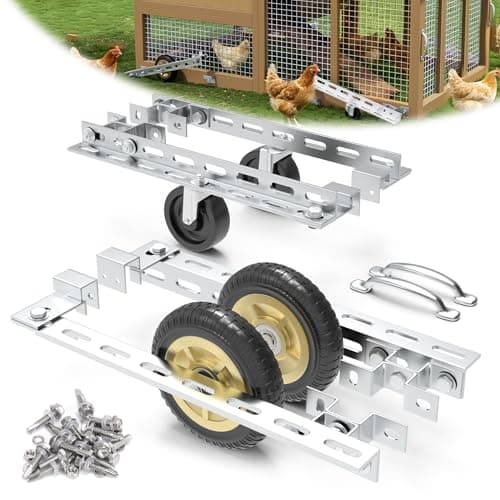
Pick 2 · A published load rating, on four wheels
Pearwow Chicken Coop Wheels Kit with Handles, 4 Pack Heavy Duty Casters
Four wheels rather than two, and the only kit here that publishes what it will carry - 360 pounds, with 4 inch swivel casters and 5 inch rear wheels.
What the numbers say
The manufacturer does not publish the dimensions this calculation needs, so we do not print a number.
Figures from Pearwow published specifications (Amazon listing) · 4" swivel casters, 5" rear wheels; supports up to 360 lbs · Thickened rubber on galvanized steel
A published load figure is the specification that separates a kit you can trust from one you are guessing about, and 360 pounds is a real number to measure your coop against rather than a claim of heavy duty.
Four wheels changes the job. Two wheels and a lift is a wheelbarrow; four wheels is a trolley, and a loaded coop rolls rather than being carried at one end.
The split sizing - 4 inch swivel at the front, 5 inch fixed at the back - is the sensible arrangement. Swivels steer, larger fixed wheels at the back carry and track straight.
Swivel casters are the weak point on soft ground. They catch in turf in a way a large fixed wheel does not, which is a real limitation in exactly the wet run this is meant to escape.
Good
- Publishes a load rating - 360 lbs - which most kits do not
- Four wheels, so the coop rolls rather than being lifted at one end
- Sensible split sizing, swivels at the front and larger fixed wheels behind
- Rubber on galvanized steel, rated for outdoor use
Not so good
- Swivel casters bog down in soft turf
- 360 lbs is comfortably under a loaded walk-in coop
- Four mounting points means four chances to get the alignment wrong
- No lift mechanism - the wheels are always down
Skip this if: you want the coop to sit flat on the ground between moves. These wheels stay down, which leaves a gap underneath - and a gap under a coop is exactly where rats set up.
#ad · how this is funded · price as of September 21, 2026
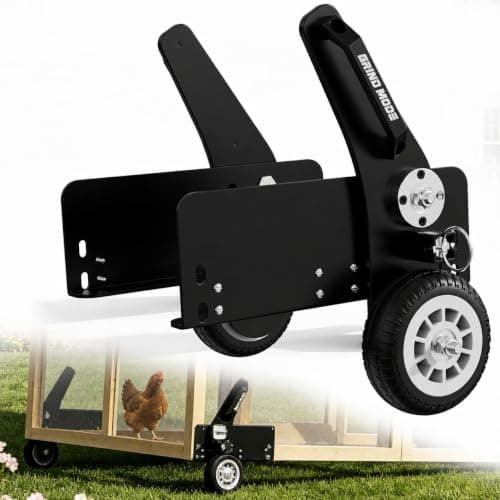
Pick 3 · Rough ground, and puncture-proof tires
GRIND MODE Chicken Tractor Wheel Lift Kit, Set of 2
Six-inch lifting wheels on solid puncture-proof tires, with spring locking latches to stop the coop shifting once it is down.
What the numbers say
The manufacturer does not publish the dimensions this calculation needs, so we do not print a number.
Figures from GRIND MODE published specifications (Amazon listing) · 13"L x 4.72"W x 4.72"H per unit, 6in wheels, set of 2 · Thickened alloy steel with solid rubber tires
Six inches is the largest wheel here, and wheel diameter is what decides whether a coop crosses rough ground or stops at the first tussock. On grass, bigger genuinely is better.
Solid puncture-proof tires remove the one failure that leaves a coop stranded mid-move. A pneumatic tire rolls better and goes flat in a shed over winter; solid rubber does neither.
Spring locking latches to stop the coop sliding after it is set down is a detail the cheaper kits skip, and it matters on any slope at all.
Like the other lift kit here, it publishes no load rating - so measure your coop and judge conservatively rather than assuming the mechanism is rated for it.
Good
- Six-inch wheels, the largest here, for rough or soft ground
- Solid puncture-proof tires - nothing to go flat
- Spring locking latches hold the coop in place once lowered
- Hardware for two different mounting methods included
Not so good
- The most expensive wheel kit on this page
- No published load rating
- Solid tires roll harder than pneumatic on hard surfaces
- Set of two, so one end at a time
Skip this if: you are moving a light coop across a flat lawn. Six-inch solid wheels and a locking lift are built for ground that fights back, and on a mown level yard the cheap caster kit does the same job.
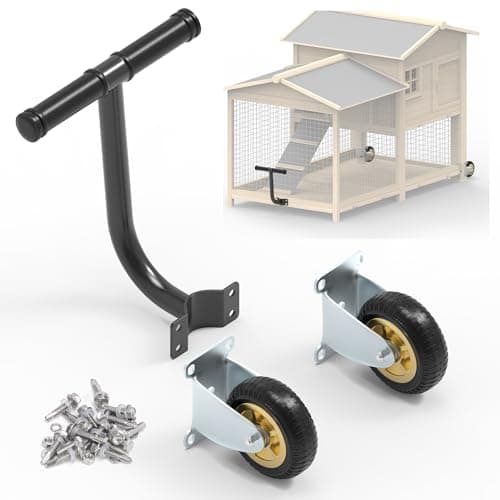
Pick 4 · The cheapest way to make a static coop movable
Flehomo Chicken Coop Wheels Kit, 2 Pack 4in Casters with Lifting Handle
Two four-inch casters and a lifting handle, with a no-drill mounting option - the entry price for turning a coop you already own into one you can move.
What the numbers say
The manufacturer does not publish the dimensions this calculation needs, so we do not print a number.
Figures from Flehomo published specifications (Amazon listing) · 4" caster wheels; 3.9"L x 3.9"W x 1.5"H per wheel · Rubber wheels on thickened galvanized steel
The reason to move a coop is fresh ground. A static coop turns its patch to bare mud and keeps the parasite cycle running in the same place; moving it breaks both, which is the whole argument the the mobile tractor page makes for the format.
Two wheels and a handle is the wheelbarrow arrangement: the wheels take one end, you lift the other. That works up to the weight one person can actually lift, and no further.
A no-drill mounting option for the handle is stated, which matters if you would rather not put screws through a coop you are still paying off.
No load rating is published for this kit. That is the specification to want on anything holding a loaded coop, and its absence is the honest reason this sits below the rated kits here.
Good
- By far the cheapest route into a movable coop
- Drill or no-drill mounting for the handle
- Rubber on galvanized steel rather than bare plastic castors
- Two wheels plus a handle is all a light coop needs
Not so good
- No published load rating anywhere in the listing
- Four-inch wheels are small for rough or soft ground
- Two wheels means you are lifting the other end yourself
- Nothing here raises the coop - you tilt it
Skip this if: your coop is heavy or your ground is rough. Four-inch casters and a hand lift are for a light coop on firm, level ground, and a loaded walk-in is neither.
#ad · how this is funded · price as of September 21, 2026
How often to move it
Often enough that the grass under it survives, which in practice means before the patch goes bare rather than after. A coop that has killed its footprint has already concentrated the droppings and the parasite load you were moving it to avoid.
Mobility does not change the space arithmetic. A coop that houses four birds houses four birds on wheels, and how much space one chicken needs still applies. What moving buys is ground condition, not capacity.
Where to go next
- Mobile coops and tractors - buying the format outright instead of retrofitting
- Rats in the chicken coop - why the gap under a raised coop matters
- Run flooring - the other answer to a patch that has turned to mud
- Run extensions - if the problem is area rather than ground condition
Questions people actually ask
+Can you add wheels to an existing chicken coop?
+What is the difference between a caster kit and a lift kit?
+How much weight do chicken coop wheel kits hold?
+What size wheels do I need for a chicken coop?
+Why move a chicken coop at all?
Sources
- Penn State Extension - Small-scale poultry housing
- University of Minnesota Extension - Raising chickens for eggs (3-5 sq ft indoor space per bird; one nest box per 4-5 birds)
- Michigan State University Extension - Backyard poultry housing
- University of Minnesota Extension - Common concerns with backyard or urban poultry keeping (remove wet feed and soiled bedding; cleanliness reduces house mice and Norway rats)
Read next
Mobile chicken coops and tractors
Wheeled coops and tractors ranked on measured area, with the honest three-to-four-bird ceiling stated rather than buried.

Rats in the chicken coop
Why rats colonize a coop, the half-inch figure that excludes them, and the three purchases that close off feed, entry and harborage.
Chicken run flooring, and what actually fixes mud
Run flooring judged on drainage and cost per square foot - including why the cheapest answer is not a shipped product.

Run extensions for a coop you already own
Bolt-on runs ranked by measured area added, with the crucial distinction between what an extension fixes and what it does not.
Coop gear, ranked by the problem it solves
The gear that fixes what coops arrive without - doors, mesh, roosts, boxes, heat and airflow - in buying order.
How much space one chicken needs
The per-bird floor figure by breed class and run access, with worked examples and the coops that actually meet it.