The best chicken coops for beginners
A first coop needs three things: it has to be easy to clean, it has to be genuinely secure, and it has to be bigger than the number of birds you think you want.
We have not handled these coops, and we do not pretend to have. Here is what we did instead. Links to Amazon earn us a commission at no extra cost to you - disclosure.
| # | Coop | Best for | Honest count | Price |
|---|---|---|---|---|
| 1 | 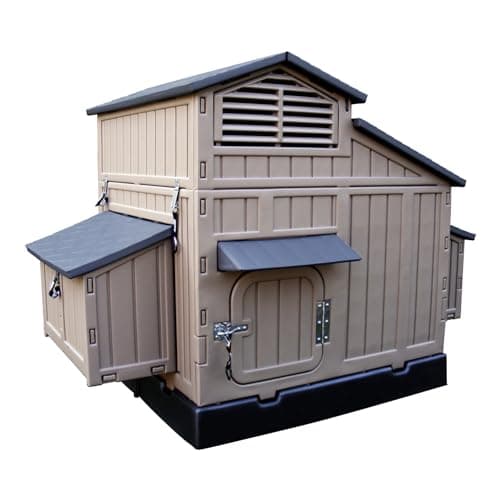 Hatching Time Formex Snap Lock Large Chicken CoopTop pickThe one coop here whose material genuinely earns its price, sized for four hens rather than the six on the box. | Cleaning, and cold that stays out | 4box says 6 | |
| 2 | 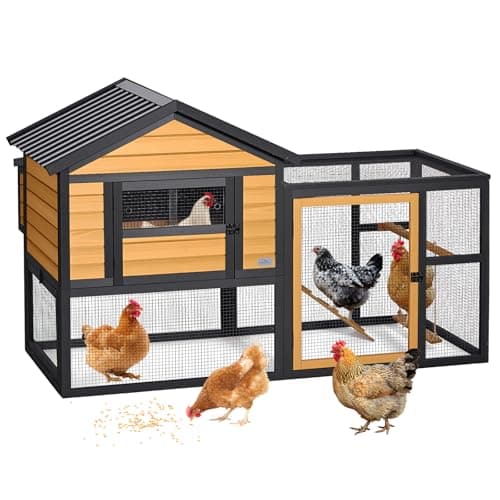 Petsfit Outdoor Coop with Run20.7 sq ft against a claim of six - one bird out, which makes it one of the more honest small coops here. | Five hens, honestly | 5box says 6 | Check price#ad |
| 3 | 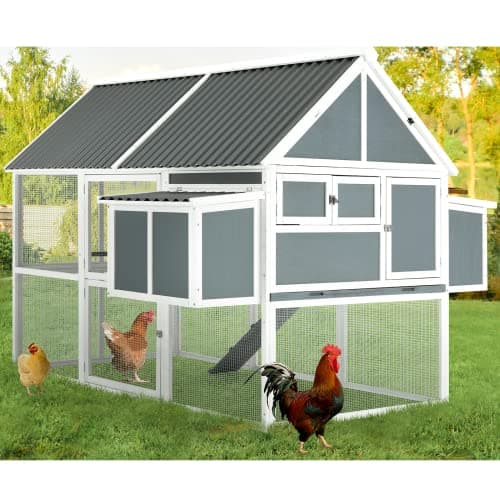 AECOJOY 84" Large Chicken Coop40.3 sq ft against a claim of ten. The numbers land exactly where the box says they do, which is rarer here than it should be. | Ten hens, claim and arithmetic agreeing | 10box says 10 | |
| 4 | 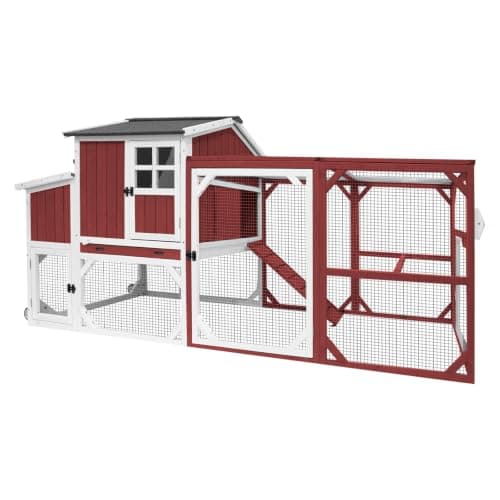 Pawbuilt 95.3" Coop with Run and Wheels20.8 sq ft against a claim of six, so five hens - and the wheels mean the grass underneath survives. | Moving the flock around the yard | 5box says 6 | Check price#ad |
| 5 | 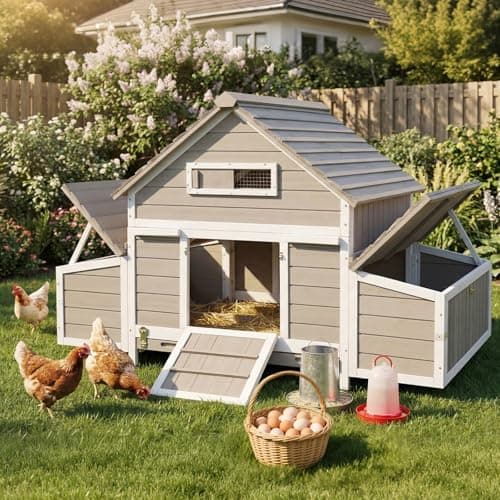 Magazoopet Wooden Hen House with 6 Nesting Boxes14.2 sq ft against a claim of six. Same pattern as the AECOJOY: real floor for three, nest boxes for a flock twice the size. | Three hens in a compact footprint | 3box says 6 |
Most advice for first-time chicken keepers is about the chickens. This page is about the object you are going to be scraping out every weekend for the next several years, in the rain, before work.
The three things that matter first
1. Cleaning, because that is the part you will actually do
A coop you can clean in ten minutes gets cleaned weekly. A coop that needs you on your knees reaching through a hatch gets cleaned when it starts to smell. The features that make the difference are a pull-out droppings tray, a roof or side that opens fully, and an interior surface that is not raw untreated timber.
This is the argument for plastic over wood at the small end. Double-walled polyethylene has no end grain to absorb moisture and nowhere for red mite to colonize, and it takes a hose. Rough fir has both problems, and red mite living in the seams of a wooden coop is the single most common reason people give up on chickens.
2. Security, because you only get one mistake
The bundled run on a cheap coop is almost always chicken wire, which is a containment material - it keeps chickens in and does very little to keep anything out. Raccoons reach through one-inch mesh; weasels walk through it. Half-inch hardware cloth is the specification that matters, and most first coops need it added.
The second failure point is the latch. Raccoons have functional thumbs and reliably open simple slide bolts and hook-and-eye catches. A bolt with a padlock hole and a carabiner through it costs very little and solves it. The full predator-proofing walkthrough is here.
3. Size, because you will get more chickens
This is not a joke and it is not upselling. Chicken keeping has an extremely reliable pattern: people start with four birds and have seven within eighteen months. A coop bought exactly for four is full on day one.
The beginner picks
| Coop | Published size | Floor area | Maker says | Arithmetic says |
|---|---|---|---|---|
| Hatching Time Formex Snap Lock Large Chicken Coop | 64"L x 39"W x 42"H | 17.3 sq ft | 6 hens | 4 hens |
| Petsfit Outdoor Coop with Run | 71"L x 42"W x 45"H | 20.7 sq ft | 6 hens | 5 hens |
| AECOJOY 84" Large Chicken Coop | 84"L x 69"W x 60"H | 40.3 sq ft | 10 hens | 10 hens |
| Pawbuilt 95.3" Coop with Run and Wheels | 95.3"L x 31.5"W x 44.9"H | 20.8 sq ft | 6 hens | 5 hens |
| Magazoopet Wooden Hen House with 6 Nesting Boxes | 61"L x 33.5"W x 40.2"H | 14.2 sq ft | 6 hens | 3 hens |
Floor area is the maker’s published footprint. Where a unit includes an attached run that figure spans the run too, which makes it a generous reading - the enclosed roosting floor is smaller still. How we work these out.
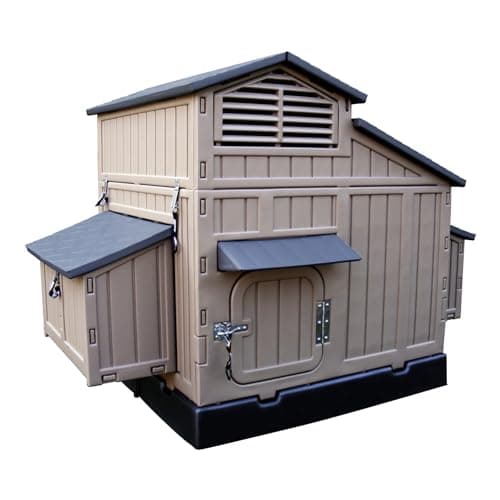
Top pick · Cleaning, and cold that stays out
Hatching Time Formex Snap Lock Large Chicken Coop
The one coop here whose material genuinely earns its price, sized for four hens rather than the six on the box.
What the numbers say
64in x 39in = 17.3 sq ft of enclosed henhouse floor. At 4 sq ft per standard hen that is 4 birds, against a claim of 6.
Figures from Hatching Time published specifications (Amazon listing) · 64"L x 39"W x 42"H · Double-walled polyethylene
This is a standalone henhouse with no attached run, so the published footprint is all enclosed floor. That makes it one of the few coops on this site where the generous reading and the honest reading are the same number.
17.3 sq ft supports four standard hens at the 4 sq ft figure. The listing says four to six. Four is right; six is a winter of pecked backs.
Double-walled polyethylene is the reason to buy it. There is no end grain to rot, no seam for mites to colonize, and it hoses out in minutes - the single biggest practical difference between a coop you keep clean and one you avoid.
Good
- Whole footprint is enclosed floor, not run
- Double-walled plastic will not rot, absorb, or harbor mites the way fir does
- Panels unclip for cleaning without tools
Not so good
- Costs more than the wooden coops it outlasts
- No run included, so budget for one
- Plastic walls hold no insulation value on their own
Skip this if: you want a coop and run in one purchase. This is a henhouse only, and pairing it with a run pushes the total past most wooden coop-plus-run kits.
#ad · how this is funded · price as of October 17, 2026
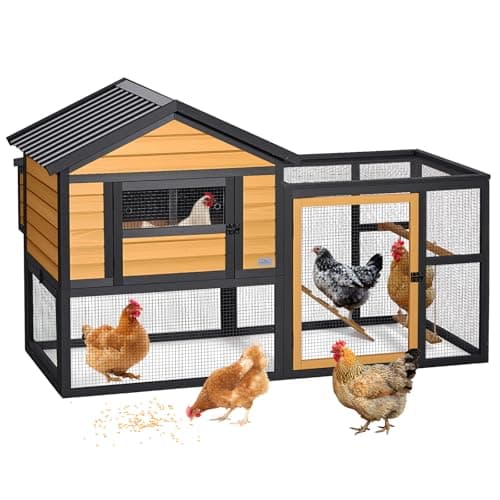
Pick 2 · Five hens, honestly
Petsfit Outdoor Coop with Run
20.7 sq ft against a claim of six - one bird out, which makes it one of the more honest small coops here.
What the numbers say
71in x 42in = 20.7 sq ft of whole-unit footprint, which includes the attached run and is therefore generous. At 4 sq ft per standard hen that is 5 birds, against a claim of 6.
Figures from Petsfit published specifications (Amazon listing) · 71"L x 42"W x 45"H · Fir
20.7 sq ft supports five standard hens. Petsfit claims four to six, so the arithmetic sits inside its stated range rather than outside it.
The 42in depth is why. Among the small coops on this site, depth is almost perfectly predictive of whether the claim survives contact with a tape measure.
Three nesting boxes for five hens is more than the one-per-four guidance requires, but not wastefully so.
Good
- Arithmetic lands inside the claimed range
- 42in depth is generous for this size class
- Predator-resistant hardware noted in the listing specification
Not so good
- Six is one bird past the floor
- Fir needs seasonal re-treating
- 45in height means stooping to clean
Skip this if: you are set on six birds. Five is what it holds, and the sixth is the one that gets pecked.
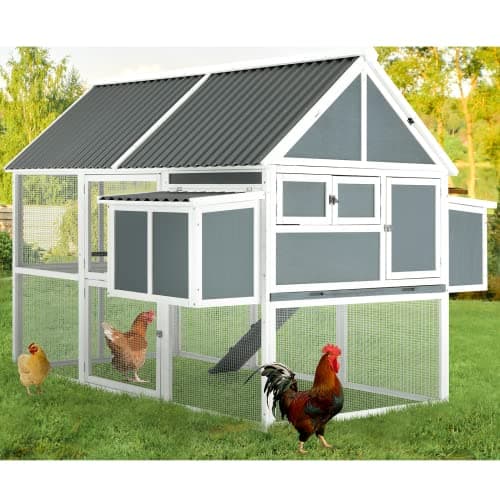
Pick 3 · Ten hens, claim and arithmetic agreeing
AECOJOY 84" Large Chicken Coop
40.3 sq ft against a claim of ten. The numbers land exactly where the box says they do, which is rarer here than it should be.
What the numbers say
84in x 69in = 40.3 sq ft of whole-unit footprint, which includes the attached run and is therefore generous. At 4 sq ft per standard hen that is 10 birds, against a claim of 10.
Figures from AECOJOY published specifications (Amazon listing) · 84"L x 69"W x 60"H · Wood
84 x 69 inches is 40.3 sq ft, which is exactly ten standard hens at the published 4 sq ft figure. AECOJOY claims eight to ten.
The 69in depth is what makes it work. Most coops in this class buy their length cheaply and stay narrow, which produces a corridor rather than a floor.
It is a square-ish footprint rather than a long thin one, so the usable area is genuinely usable - birds distribute across it instead of queueing down it.
Good
- Claim and arithmetic agree at ten hens
- 69in depth gives a floor rather than a corridor
- Two nesting boxes, which is the right count for ten hens on the published ratio
Not so good
- No margin - ten is the ceiling, not a comfortable number
- Wood construction needs annual attention
- Heavy once assembled and awkward to reposition
Skip this if: you plan to grow past ten birds. It meets its claim exactly, which means it has no room for the two extra chicks you will inevitably bring home.
#ad · how this is funded · price as of October 17, 2026
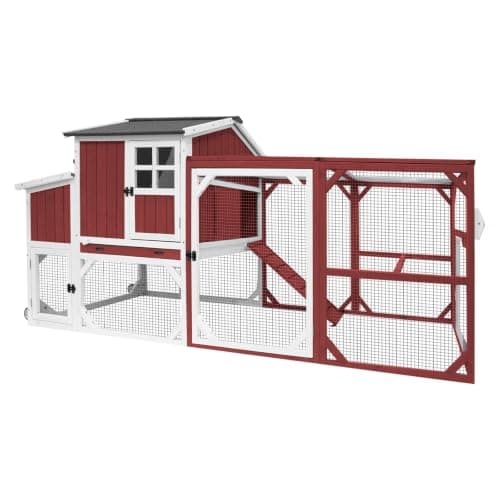
Pick 4 · Moving the flock around the yard
Pawbuilt 95.3" Coop with Run and Wheels
20.8 sq ft against a claim of six, so five hens - and the wheels mean the grass underneath survives.
What the numbers say
95.3in x 31.5in = 20.8 sq ft of whole-unit footprint, which includes the attached run and is therefore generous. At 4 sq ft per standard hen that is 5 birds, against a claim of 6.
Figures from Pawbuilt published specifications (Amazon listing) · 95.3"L x 31.5"W x 44.9"H · Asphalt, fir, metal and wood
20.8 sq ft is five standard hens against a claim of three to six. The bottom of the range is comfortable; the top is one bird optimistic.
The three-compartment nesting box is more than five hens need. One box per four birds is the published guidance.
The wheels are the point. A stationary run of this size turns to bare mud within a season; a moved one does not.
Good
- Wheels genuinely work at this size and weight
- Pull-out tray under the house end
- Comfortable at the middle of its claimed range
Not so good
- Six is one past the floor area
- 31.5in depth is narrow for the length
- Asphalt roof adds weight to something meant to move
Skip this if: the ground is uneven or sloped. Wheeled coops need reasonably flat ground, otherwise the frame racks and the doors stop closing square.
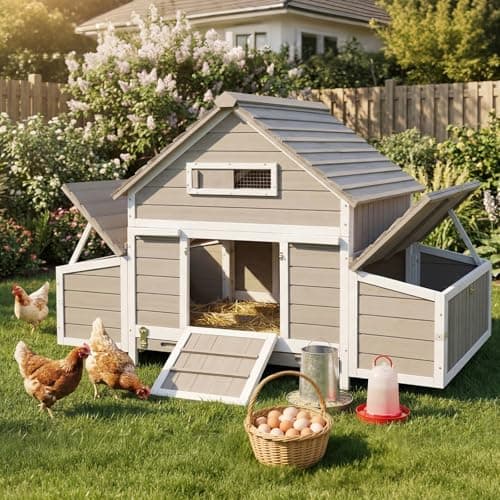
Pick 5 · Three hens in a compact footprint
Magazoopet Wooden Hen House with 6 Nesting Boxes
14.2 sq ft against a claim of six. Same pattern as the AECOJOY: real floor for three, nest boxes for a flock twice the size.
What the numbers say
61in x 33.5in = 14.2 sq ft of whole-unit footprint, which includes the attached run and is therefore generous. At 4 sq ft per standard hen that is 3 birds, against a claim of 6.
Figures from Magazoopet published specifications (Amazon listing) · 61"L x 33.5"W x 40.2"H · Fir
14.2 sq ft supports three standard hens. The claim is four to six.
33.5in of depth is respectable; 61in of length is simply not much coop. The two together produce a footprint that is honest for three birds and marketed for six.
The pull-out tray is the practical high point and the reason to prefer it over similarly sized coops without one.
Good
- Pull-out tray makes cleaning genuinely quick
- Sensible depth for the footprint
- Compact enough for a small yard
Not so good
- Six is double the honest count
- Six nest boxes for three hens of floor
- Fir at this price point will need re-treating
Skip this if: you keep more than three standard hens, or step up to something with a 50in-plus depth.
#ad · how this is funded · price as of October 17, 2026
What you will need beyond the coop
- Half-inch hardware cloth to upgrade the run - see hardware cloth against chicken wire
- A latch that takes a padlock or carabiner - coop latches and locks
- Bedding, and a plan for where the used litter goes
- A feeder and drinker that will not be knocked over or fouled
- Somewhere to put the birds if the coop needs repairing
You do not need a heater. Cold-hardy breeds handle hard frost without supplemental heat, and adding heat to a coop that is not properly ventilated makes frostbite more likely rather than less. The ventilation guide explains why.
Questions people actually ask
+What size coop should a beginner buy?
+What is the easiest chicken coop to clean?
+Do beginners need a coop with a run included?
+How many chickens should a beginner start with?
+Do I need a heater for my first winter?
+What is the biggest mistake first-time coop buyers make?
Sources
Read next
Chicken coops, sized by the tape measure
The main hub: flock-size roundups from four hens to twenty, each with the capacity arithmetic shown.
Chicken coops for 4 chickens
Four hens need 16 sq ft. The coops whose published dimensions genuinely reach it, ranked.
Chicken coops for 6 chickens
Six hens need 24 sq ft. Coops sold for six average 13. The ones that genuinely fit, ranked.
Predator-proofing a coop, step by step
The full walkthrough: mesh, latches and apron, with a materials list and the openings that get missed.

Ventilation, not insulation
Why sealing a coop causes frostbite, where vents belong, and how to tell whether yours has enough.
Chicken coops for 3 chickens
Coops measured against the 12 sq ft three hens need, in the size class where listing claims are inflated by the widest ratio.