Chicken coops for 2 chickens
The smallest flock worth keeping, and the size class where a coop listing is most likely to be selling you two birds' worth of space with a four on the label.
We have not handled these coops, and we do not pretend to have. Here is what we did instead. Links to Amazon earn us a commission at no extra cost to you - disclosure.
| # | Coop | Best for | Honest count | Price |
|---|---|---|---|---|
| 1 | 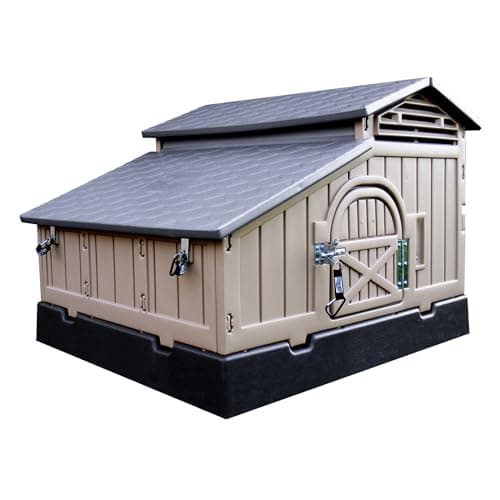 Hatching Time SnapLock Formex Standard CoopTop pickSame material logic as its bigger sibling, but the claim of four hens is the most overstated on this page relative to its size. | Two hens, or a bantam trio | 2box says 4 | |
| 2 | 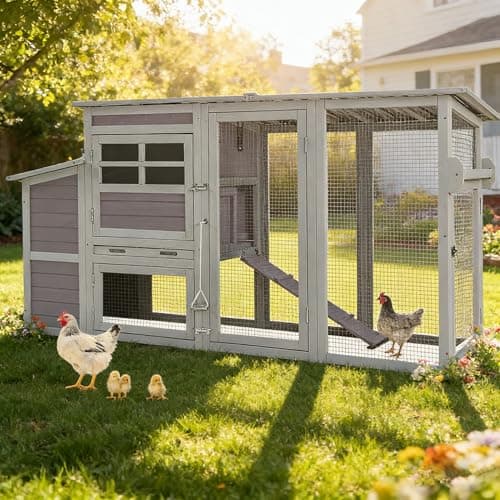 Aivituvin AIR31 Wooden Hen HouseWell made for the money and unusually honest by omission - Aivituvin publishes no bird count here at all. | A tidy two-hen setup in a small yard | 3no claim made | Check price#ad |
| 3 | 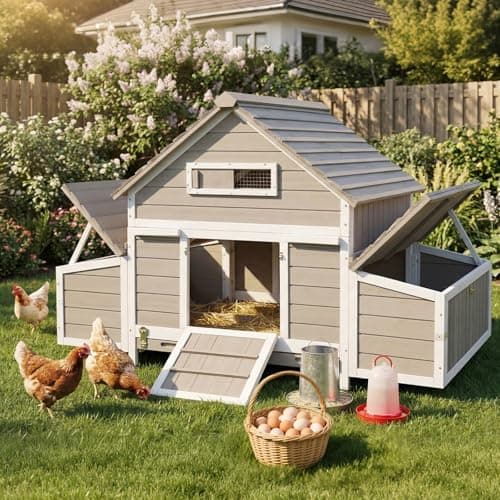 Magazoopet Wooden Hen House with 6 Nesting Boxes14.2 sq ft against a claim of six. Same pattern as the AECOJOY: real floor for three, nest boxes for a flock twice the size. | Three hens in a compact footprint | 3box says 6 | |
| 4 | 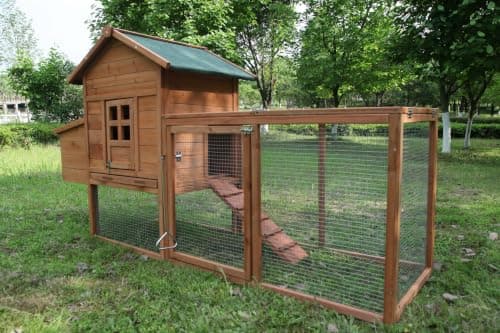 GOJOOASIS 80" Wooden Hen House14.4 sq ft against a claim of four, so three hens - a small, honest-ish coop for a first flock. | A first coop for three hens | 3box says 4 | |
| 5 | 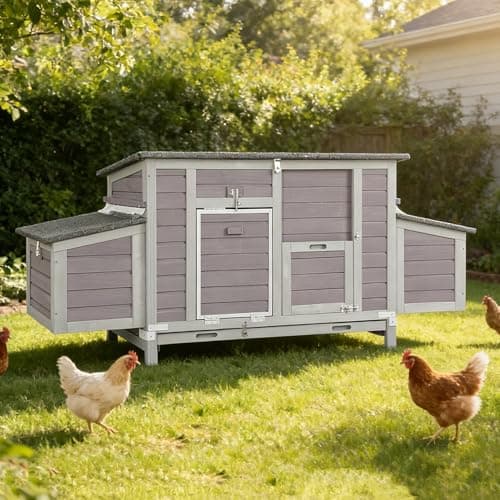 MEDEHOO Reinforced Predator-Proof Coop12.3 sq ft against a claim of six. Genuinely reinforced, genuinely a three-hen coop. | Security hardware on a small footprint | 3box says 6 | |
| 6 | 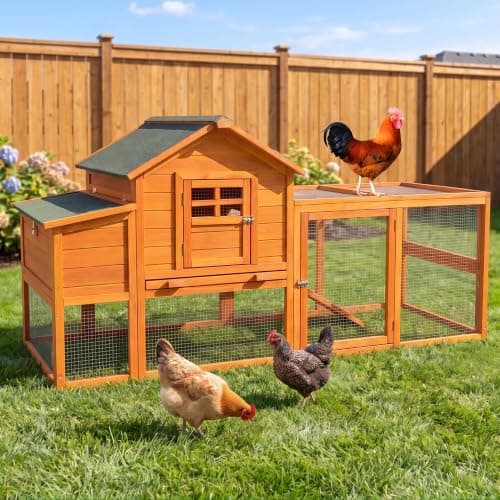 RUNSHED 76" Wooden Coop with Run11.9 sq ft against a claim of six. The smallest floor on this page carrying one of the largest claims. | Two hens and a tight budget | 2box says 6 |
Two hens is a real flock. Chickens are social and do badly alone, so a pair is the floor rather than a compromise, and plenty of small yards have room for nothing more. It is also the only size class on this site where nearly every coop we measured is genuinely big enough.
That sounds like good news and it is mostly a warning. If two birds is what you need, you are shopping in the part of the market where the gap between the number on the box and the number the dimensions support is at its widest - not because these coops are unusually small, but because they are labeled for four and six.
The arithmetic for a pair
Eight square feet is a low bar. Every coop on this page clears it, and so do most coops in the category. What separates them is what you get above the bar - whether the footprint is enclosed henhouse or mostly open run, whether the depth allows a roost at all, and whether the thing survives more than a few seasons.
Depth, not length, again
The pattern that runs through this whole site is at its clearest in the small coops. The RUNSHED is 76 inches long, which reads as generous, and 22.5 inches deep, which is what actually decides it. 11.9 square feet whole-unit, run included. Two hens.
Set that against the Formex Snap Lock Standard, which is 39 inches long - half the length - and 42 inches deep. 11.4 square feet, and every one of them is enclosed henhouse floor rather than run. Practically the same headline area, and a completely different coop.
Two hens is not half of four
A pair has less social buffer than a larger flock. There is no third bird for a bullied hen to sit next to, and if one dies the survivor is alone - which is genuinely bad for a chicken, and is the main practical argument for starting at three rather than two.
It also means the coop you buy now is likely the coop you outgrow. Most keepers add birds in the first year. If there is any chance of that, buy at the four-hen size and read coops for 4 chickens instead - the price step between the two classes is usually smaller than the space step.
What we looked for
- At least 8 square feet of floor on the published dimensions, and preferably enclosed rather than counting the run.
- Enough depth for a roost bar with clearance front and back - about 16 inches of bar for two birds, which is easy, but the bar has to physically fit.
- A material that survives. At this size the price difference between fir and polyethylene is small in absolute terms and the lifespan difference is not.
- Cleaning access. A small coop with a tray you can pull out gets cleaned; one you have to crawl into does not.
- One nest box is enough for two hens. Several coops here ship with six, and those boxes come out of the same footprint.
- The usual three security upgrades, because a small flock is not a less attractive target.
The ranked picks
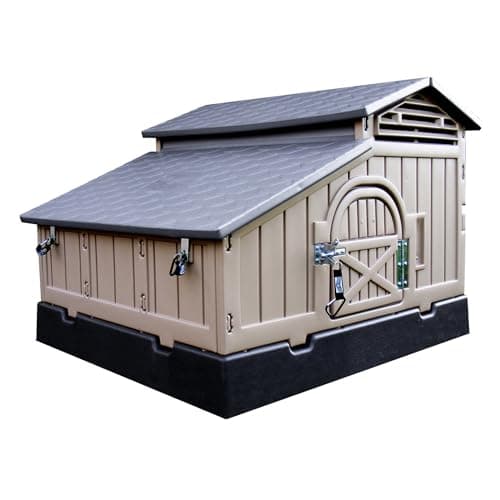
Top pick · Two hens, or a bantam trio
Hatching Time SnapLock Formex Standard Coop
Same material logic as its bigger sibling, but the claim of four hens is the most overstated on this page relative to its size.
What the numbers say
39in x 42in = 11.4 sq ft of enclosed henhouse floor. At 4 sq ft per standard hen that is 2 birds, against a claim of 4.
Figures from Hatching Time published specifications (Amazon listing) · 39"L x 42"W x 29"H · Lightweight double-walled polyethylene
11.4 sq ft of enclosed floor is two standard hens. The listing says four.
For bantams, where the published guidance is nearer 2 sq ft a bird, four is defensible. For standard-size layers it is not, and the listing does not draw that distinction.
The material is the same double-walled polyethylene that makes the larger Snap Lock worth owning. The problem here is arithmetic, not build quality.
Good
- Genuinely easy to clean and impossible to rot
- Small enough for a courtyard or a side return
- Honest fit for a bantam trio
Not so good
- Two standard hens, not the four claimed
- Low roof height limits where you can put roost bars
- Run sold separately
Skip this if: you keep standard-size layers and want more than two. Buy the larger Snap Lock instead - the price step is smaller than the space step.
#ad · how this is funded · price as of October 20, 2026
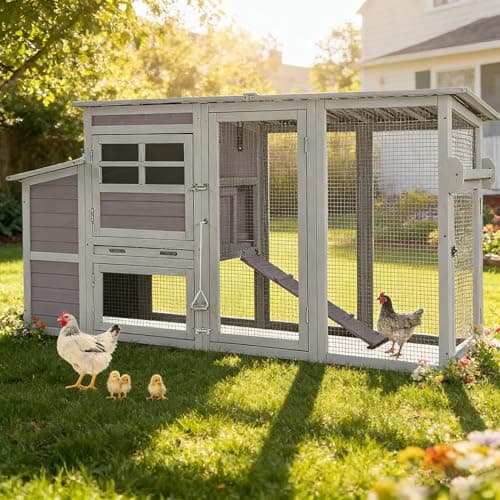
Pick 2 · A tidy two-hen setup in a small yard
Aivituvin AIR31 Wooden Hen House
Well made for the money and unusually honest by omission - Aivituvin publishes no bird count here at all.
What the numbers say
74.9in x 26in = 13.5 sq ft of whole-unit footprint, which includes the attached run and is therefore generous. At 4 sq ft per standard hen that is 3 birds. The maker publishes no bird count of its own to compare against.
Figures from Aivituvin published specifications (Amazon listing) · 74.9"L x 26"W x 39.4"H · Fir
13.5 sq ft across the whole unit, and that figure includes the open run beneath the raised house. The enclosed portion is a fraction of it.
Aivituvin does not claim a bird count for this model. That is worth noting in a category where almost every competitor prints one it cannot support - there is nothing here to correct.
Treat it as a two-hen coop and it is a good one. The pull-out tray and the ramp are better executed than on most fir coops at this size.
Good
- No inflated bird-count claim to correct
- Pull-out tray makes weekly cleaning quick
- Fir construction is solid for the price
Not so good
- Narrow 26in depth limits usable roost space
- Whole-unit footprint counts the run, not just the house
- Fir needs re-treating every couple of seasons
Skip this if: you have three or more standard hens. The depth is the constraint, and no amount of length fixes a 26in-wide house.
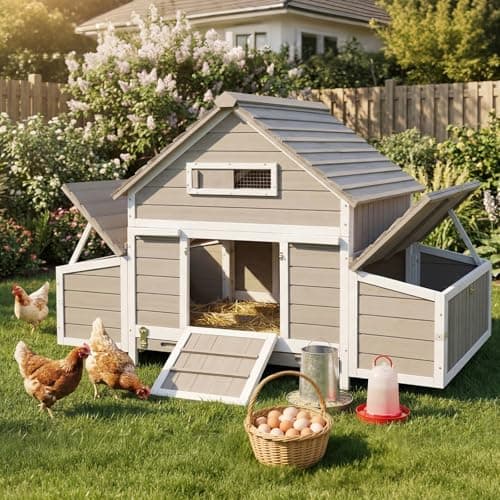
Pick 3 · Three hens in a compact footprint
Magazoopet Wooden Hen House with 6 Nesting Boxes
14.2 sq ft against a claim of six. Same pattern as the AECOJOY: real floor for three, nest boxes for a flock twice the size.
What the numbers say
61in x 33.5in = 14.2 sq ft of whole-unit footprint, which includes the attached run and is therefore generous. At 4 sq ft per standard hen that is 3 birds, against a claim of 6.
Figures from Magazoopet published specifications (Amazon listing) · 61"L x 33.5"W x 40.2"H · Fir
14.2 sq ft supports three standard hens. The claim is four to six.
33.5in of depth is respectable; 61in of length is simply not much coop. The two together produce a footprint that is honest for three birds and marketed for six.
The pull-out tray is the practical high point and the reason to prefer it over similarly sized coops without one.
Good
- Pull-out tray makes cleaning genuinely quick
- Sensible depth for the footprint
- Compact enough for a small yard
Not so good
- Six is double the honest count
- Six nest boxes for three hens of floor
- Fir at this price point will need re-treating
Skip this if: you keep more than three standard hens, or step up to something with a 50in-plus depth.
#ad · how this is funded · price as of October 20, 2026
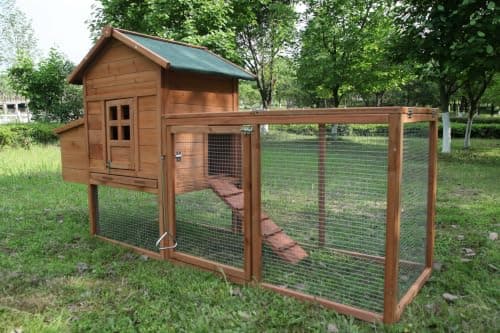
Pick 4 · A first coop for three hens
GOJOOASIS 80" Wooden Hen House
14.4 sq ft against a claim of four, so three hens - a small, honest-ish coop for a first flock.
What the numbers say
80in x 26in = 14.4 sq ft of whole-unit footprint, which includes the attached run and is therefore generous. At 4 sq ft per standard hen that is 3 birds, against a claim of 4.
Figures from GOJOOASIS published specifications (Amazon listing) · 80"L x 26"W x 44"H · Wood
14.4 sq ft supports three standard hens. The claim is two to four, so the arithmetic sits inside the range.
Makers that claim a range starting at two are generally more trustworthy than ones that print a single confident number, and this listing is an example.
The 26in depth is the constraint, as it is on every narrow coop here. Length past about 70in stops adding useful floor once the depth is this tight.
Good
- Claimed range brackets the honest number
- Small enough for a suburban yard
- Simple build with few failure points
Not so good
- 26in depth limits roost arrangement
- Four is one bird past the floor
- No wheels, so the ground beneath will bare off
Skip this if: you are already thinking about a fourth or fifth hen. Flocks grow, and this one has no margin at all.
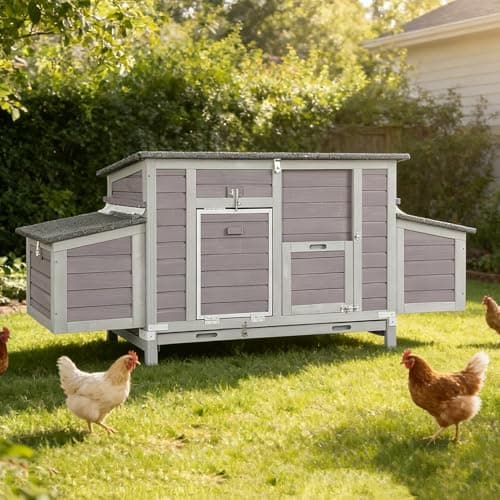
Pick 5 · Security hardware on a small footprint
MEDEHOO Reinforced Predator-Proof Coop
12.3 sq ft against a claim of six. Genuinely reinforced, genuinely a three-hen coop.
What the numbers say
70.6in x 25in = 12.3 sq ft of whole-unit footprint, which includes the attached run and is therefore generous. At 4 sq ft per standard hen that is 3 birds, against a claim of 6.
Figures from MEDEHOO published specifications (Amazon listing) · 70.6"L x 25"W x 28"H · Wood
12.3 sq ft is three standard hens against a claim of four to six.
The reinforced frame and the ventilated design are real, and at 25in deep and 28in tall this is a low, tight unit - more hutch than coop.
Ventilation matters more in a small enclosed volume, not less, so the ventilated design is the right call for the size.
Good
- Reinforced frame is a genuine build feature
- Ventilated design suited to the tight interior volume
- Pull-out tray for cleaning
Not so good
- Six is double the honest count
- 28in height is the lowest here - awkward to service
- 25in depth is the narrowest on this page
Skip this if: you want to reach into the coop comfortably. At 28in tall and 25in deep, every cleaning job is done at arm's length through a hatch.
#ad · how this is funded · price as of October 20, 2026
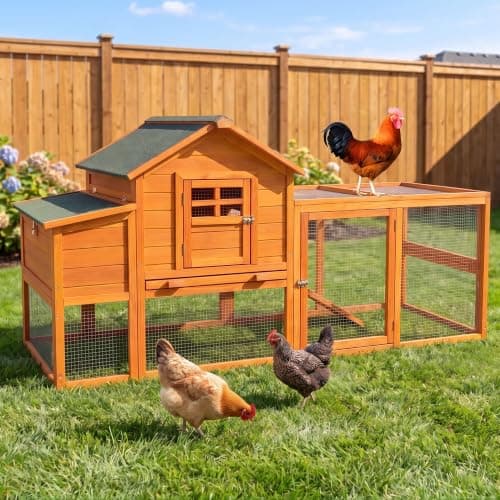
Pick 6 · Two hens and a tight budget
RUNSHED 76" Wooden Coop with Run
11.9 sq ft against a claim of six. The smallest floor on this page carrying one of the largest claims.
What the numbers say
76in x 22.5in = 11.9 sq ft of whole-unit footprint, which includes the attached run and is therefore generous. At 4 sq ft per standard hen that is 2 birds, against a claim of 6.
Figures from RUNSHED published specifications (Amazon listing) · 76"L x 22.5"W x 38.6"H · Fir with asphalt roof
11.9 sq ft supports two standard hens. The listing claims four to six.
At 22.5 inches this is the narrowest unit in the research pass, and the 76in length cannot compensate. Floor area is length times depth, and depth is doing none of the work here.
As a two-hen coop with a run attached, at this price, it is defensible. As the six-hen coop it is sold as, it is not.
Good
- Cheap way into a coop-plus-run in one purchase
- Asphalt roof and wire lock are sensible inclusions
- Light enough for one person to reposition
Not so good
- Six is three times the honest count
- 22.5in depth is the narrowest here
- Fir this thin will need re-treating quickly
Skip this if: you have more than two hens. This is the clearest example on the site of length being sold as capacity.
Measured against the claims
| Coop | Published size | Floor area | Maker says | Arithmetic says |
|---|---|---|---|---|
| Hatching Time SnapLock Formex Standard Coop | 39"L x 42"W x 29"H | 11.4 sq ft | 4 hens | 2 hens |
| Aivituvin AIR31 Wooden Hen House | 74.9"L x 26"W x 39.4"H | 13.5 sq ft | no claim | 3 hens |
| Magazoopet Wooden Hen House with 6 Nesting Boxes | 61"L x 33.5"W x 40.2"H | 14.2 sq ft | 6 hens | 3 hens |
| GOJOOASIS 80" Wooden Hen House | 80"L x 26"W x 44"H | 14.4 sq ft | 4 hens | 3 hens |
| MEDEHOO Reinforced Predator-Proof Coop | 70.6"L x 25"W x 28"H | 12.3 sq ft | 6 hens | 3 hens |
| RUNSHED 76" Wooden Coop with Run | 76"L x 22.5"W x 38.6"H | 11.9 sq ft | 6 hens | 2 hens |
Floor area is the maker’s published footprint. Where a unit includes an attached run that figure spans the run too, which makes it a generous reading - the enclosed roosting floor is smaller still. How we work these out.
Read that table as the argument for this page. Every coop on it houses two hens comfortably. Not one of them houses the number printed on its own listing.
Where to go next
- Coops for 4 chickens - the size most people should actually buy
- Coops for silkies and bantams - if the pair are bantams, halve the floor and lower the roost
- What a listing means by holds 6 chickens - the thirty-second check that works on any coop
- Work out your own numbers
Questions people actually ask
+How big should a coop be for 2 chickens?
+Can you keep just 2 chickens?
+Is a coop sold for 4 chickens big enough for 2?
+Do 2 chickens need a run?
Sources
Read next
Chicken coops for 4 chickens
Four hens need 16 sq ft. The coops whose published dimensions genuinely reach it, ranked.
Chicken coops for silkies and bantams
Six small coops measured against the published bantam figures, with roost height and dryness treated as the deciding factors rather than floor area alone.
What a coop listing means by holds 6 chickens
How listing bird counts are constructed, the four ways they drift, and a thirty-second check that works on any product page.
Chicken coops, sized by the tape measure
The main hub: flock-size roundups from four hens to twenty, each with the capacity arithmetic shown.
Wooden chicken coops, measured and weathered
Wooden coops ranked on measured floor area, with the maintenance cost of untreated fir priced in rather than left out.
Chicken coops for 3 chickens
Coops measured against the 12 sq ft three hens need, in the size class where listing claims are inflated by the widest ratio.