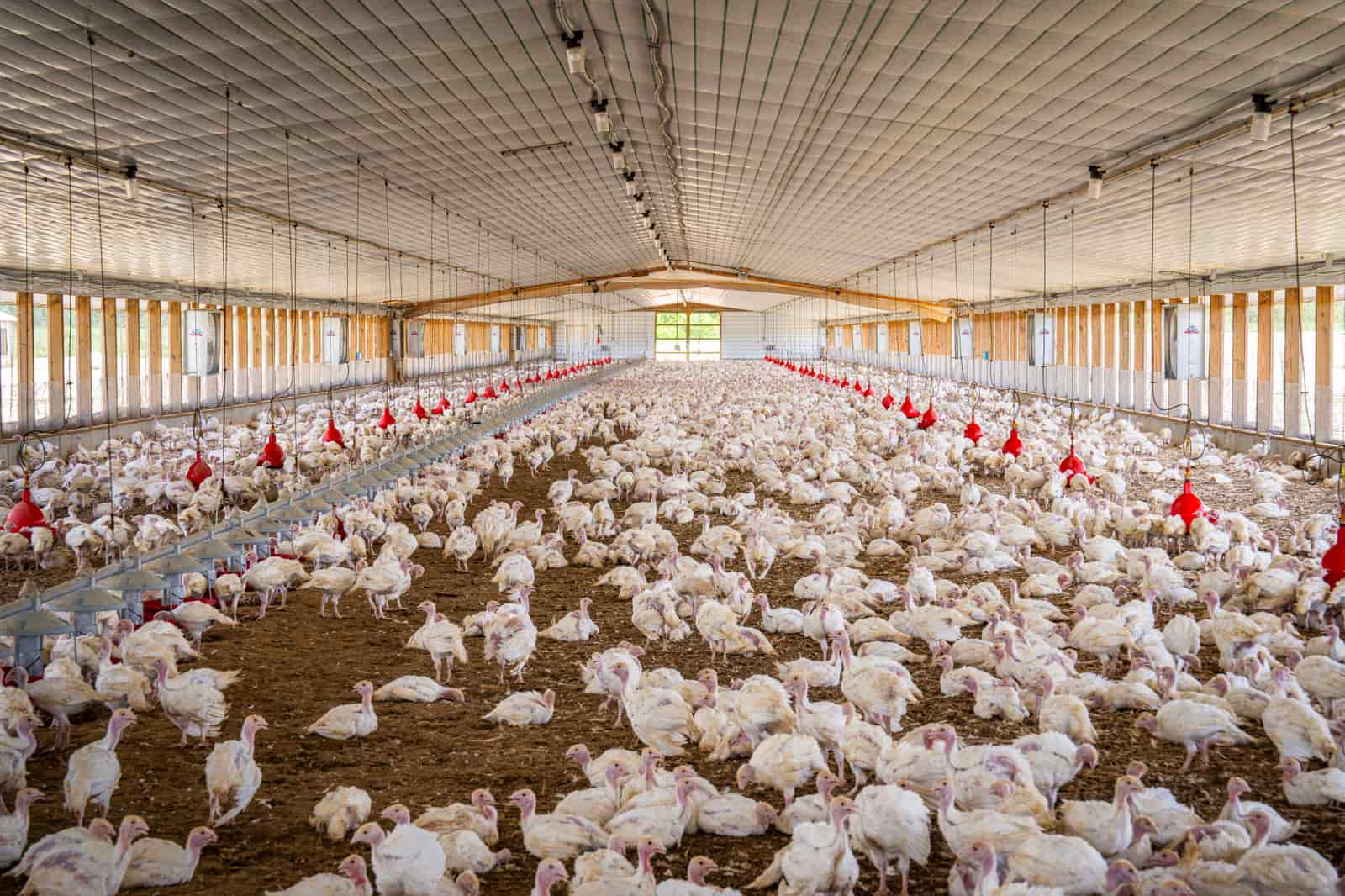
Can turkeys live in a chicken coop?
Almost never, and the space arithmetic is the second reason. The first is a disease with no approved treatment in the United States.
We have not handled these coops, and we do not pretend to have. Here is what we did instead. Links to Amazon earn us a commission at no extra cost to you - disclosure.
| # | Coop | Best for | Honest count | Price |
|---|---|---|---|---|
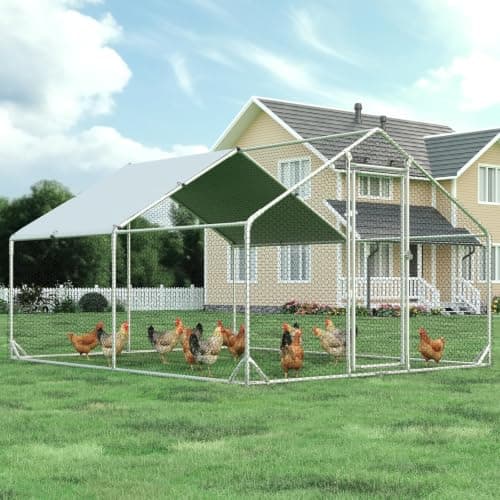
| 1 | 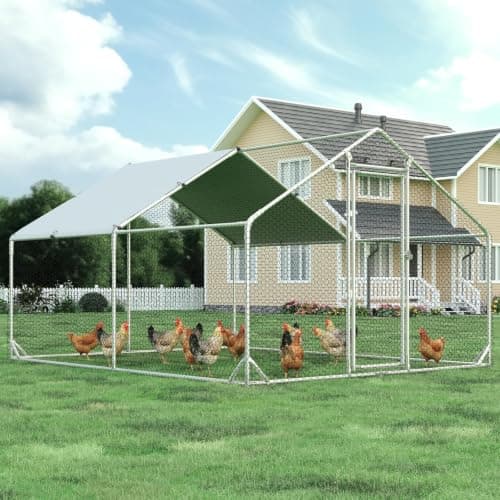 4ever2buy Metal Chicken Coop, 10x13 FT Walk-In RunTop pick128.4 sq ft of walk-in enclosure wrapped in galvanized hardware cloth - the largest ground area on this site, and a cover included. | A genuine walk-in enclosure | 32box says 15 | |
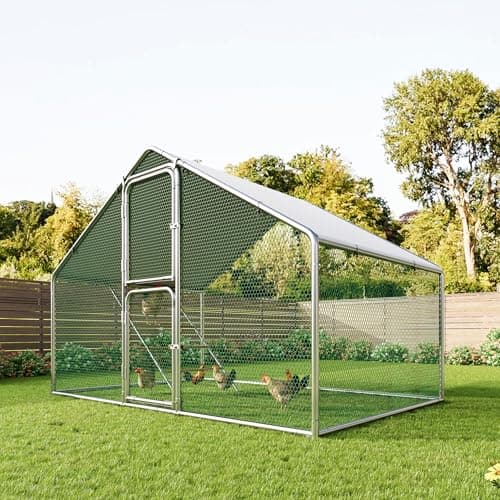
| 2 | 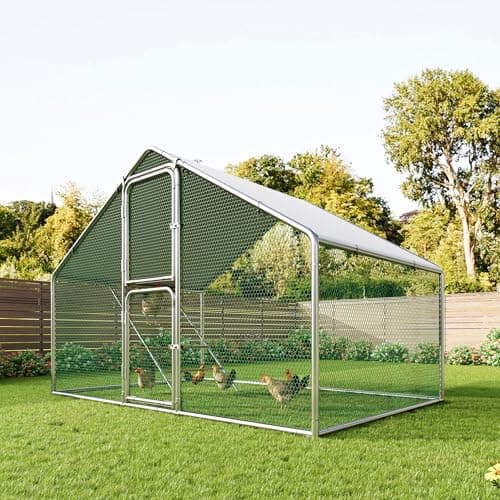 Amopatio Metal Walk-In Run with Perch65.3 sq ft with a roosting perch fitted and a security lock. No bird count claimed, correctly. | A walk-in run with roosting already solved | 16no claim made | |
| 3 | 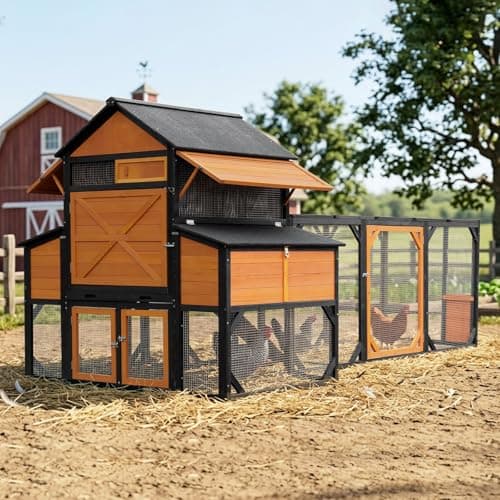 Pawpuler 135.7" Extra Large Coop with Run59.5 sq ft, which is fourteen hens rather than the fifteen claimed - the closest near-miss on this site. | A flock in the low teens | 14box says 15 | |
| 4 | 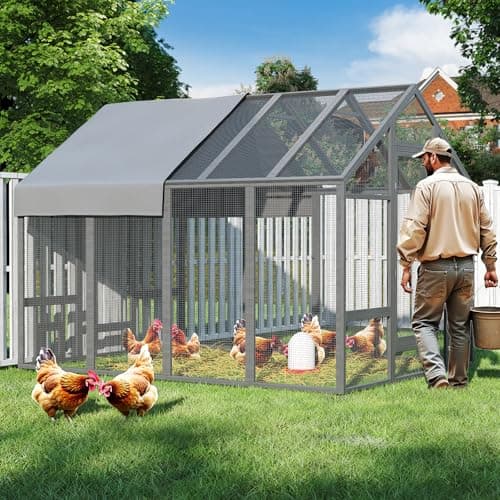 TRYKERPET Walk-In Coop for 10-12 Chickens47.4 sq ft against a claim of twelve, so eleven is the honest number - and you can stand up in it. | Walk-in access without a metal run | 11box says 12 | |
| 5 | 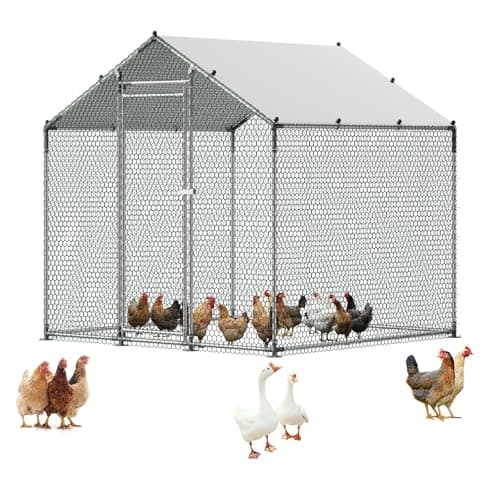 VEVOR Metal Walk-In Run, Spire Roof43 sq ft under a spire roof - the pitched cover is the reason to pick it over a flat-topped run. | Shedding snow and rain off a run | 10no claim made |
People arrive at this question having already bought chickens, with a coop in the yard and a plan to add two turkeys to it. That is the case this page is written for, and the answer has two parts that point the same way.
Reason one: the disease risk is the serious part
Penn State Extension's backyard turkey health page is unusually blunt. Raising chickens and turkeys on the same site poses increased disease risk to the turkeys. Turkeys are highly susceptible to Blackhead, a fatal disease of the liver and ceca, and there are currently no approved medications for prevention or treatment of Blackhead in the United States.
The mechanism is specific: chickens can serve as an amplifying host for the cecal worm and therefore for the parasite that causes it, while being less susceptible to the clinical disease themselves. Penn State also notes that many backyard chicken flocks are chronic carriers of Mycoplasma gallisepticum and synoviae and can introduce those to turkeys.
Reason two: the arithmetic rules out almost every coop
eXtension publishes a minimum of 6 square feet per turkey indoors and 20 square feet per turkey outdoors. Against a laying hen's 3 to 4 square feet indoors, a turkey is roughly a bird and a half to two hens - and against Penn State's own table, where a large chicken is 2 square feet, a turkey is three.
Even the largest wooden coop in our registry, which publishes 59.5 square feet of whole-unit footprint and claims fifteen chickens, comes to nine turkeys on the same generous reading. The category simply is not built for a bird this size.
The published space figures, side by side
It is worth seeing all four birds on one table, because the turkey number only looks extreme next to the others. These are the two sources this site uses throughout, unaltered.
| Bird | Indoor, eXtension | Outdoor, eXtension | Indoor, Penn State | Outdoor, Penn State |
|---|---|---|---|---|
| Bantam chicken | not covered | not covered | 1 sq ft | 4 sq ft |
| Laying hen | 3-4 sq ft | 10 sq ft | 1.5 sq ft | 8 sq ft |
| Large chicken | 3-4 sq ft | 10 sq ft | 2 sq ft | 10 sq ft |
| Quail | not covered | not covered | 1 sq ft | 4 sq ft |
| Duck | 5 sq ft | no figure given | 3 sq ft | 15 sq ft |
| Turkey | 6 sq ft | 20 sq ft | not listed | not listed |
A turkey is the most demanding bird on the table on both counts, and the only one with a published outdoor figure as large as 20 square feet. Note also that neither source covers every bird - we print not covered rather than filling the gaps, because a space figure we invented would be worse than an absent one.
If you already keep both
Plenty of people arrive here having already put turkeys in with chickens, and telling them not to is not useful on its own. Penn State's own framing is that successful control of Blackhead is dependent on limiting exposure of turkeys to worms, which is a management target rather than a prohibition.
- Separate the housing first, before the range. Night housing is where contact is closest and it is the easiest thing to change.
- Give the turkeys ground the chickens have not been on, which is the exposure Penn State names.
- Keep biosecurity between the two groups - Penn State's small-flock guidance lists clean boots, limited visitors and sanitized equipment, and the same practices apply between your own two flocks.
- Source poults carefully. Penn State's stated route to preventing Mycoplasma is strict biosecurity and obtaining poults from NPIP, since many backyard chicken flocks are chronic carriers of MG and MS.
- Then ask a veterinarian or your extension service. We are a coop site; the point at which this becomes a health question is the point at which we stop.
What a turkey enclosure has to do that a coop does not
- Carry 6 square feet of shelter per bird, plus 20 square feet of outdoor space per bird on the published guidance.
- Stand clear of where chickens have been, because the disease risk travels with the ground rather than the birds.
- Give enough height to stand up inside, which for a bird this size is a management requirement rather than a convenience.
- Hold mesh that excludes the same predators a coop does - the walk-in runs in the picks below ship with galvanized hardware cloth rather than chicken wire, which is unusual in this category.
Penn State publishes no turkey housing or roost figures at all - its turkey page covers health only - so anything beyond floor area and height is not something we can source, and we are not going to invent it.
How we judged these picks
- Published footprint divided by 6 square feet per turkey, computed from the maker's own dimensions.
- Whether the structure is a separate enclosure rather than an add-on to an existing coop, because that is the health requirement.
- Standing height inside, from the published height figure.
- What the enclosure ships with for mesh, since re-meshing an enclosure this size is a significant cost.
- Whether the roof sheds snow and rain, because an enclosure this large is a structure rather than a box.
Enclosures big enough for turkeys
Top pick · A genuine walk-in enclosure
4ever2buy Metal Chicken Coop, 10x13 FT Walk-In Run
128.4 sq ft of walk-in enclosure wrapped in galvanized hardware cloth - the largest ground area on this site, and a cover included.
What the numbers say
157.2in x 117.6in = 128.4 sq ft of whole-unit footprint, which includes the attached run and is therefore generous. At 4 sq ft per standard hen that is 32 birds, against a claim of 15.
Figures from 4ever2buy published specifications (Amazon listing) · 157.2"L x 117.6"W x 76.8"H (10 x 13 ft) · Rust-resistant steel frame with galvanized hardware cloth
128.4 sq ft is the largest ground area on this site by a wide margin - more than twice the next biggest.
The listing claims room for 12 to 15 chickens. Read as run space at the published 8 sq ft a bird that is about 16, so the claim is reasonable - which is unusual enough here to say out loud. The bird column in our table divides by the 4 sq ft indoor figure, and that is the wrong measure for an enclosure with no henhouse in it.
Fully wrapped in galvanized hardware cloth rather than chicken wire is the specification that matters. Chicken wire keeps chickens in; hardware cloth keeps raccoons out, and they are not the same job.
A waterproof anti-UV cover is included, which is the detail that keeps the ground under it usable through a wet season.
Good
- Galvanized hardware cloth all round, not chicken wire
- 76.8in height is a true walk-in at 6.4 ft
- Waterproof cover included rather than sold separately
Not so good
- It is a run, not a coop - you still need a henhouse
- 13ft x 10ft needs serious yard space
- The 12-15 bird claim only holds as run space, never as roosting room
Skip this if: you expected a coop. There is no insulated, enclosed house in it, and birds cannot roost in a run overnight safely in most climates.
Pick 2 · A walk-in run with roosting already solved
Amopatio Metal Walk-In Run with Perch
65.3 sq ft with a roosting perch fitted and a security lock. No bird count claimed, correctly.
What the numbers say
79in x 119in = 65.3 sq ft of whole-unit footprint, which includes the attached run and is therefore generous. At 4 sq ft per standard hen that is 16 birds. The maker publishes no bird count of its own to compare against.
Figures from Amopatio published specifications (Amazon listing) · 79"L x 119"W x 79"H · Alloy steel
65.3 sq ft of ground with 79 inches of headroom - comfortably walk-in for most people.
Amopatio claims no bird count. That is the right call for an enclosure - capacity depends on the henhouse you put inside it - and it means there is nothing here to correct.
The split door is more useful than it sounds: it lets you get in with both hands full without a bird getting past your ankles.
Good
- Roosting perch included
- Split door genuinely helps daily access
- Security lock fitted as standard
Not so good
- A run, not a coop
- Alloy steel needs the coating kept intact to resist rust
- Large footprint for a suburban yard
Skip this if: you need overnight predator security on its own. A run is a daytime enclosure; birds still need a lockable house inside it after dark.
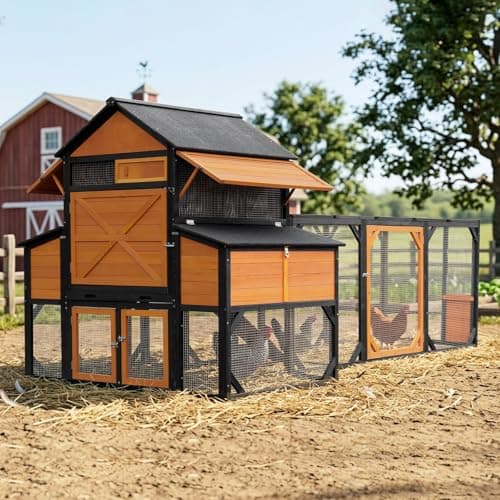
Pick 3 · A flock in the low teens
Pawpuler 135.7" Extra Large Coop with Run
59.5 sq ft, which is fourteen hens rather than the fifteen claimed - the closest near-miss on this site.
What the numbers say
135.7in x 63.11in = 59.5 sq ft of whole-unit footprint, which includes the attached run and is therefore generous. At 4 sq ft per standard hen that is 14 birds, against a claim of 15.
Figures from Pawpuler published specifications (Amazon listing) · 135.7"L x 63.11"W x 62.5"H · Wood, PVC and asphalt
59.5 sq ft supports fourteen standard hens. The listing claims ten to fifteen, so the top of its range is one bird optimistic and the rest of it is sound.
A one-bird overstatement is a rounding difference, not a misrepresentation. Most of this category is out by three to seven.
The 63in depth is the second-best on this site and it is what carries the floor area. Long, narrow coops of the same length would land nearer 35 sq ft.
Good
- Only one bird short of its own top claim
- 63in depth gives a wide, usable floor
- Asphalt roof over a PVC-protected frame holds up outdoors
Not so good
- Fifteen is optimistic; fourteen is the honest ceiling
- 11ft of yard needed
- Heavy build - plan the position before assembly
Skip this if: you actually need fifteen birds housed. Buy for fourteen or step up, because the difference shows up as pecking in February, not in the first week.
#ad · how this is funded · price as of October 17, 2026
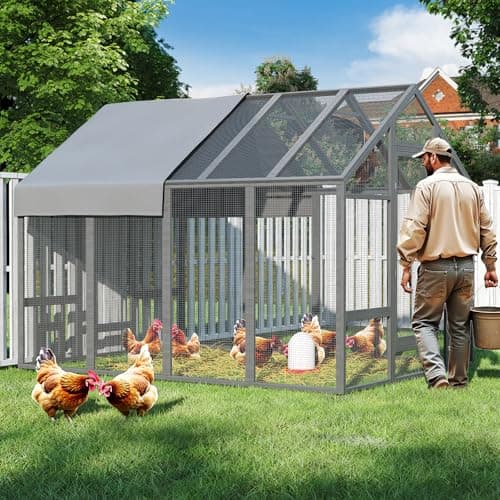
Pick 4 · Walk-in access without a metal run
TRYKERPET Walk-In Coop for 10-12 Chickens
47.4 sq ft against a claim of twelve, so eleven is the honest number - and you can stand up in it.
What the numbers say
96.1in x 71in = 47.4 sq ft of whole-unit footprint, which includes the attached run and is therefore generous. At 4 sq ft per standard hen that is 11 birds, against a claim of 12.
Figures from TRYKERPET published specifications (Amazon listing) · 96.1"L x 71"W x 71"H · Wood
47.4 sq ft is eleven standard hens. The claim is ten to twelve, so it holds the bottom of its range comfortably and misses the top by one.
71 inches of height is the feature. Walk-in access is the single change that makes people actually clean a coop weekly rather than seasonally.
71in depth as well as 71in height means the floor is close to square, so the area is usable rather than nominal.
Good
- Genuine walk-in height at 71in
- Near-square floor, so the area is usable
- Holds the bottom of its claimed range with room
Not so good
- Twelve is one bird past what the floor supports
- Wooden walk-in structures need bracing checked annually
- 8ft x 6ft of ground is a real footprint
Skip this if: you want a coop you can move. Walk-in wooden structures are effectively permanent once built, and repositioning means partial disassembly.
#ad · how this is funded · price as of October 17, 2026
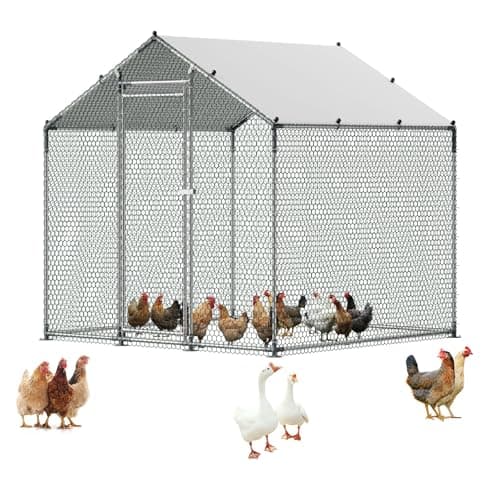
Pick 5 · Shedding snow and rain off a run
VEVOR Metal Walk-In Run, Spire Roof
43 sq ft under a spire roof - the pitched cover is the reason to pick it over a flat-topped run.
What the numbers say
78.72in x 78.72in = 43 sq ft of whole-unit footprint, which includes the attached run and is therefore generous. At 4 sq ft per standard hen that is 10 birds. The maker publishes no bird count of its own to compare against.
Figures from VEVOR published specifications (Amazon listing) · 78.72"L x 78.72"W x 78.72"H · High-carbon steel
43 sq ft in a perfect square, which is the most efficient shape for a given perimeter of frame.
The spire roof is the differentiator. Flat-covered runs pool water and collapse under wet snow; a pitched cover sheds both.
No bird count is claimed, which is correct for an enclosure.
Good
- Pitched roof sheds snow and standing water
- Square footprint is frame-efficient
- Security lock included
Not so good
- A run, not a coop
- Cover material will degrade before the frame does
- 6.5ft square is smaller than it sounds once a henhouse is inside
Skip this if: you get heavy snow loads. A spire helps, but no fabric-covered run is a substitute for a rigid roof where snow sits.
#ad · how this is funded · price as of October 17, 2026
Four of these five are metal walk-in runs, which is the category that has the floor area. The one wooden entry is here because it is the largest in our registry and it is instructive: even at its size, it is a nine-turkey structure at most.
Measured against the claims
| Coop | Published size | Floor area | Maker says | Arithmetic says |
|---|---|---|---|---|
| 4ever2buy Metal Chicken Coop, 10x13 FT Walk-In Run | 157.2"L x 117.6"W x 76.8"H (10 x 13 ft) | 128.4 sq ft | 15 hens | 32 hens |
| Amopatio Metal Walk-In Run with Perch | 79"L x 119"W x 79"H | 65.3 sq ft | no claim | 16 hens |
| Pawpuler 135.7" Extra Large Coop with Run | 135.7"L x 63.11"W x 62.5"H | 59.5 sq ft | 15 hens | 14 hens |
| TRYKERPET Walk-In Coop for 10-12 Chickens | 96.1"L x 71"W x 71"H | 47.4 sq ft | 12 hens | 11 hens |
| VEVOR Metal Walk-In Run, Spire Roof | 78.72"L x 78.72"W x 78.72"H | 43 sq ft | no claim | 10 hens |
Floor area is the maker’s published footprint. Where a unit includes an attached run that figure spans the run too, which makes it a generous reading - the enclosed roosting floor is smaller still. How we work these out.
Those counts are hens at 4 square feet per bird. For turkeys, divide the square-footage column by 6 instead. The claim column is worth reading as well - it is the chicken claim, and no maker in this category publishes a turkey figure at all.
Where to go next
- Metal chicken coops and runs - the category with the floor area
- Walk-in chicken coops that are actually walk-in - measured on standing height
- Chicken coops for 20 chickens - where the kit market runs out, and why
- Build or buy a chicken coop - the free published plans for structures this size
Questions people actually ask
+Can turkeys and chickens live together?
+How much space does a turkey need?
+How many turkeys fit in a chicken coop?
+What kind of coop do turkeys need?
+Is it safe to raise turkeys after keeping chickens on the same ground?
Sources
- Penn State Extension - Backyard turkey health (raising chickens and turkeys on the same site poses increased disease risk to the turkeys; turkeys are highly susceptible to Blackhead, which is fatal and has no approved medication in the United States; chickens amplify the cecal worm that carries the parasite)
- eXtension Small and Backyard Poultry - Space allowances in housing (3-4 sq ft indoor / 10 sq ft outdoor per laying hen; 5 sq ft indoor per duck; 6 sq ft indoor and 20 sq ft outdoor per turkey; states there is very little peer-reviewed research on backyard space allowances)
- Penn State Extension - Small-scale poultry housing
- Penn State Extension - Successfully raising a small flock of laying chickens (never mix different species in the same flock; 2 sq ft of indoor space per bird; 6 inches of roost per bird; 3 inches of feed space per bird; two nests for the first four hens, then one per four more; limit drafts and moisture)
Read next
Metal chicken coops and runs
Steel runs and enclosures ranked on measured area, with the henhouse gap and the base-security fix stated up front.
Walk-in chicken coops that are actually walk-in
Walk-in coops and runs ranked on measured area, with a clear split between enclosures that include a henhouse and those that do not.
Chicken coops for 20 chickens
Twenty hens need 80 sq ft. No off-the-shelf coop we measured gets there - here is the honest route.
Build or buy a chicken coop
The build-versus-buy decision judged on floor area, time and skill rather than sticker price - with the free published plans nobody mentions.
Can you use a chicken coop for ducks?
Ducks need roughly twice a hen's indoor floor and produce manure wet enough to rot a timber coop. The coops that work, with the published figures.

Can you keep quail in a chicken coop?
Penn State puts quail at 1 square foot indoors, so any coop is big enough. What stops it working is the 1in mesh every kit ships with.