Pawpuler 135.7in Extra Large Coop with Run
The biggest wooden coop-and-run kit on this site by measured footprint, and a bird-count claim that misses by one rather than by a factor of three.
We have not handled these coops, and we do not pretend to have. Here is what we did instead. Links to Amazon earn us a commission at no extra cost to you - disclosure.
| # | Coop | Best for | Honest count | Price |
|---|---|---|---|---|
| 1 | 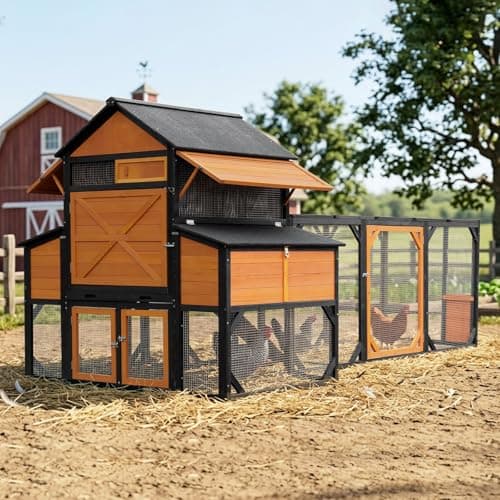 Pawpuler 135.7" Extra Large Coop with RunTop pick59.5 sq ft, which is fourteen hens rather than the fifteen claimed - the closest near-miss on this site. | A flock in the low teens | 14box says 15 |
There is a point above which wooden coop-and-run kits simply stop existing, and this coop is close to it. At 59.5 square feet it is the largest we measured in the format - the next tier up is a steel walk-in enclosure with a henhouse problem to solve separately.
The measurement
135.7 inches by 63.11 inches is 8,564 square inches, which is 59.5 square feet. Fourteen standard hens at 4 square feet a bird, against a listing claim of fifteen.
One bird out. Given that the published guidance this site uses is the midpoint of a 3-to-5 square foot range, a claim of fifteen sits inside what a reasonable reading of the same source would support. We print fourteen because we use one figure consistently across every coop, not because the claim is wrong in any meaningful way.
As always, the footprint spans the attached run as well as the enclosed house, so the real roosting floor is smaller than 59.5 square feet. On a coop this size that gap is worth taking seriously - a large kit is frequently a modest henhouse with a very large run attached, and it is the henhouse that has to hold the flock overnight.
Depth is again the reason
63.11 inches. Only two coops on this site are deeper. The pattern holds without exception: everything that clears its claim does it on depth, and everything that fails badly is a long narrow unit whose length flatters the footprint.
Fifteen birds is a different scale of ownership
- 120 square feet of run at 8 square feet a bird - substantially more than the coop itself, and more than most yards allocate without planning for it.
- 120 inches of roost bar, which is ten feet. No kit in this class supplies that; it is a build-your-own item.
- Four nest boxes at one per four hens.
- Litter volume that makes a droppings board under the roost close to essential rather than a nice idea.
- Local rules that may cap flock size regardless of what fits. Check before buying at this scale - permits and zoning covers what to ask.
The material problem scales too
Wood, PVC and asphalt per the maker's own listing. The timber carries the usual three-to-six season life untreated, and on a coop this large the annual treatment is a genuinely bigger job - more surface area, more end grain, more cut edges from a longer assembly.
That is worth pricing in at purchase rather than discovering in year two. The ten-year arithmetic on what a coop really costs turns hardest on exactly this: a large fir coop bought twice against a steel enclosure bought once.
What it still needs
- Half-inch hardware cloth over a large amount of supplied mesh - budget more than you think for a run this size.
- Two-motion latches on every opening, and there are more openings on a large kit than a small one.
- A ground apron around a long perimeter.
- Roost bar to reach 120 inches, which means building rather than buying.
- Annual treatment, with the base rails checked each spring.
The full write-up
Top pick · A flock in the low teens
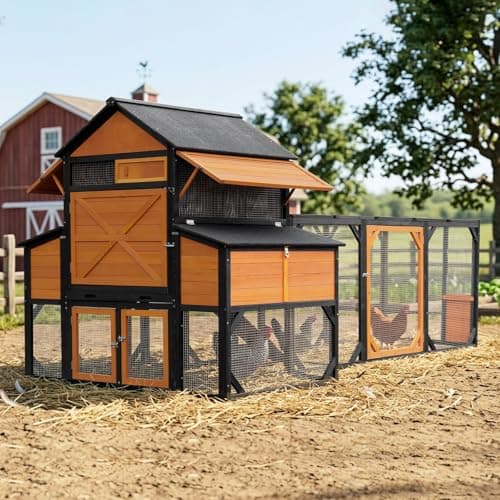
Pawpuler 135.7" Extra Large Coop with Run
59.5 sq ft, which is fourteen hens rather than the fifteen claimed - the closest near-miss on this site.
What the numbers say
135.7in x 63.11in = 59.5 sq ft of whole-unit footprint, which includes the attached run and is therefore generous. At 4 sq ft per standard hen that is 14 birds, against a claim of 15.
Figures from Pawpuler published specifications (Amazon listing) · 135.7"L x 63.11"W x 62.5"H · Wood, PVC and asphalt
59.5 sq ft supports fourteen standard hens. The listing claims ten to fifteen, so the top of its range is one bird optimistic and the rest of it is sound.
A one-bird overstatement is a rounding difference, not a misrepresentation. Most of this category is out by three to seven.
The 63in depth is the second-best on this site and it is what carries the floor area. Long, narrow coops of the same length would land nearer 35 sq ft.
Good
- Only one bird short of its own top claim
- 63in depth gives a wide, usable floor
- Asphalt roof over a PVC-protected frame holds up outdoors
Not so good
- Fifteen is optimistic; fourteen is the honest ceiling
- 11ft of yard needed
- Heavy build - plan the position before assembly
Skip this if: you actually need fifteen birds housed. Buy for fourteen or step up, because the difference shows up as pecking in February, not in the first week.
#ad · how this is funded · price as of October 20, 2026
| Coop | Published size | Floor area | Maker says | Arithmetic says |
|---|---|---|---|---|
| Pawpuler 135.7" Extra Large Coop with Run | 135.7"L x 63.11"W x 62.5"H | 59.5 sq ft | 15 hens | 14 hens |
Floor area is the maker’s published footprint. Where a unit includes an attached run that figure spans the run too, which makes it a generous reading - the enclosed roosting floor is smaller still. How we work these out.
Where it sits
It leads coops for 12 chickens and appears on coops for 20 chickens as the largest wooden option before the format runs out entirely. If your flock is heading past fifteen, that second page explains why almost nothing sold as a coop reaches it.
Questions people actually ask
+How many chickens does the Pawpuler 135in coop hold?
+Is this the biggest wooden chicken coop available?
+How much run space do 15 chickens need?
+Is a large wooden coop worth it over a metal run?
Sources
Read next
Chicken coops for 12 chickens
Twelve hens need 48 sq ft. Only two coops we measured reach it, and both are walk-ins.
Chicken coops for 20 chickens
Twenty hens need 80 sq ft. No off-the-shelf coop we measured gets there - here is the honest route.
Metal chicken coops and runs
Steel runs and enclosures ranked on measured area, with the henhouse gap and the base-security fix stated up front.
Wooden chicken coops, measured and weathered
Wooden coops ranked on measured floor area, with the maintenance cost of untreated fir priced in rather than left out.
Single-model reviews
Individual coop reviews, each measured against the maker's own published dimensions rather than its marketing.
What a coop costs, beyond the listing price
The four costs that follow a coop purchase, and why the cheapest coop is usually the expensive one over a decade.